The Paradox of the Twin Congos: Echoes of June 30 and the River that Divides History
History is often written in textbooks, but it is best understood through the geography of its borders and the scars of its past. Yesterday, June 30th, marked the 66th Independence Day of the Democratic Republic of Congo (DRC)—a nation of staggering proportions, immense wealth, and a historical trajectory that remains one of the most intense […]
 Black News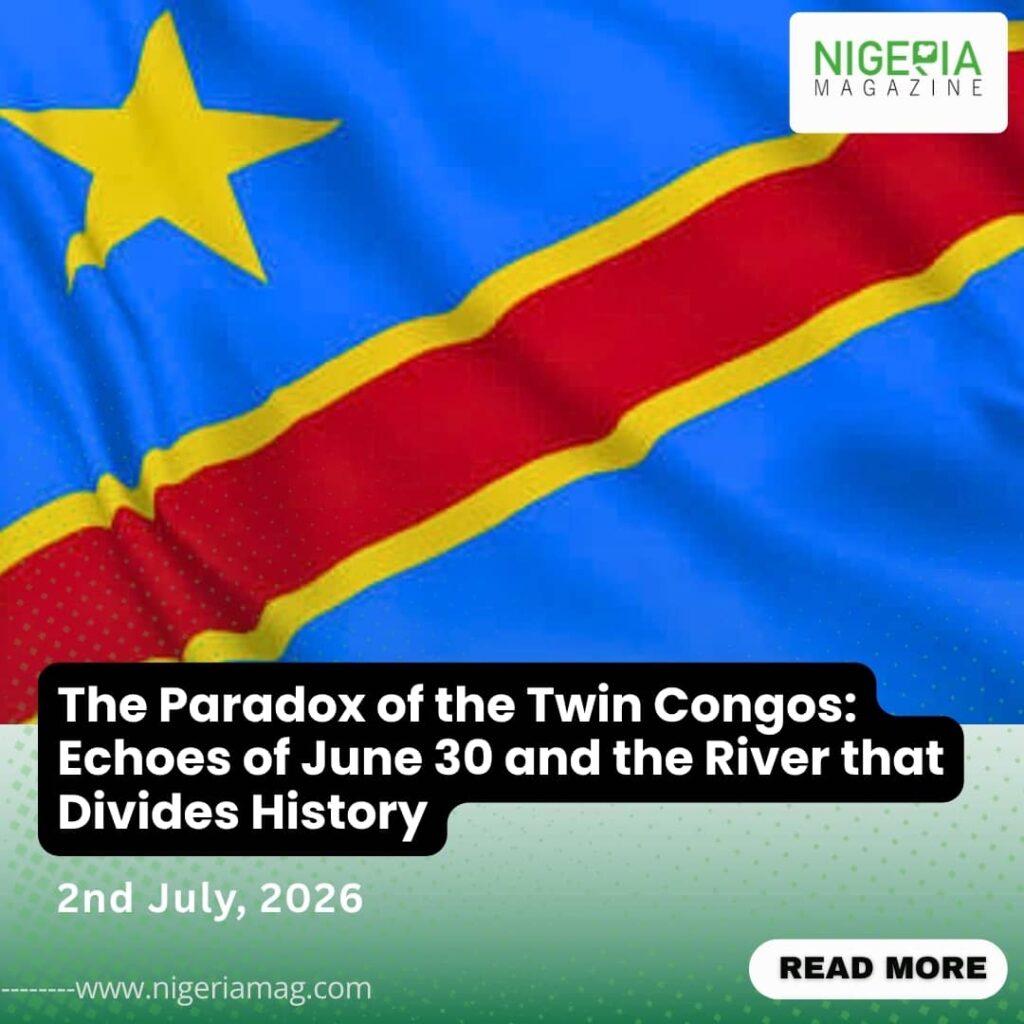
History is often written in textbooks, but it is best understood through the geography of its borders and the scars of its past. Yesterday, June 30th, marked the 66th Independence Day of the Democratic Republic of Congo (DRC)—a nation of staggering proportions, immense wealth, and a historical trajectory that remains one of the most intense studies in colonial exploitation and resilience.
To truly understand the DRC today, one must stand on the banks of the Congo River, looking across the water.
A River Apart: Kinshasa and Brazzaville
There is perhaps no geographical relationship in the world quite like that of the two Congos. Separated only by the churning waters of the Congo River, their capitals—Kinshasa and Brazzaville—stare directly at one another. For a local comparison, imagine standing on the Falomo Bridge in Ikoyi, looking across at Victoria Island in Lagos. You can stand on the riverbank in Kinshasa and easily call a friend over the water in Brazzaville.
Yet, despite their proximity, no bridge connects them. This missing link is not a failure of modern engineering, but a stubborn relic of European rivalry.
To the north sits the Republic of the Congo (Congo-Brazzaville), colonized by France and named after the Italian-French explorer Pierre Savorgnan de Brazza. To the south lies the massive Democratic Republic of Congo (DRC), a titan that is the second-largest country in Africa by landmass, trailing only Algeria. It is a nation over 100 times the size of its former colonial master, Belgium.
The Tragedy of Corporate Ownership
The root of the DRC’s modern structural struggles traces back to an unprecedented historical anomaly: between 1885 and 1908, this vast territory was not owned by a European nation, but by a single individual. King Leopold II of Belgium claimed the land as his private property, naming it the “Congo Free State” and running it as a brutal, profit-driven rubber and ivory corporation. He named the capital Leopoldville (now Kinshasa) after himself.
Following international outcry over atrocities, the territory was reluctantly transferred from Leopold’s personal control to the Belgian state. The geopolitical shakeups of the post-WWI era further solidified Belgium’s administrative grip on this massive expanse, while Germany lost its African territories—Namibia went to South Africa, Cameroon to France, and Tanganyika to the UK.
Yet, despite controlling a territory of unimaginable mineral and resource wealth, Belgium failed to build a sustainable state infrastructure. When the DRC finally forced its hand and gained independence on June 30, 1960, the colonial administration left behind a massive country with millions of people, a thriving musical culture, but a catastrophic lack of institutional leadership: the nation possessed only six university graduates.
Independence, Crisis, and the Nigerian Connection
The vacuum left by the sudden Belgian exit sparked immediate unrest. Just twenty-four hours after the independence flags were raised, an army mutiny and political crisis erupted, drawing the eyes of the world.
It also drew the immediate brotherhood of Nigeria. Just four days after Nigeria celebrated its own independence on October 1, 1960, Nigerian troops and police were dispatched to the Congo as part of the United Nations peacekeeping operation. It was a baptism by fire for Nigeria’s early foreign policy, seeing figures like Aguiyi-Ironsi lead troops in a complex landscape caught in the crosshairs of the Cold War, internal power struggles between President Joseph Kasa-Vubu and Prime Minister Patrice Lumumba, and the secessionist crises in Katanga.
From Zaire to the DRC: Trading in the 90s
The country’s identity continued to shift with its political tides. In 1971, under the dictatorship of Mobutu Sese Seko, the nation and its river were renamed Zaire.
For those who did business there in the 1990s, the country was a place of raw commercial energy despite its political volatility. Traders and multinational representatives, such as those distributing Unilever Group products, navigated a unique economic landscape. Importing goods and bringing in vital commodities like palm oil meant relying heavily on Matadi, the country’s crucial major sea port nestled on the narrow strip of Atlantic coastline. It was a bustling gateway where the realities of central African logistics met global trade.
Following the fall of Mobutu and the rise of Laurent-Désiré Kabila, followed by Joseph Kabila, the nation shed the name Zaire and reclaimed its identity as the Democratic Republic of Congo.
Looking Forward
As we reflect on the DRC’s Independence Day, we look past the headlines of conflict and focus on the immense potential of its people, its resources, and its central position in Africa’s future. The story of the Congo is a reminder that borders may be drawn by history, but the resilience of a nation is written by its people.