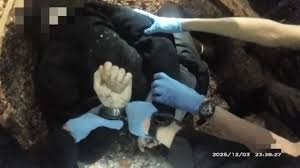
A War of Starvation and Livelihood Destruction in Northern Mali: Is Aguelhok Becoming a Symbol of Scorched-Earth Tactics?
Reports emerging from the strategic town of Aguelhok in northern Mali are raising growing concerns over alleged abuses against civilians, following accusations that Malian forces and members of the Russian Africa Corps targeted livestock, tents and civilian property during military operations in the area. While Malian authorities continue to reject such allegations, observers and human […] ظهرت المقالة A War of Starvation and Livelihood Destruction in Northern Mali: Is Aguelhok Becoming a Symbol of Scorched-Earth Tactics? أولاً على African Percentions.
 Black News
Reports emerging from the strategic town of Aguelhok in northern Mali are raising growing concerns over alleged abuses against civilians, following accusations that Malian forces and members of the Russian Africa Corps targeted livestock, tents and civilian property during military operations in the area.
While Malian authorities continue to reject such allegations, observers and human rights organizations argue that these incidents form part of a broader pattern of operations affecting the economic and social foundations of local communities in northern Mali, where armed rebellions, jihadist groups and disputes over identity and sovereignty intersect.
From Military Confrontation to the Targeting of Livelihoods
Across the desert regions stretching from Kidal to Aguelhok and Taoudenni, livestock represent far more than a source of income. They form the backbone of local livelihoods, social organization and food security.
Field testimonies and local reports suggest that the destruction of herds and the burning of tents have become recurring features of operations in areas where Malian forces and their Russian allies are deployed. Some analysts view these actions as part of a broader strategy aimed at weakening local communities and depriving armed groups of potential support networks.
International and regional human rights organizations warn that applying such an approach on a large scale risks turning entire civilian populations into targets of collective punishment, regardless of whether they have any actual links to armed groups.
Battlefield Pressures and Evolving Military Tactics
These developments come at a time when Malian forces and their Russian allies face increasing operational challenges in northern Mali.
Since the Malian army reasserted control over several areas following the withdrawal of the United Nations peacekeeping mission, the region has witnessed a series of attacks and ambushes carried out by various armed actors, including Azawad movements and Jama’at Nusrat al-Islam wal-Muslimin (JNIM), the Al-Qaeda-linked coalition active across the Sahel.
Security analysts argue that the difficulty of controlling vast desert territories, rising operational costs and persistent logistical pressures have pushed government forces toward tougher approaches in managing rural areas surrounding military deployment zones.
In this environment, villages and nomadic settlements increasingly become indirect battlegrounds, with economic resources themselves turning into instruments of pressure and conflict.
Repeated Allegations and Growing International Scrutiny
The accusations directed at Malian forces and their Russian partners are not new.
Over recent years, international organizations, United Nations bodies and independent human rights groups have documented allegations of extrajudicial killings, enforced disappearances and abuses against civilians in various parts of the country.
The events in Moura in 2022 remain among the most controversial cases, after UN reports and rights organizations alleged that hundreds of civilians were killed during a large-scale military operation. Malian authorities have consistently rejected allegations of widespread abuses.
Since then, joint operations involving Malian troops and Russian personnel have come under increasing international scrutiny, particularly in northern and central regions where insurgent activity remains intense.
Oversight Vacuum Following the UN Withdrawal
Many observers link the rise in such allegations to the monitoring vacuum left by the withdrawal of the United Nations Multidimensional Integrated Stabilization Mission in Mali (MINUSMA).
For years, the mission served as a key source of field monitoring and documentation, while also providing an important channel for reporting developments to international institutions concerned with human rights and armed conflicts.
Following the mission’s departure at the request of Mali’s authorities, the international community’s ability to independently monitor developments on the ground declined significantly, making verification of incidents in remote areas increasingly difficult.
The Malian government, however, maintains that the withdrawal represents a restoration of national sovereignty and insists that military operations are conducted within the framework of counterterrorism efforts and the restoration of state authority.
Humanitarian Consequences Beyond Mali’s Borders
The significance of these developments extends beyond security concerns and carries broader humanitarian and regional implications.
In desert pastoral communities, the loss of livestock often means the simultaneous collapse of both income and food security, forcing families to leave their homes in search of safety and survival.
Humanitarian organizations warn that continued deterioration could trigger new waves of displacement toward safer regions within Mali or neighboring countries such as Mauritania, Algeria and Niger, which already host large numbers of Malian refugees and displaced persons.
The worsening economic and social situation may also create more favorable conditions for recruitment by armed groups, potentially undermining long-term counterinsurgency objectives.
Conclusion
Recent developments around Aguelhok highlight a growing transformation in the nature of the conflict in northern Mali, shifting from a direct military confrontation between the state and armed groups to a struggle that increasingly affects the foundations of civilian life and survival.
In a region exhausted by years of war, rebellion and displacement, winning the trust of local communities and protecting their livelihoods may prove just as important as battlefield victories—and could ultimately determine the prospects for lasting stability in northern Mali.
ظهرت المقالة A War of Starvation and Livelihood Destruction in Northern Mali: Is Aguelhok Becoming a Symbol of Scorched-Earth Tactics? أولاً على African Percentions.