Unpacking Afropop’s Jewelry Evolution
Jewelry is no longer just proof of wealth or proximity to success; it is now its own language. The post Unpacking Afropop’s Jewelry Evolution appeared first on The NATIVE.
 Black News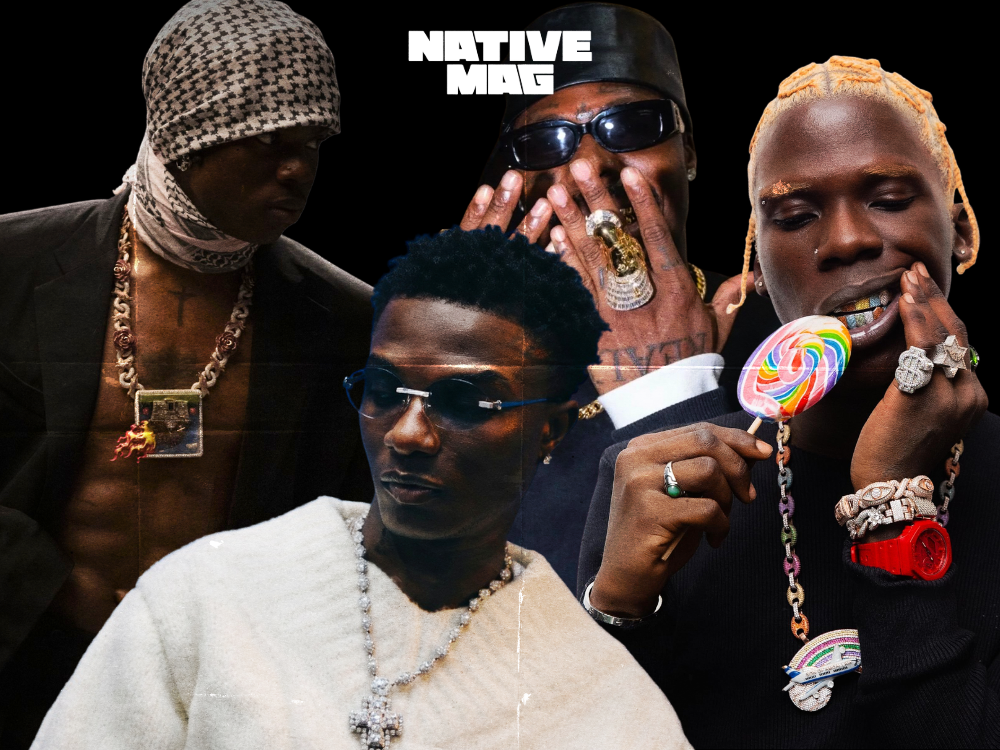
A few weeks ago, Asake reportedly purchased a custom gold-plated Cleopatra ring and a second ring featuring Egyptian hieroglyphs for approximately $1 million. Decades ago, this would have been unheard of from a Nigerian star, but it underscores the economic power of Afropop today and the assimilation of a culture that was only reserved for American Hip-Hop icons many years ago. Just like the fast cars and designer fits, luxury jewelry items have become a definitive marker of success for African acts and also evolved into a primary medium of storytelling.
In 2016, Meek Mill posted his flashy collection of luxury jewellery and diamond-encrusted accessories on Facebook, with an accompanying caption that read “TRAP TROPHIES!” As is often the case with the Philadelphia rapper’s social media activity, the post generated mixed reactions, with some commentators arguing that he was being excessively ostentatious, while others were simply bemused by the inventive caption. Showing off your jewelry as a rapper at this point is obviously far from a new trend.
Long before Meek Mill’s post, bling, ice, grills or whatever synonym has been coined for luxury jewelry items over the years, had always been inseparable from Hip-Hop culture. Meek Mill’s post, however, provided a unique, culturally specific framing for this established tradition that has greatly evolved since its inception.
To understand why this framing is pertinent, it’s worth taking a quick dive into the history of Hip-Hop and the tenets upon which the genre was originally built. Spoken-word poetry introduced African-style oration to 20th-century America, and decades later, it would metamorphose into the rhythmic structures that define much of Hip-Hop music. Taking roots in the 1970s, the genre and surrounding culture emerged as an antithesis to the ritzy culture of the heavily commercialised Disco.
The genre’s commercial success started taking off in the early 1980s, right as Disco was declining. This is why Kurtis Blow, a young man from humble beginnings in Harlem and the first rapper signed to a major label, could confidently don several gold chains on the cover of his self-titled debut album. The genre began to put money in the pockets of these marginalised artists who had previously been excluded from mainstream financial prosperity, and the expensive jewelry emerged as a signifier of economic triumph and an aspirational emblem for the communities from which they sprung. Just like Meek Mill succinctly put, a trap trophy.
As the years went by and the genre reached new heights, the jewelry items also became flashier and more symbolic. In 1985, Adidas struck a first-of-its-kind endorsement deal with Run-DMC, one of the most influential Hip-Hop groups in history, giving each member a 14-karat gold sneaker-shaped pendant. The iconic Jesus Piece chain, popularised by the influential Notorious B.I.G., later became a ritual for his friend, Jay Z, who would wear it while recording albums to commemorate B.I.G.’s death and seek inspiration. By the end of the 1990s, the genre and its accompanying bling culture had proliferated much of the globe.
In an excerpt from his book, ‘From Ojuelegba to O2 – The Story of the Afrobeats Generation,’ Ayomide Tayo highlights how the deaths of MKO Abiola and Sani Abacha shifted the collective consciousness of Nigerians as they sought a new reality and new forms of expression that would define their future. Hip-Hop and its powerful aesthetics filled this vacuum. “The pixels on the screen painted pictures of possibilities. Our minds were eager to escape the Nigerian contraption. TV was the escape. Radio too. And in 1998, nothing was blasting louder in mass media than Hip-Hop music.” Young Nigerians began to dress like American rappers, mimic their accents, and, importantly, adopt the aspirational narrative and energy that drove much of the music.
While the early pioneers of the genre in Nigeria did not achieve the same level of financial success as their American counterparts, one of the symbols of that success, the flashy jewelry, remained a crucial element of that culture, continuing to represent a motivational ideal for a new generation. So when the money really started rolling in, coinciding with the global rise of African Pop music, the conspicuous display of wealth and luxury jewelry items became not just acceptable, but expected.
When Wizkid, the quintessential Nigerian pop star, first broke out in 2010, his wardrobe and jewelry collection were initially modest, consisting mostly of rosary necklaces and other small handmade pieces. By 2013, his debut album ‘Superstar’ had already catapulted him from the crevices of Ojuelegba to national fame, and his jewelry collection began to reflect his growing status. It’s no surprise that in the video for “Jaiye Jaiye,” the lead single from his sophomore album, ‘Ayo,’ he had already swapped out the rosaries for gold chains as he sang: “Owo n wole wa / Seb’oluwa lo se o / Lagos today and London tomorrow / Seb’oluwa lo se o.”
Over the years, he would continue to build a more significant, albeit subtle – compared to his peers – jewelry collection that reflects his growing, refined taste and astronomical net worth. His acquisitions have included a gold Starboy chain, several Jesus pieces, a “Biggest Bird” sapphire/diamond piece, a 130ct art-deco cross chain, which is reported to have cost about $1 million and a few other custom-made pieces.
Conversely, expensive jewelry has not always symbolised economic triumph for Davido, who maintains a more elaborate relationship with these bespoke items. Considering his privileged upbringing, his jewelry collection has been far from subtle, but more importantly, it has held deep symbolic significance. His pieces usually serve as a way to express his identity, humour and personal narratives. Similar to how he flipped his hugely memeified Tim Westwood freestyle into an undeniable hit, his response to years-long jokes about his hoarse voice was purchasing an iced-out smoking frog from Icebox.
The other pieces in his collection are equally symbolic: a diamond-encrusted DMW pendant made in honour of his late son, Ifeanyi, a heavy, Timeless piece ordered to commemorate the success of his fourth studio album, Baddest & 30BG pendants that flex words synonymous with his brand, and a recent huge, 1-of-1 Cuban piece acquired to celebrate his most recent album, ‘5ive.’
Newer stars like Rema and Asake have carried on this tradition of purchasing bespoke jewelry and are similarly expressive with their growing collection. Rema’s “Ornament of Ravery” is one of the more elaborate, unique and symbolic pieces to have been acquired within the Afropop space. It leans into his world-building ethos, a trait that helped him stand out amongst his peers. His other pieces are also detailed and symbolic, while Asake’s equally diverse collection, which includes his newly acquired custom gold-plated rings, a “Skating Soldier” piece and a diamond-encrusted money piece, reflects the continued evolution of jewelry as not just an emblem of success but as a primary medium of storytelling and self-expression within the Afropop generation.
What began as a visible marker of escape from hardship has evolved into something far more layered decades later. Jewelry is no longer just proof of wealth or proximity to success; it is now its own language. Each pendant, chain, and custom piece carries coded messages about identity, legacy, grief, humour, and personal mythology. In a globalised music landscape where sound travels fast, these visual symbols, more often than not, now serve as an anchor for origin stories, grounding artists in their specific cultural trajectories while communicating their status to a worldwide audience.
In that sense, Meek Mill’s framing feels more relevant than ever, transcending geography and genre. For Afropop’s leading voices, these pieces are not just accessories but glittering, wearable archives of journeys shaped by resilience and reinvention. As the culture continues to expand its global footprint, these pieces will keep speaking bolder and more personal stories that words alone cannot fully capture.
The post Unpacking Afropop’s Jewelry Evolution appeared first on The NATIVE.