Why South Africa fears losing US trade deal worth billions as Trump-era tariffs slash exports
South Africa is pushing for a 15-year extension of the African Growth and Opportunity Act (AGOA), arguing that a longer-term deal would strengthen trade, investment and supply chain resilience between Africa and the United States.
 Black News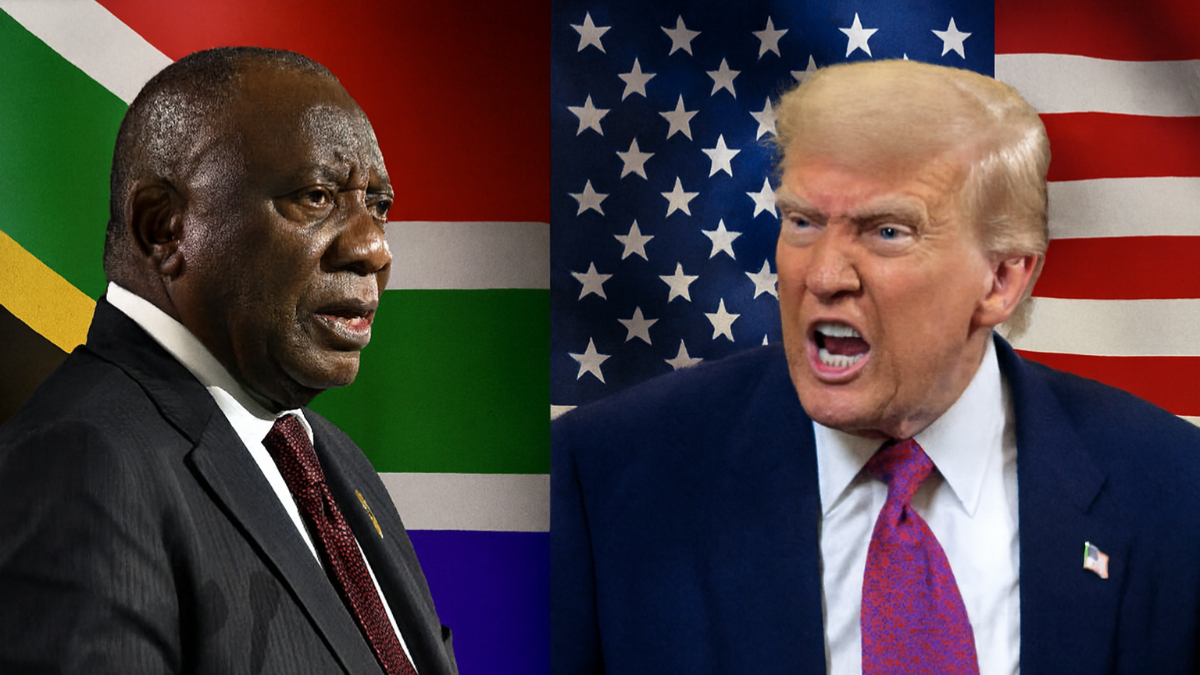
![L-R: South Africa's Cyril Ramaphosa and US President Donald Trump. [Getty Images/AI design]](https://ocdn.eu/pulscms/MDA_/3f7ec933498f064cd08ed4f9bceec1fe.jpg)
South Africa is pushing for a 15-year extension of the African Growth and Opportunity Act (AGOA), arguing that a longer-term deal would strengthen trade, investment and supply chain resilience between Africa and the United States.
- South Africa is seeking a 15-year extension of the African Growth and Opportunity Act to secure long-term trade access to the US market.
- Pretoria argues that short-term renewals create uncertainty for investors and weaken regional supply chains linked to AfCFTA.
- The US has raised concerns over South African tariffs, import restrictions and China’s growing role in African trade.
- Business groups warn that new US tariffs on vehicles, steel and aluminium are already reducing South Africa’s export earnings.
In a submission to the Office of the US Trade Representative, South Africa’s Department of Trade, Industry, and Competition said a predictable and development-focused renewal of Agoa would support regional value chains linked to the African Continental Free Trade Area (AfCFTA).
“South Africa supports an ambitious, predictable and development-oriented renewal of at least 15 years,” the department said, adding that a longer agreement would encourage investment and infrastructure development while improving supply chain resilience.
Agoa grants qualifying African countries duty-free access to the US market for thousands of products, including vehicles, textiles and agricultural goods. The current extension, approved under the administration of Donald Trump, expires at the end of 2026.
Pretoria warned that uncertainty over the programme could hurt both South African and US businesses. Officials also argued that eligibility assessments should account for inequality and poverty levels, not only gross national income per capita, despite South Africa’s classification as an upper-middle-income country.
US scrutiny intensifies
![President of the ruling African National Congress (ANC) and South African President, Cyril Ramaphosa. [Chris McGrath/Getty Images]](https://ocdn.eu/pulscms/MDA_/13b5ec6c50c43c8d1e97b5d974dec40e.jpg)
The debate over South Africa’s eligibility comes amid growing scrutiny from Washington over trade barriers and geopolitical concerns. The US Trade Representative’s office has raised objections to South African tariffs on US poultry, wine and spirits, as well as restrictions affecting US pork imports. US officials have also expressed concern about China’s expanding influence across African trade networks.
South Africa defended its strategic importance to US supply chains, particularly in critical minerals. The government said the country possesses 12 of the 50 minerals identified by the US Geological Survey as strategically important, positioning it as a potential partner in mineral processing and industrial production.
Business group Sakeliga criticised South Africa’s broad-based black economic empowerment policies, arguing that AGOA eligibility should focus on individual firms' conduct rather than on government policies.
Meanwhile, Business Unity South Africa (BUSA) and trade union federation Cosatu backed a longer extension but cautioned that broader US tariffs were eroding Agoa’s value. Business Unity South Africa said vehicle exports, which accounted for 64% of South Africa’s AGOA exports in 2024, suffered after US tariffs on vehicles, steel and aluminium reduced export earnings from R17.7bn to R8bn, equivalent to about $968 million and $437 million respectively at current exchange rates.