ANC and SACP – Political Merry-Go-Round
The Communists don't feature as a force of any kind in opinion polls and when it has tried its luck in local by-elections it has been routed, at times struggling to get even a handful of votes. All indications are that it will have zero impact in the local elections
 Black News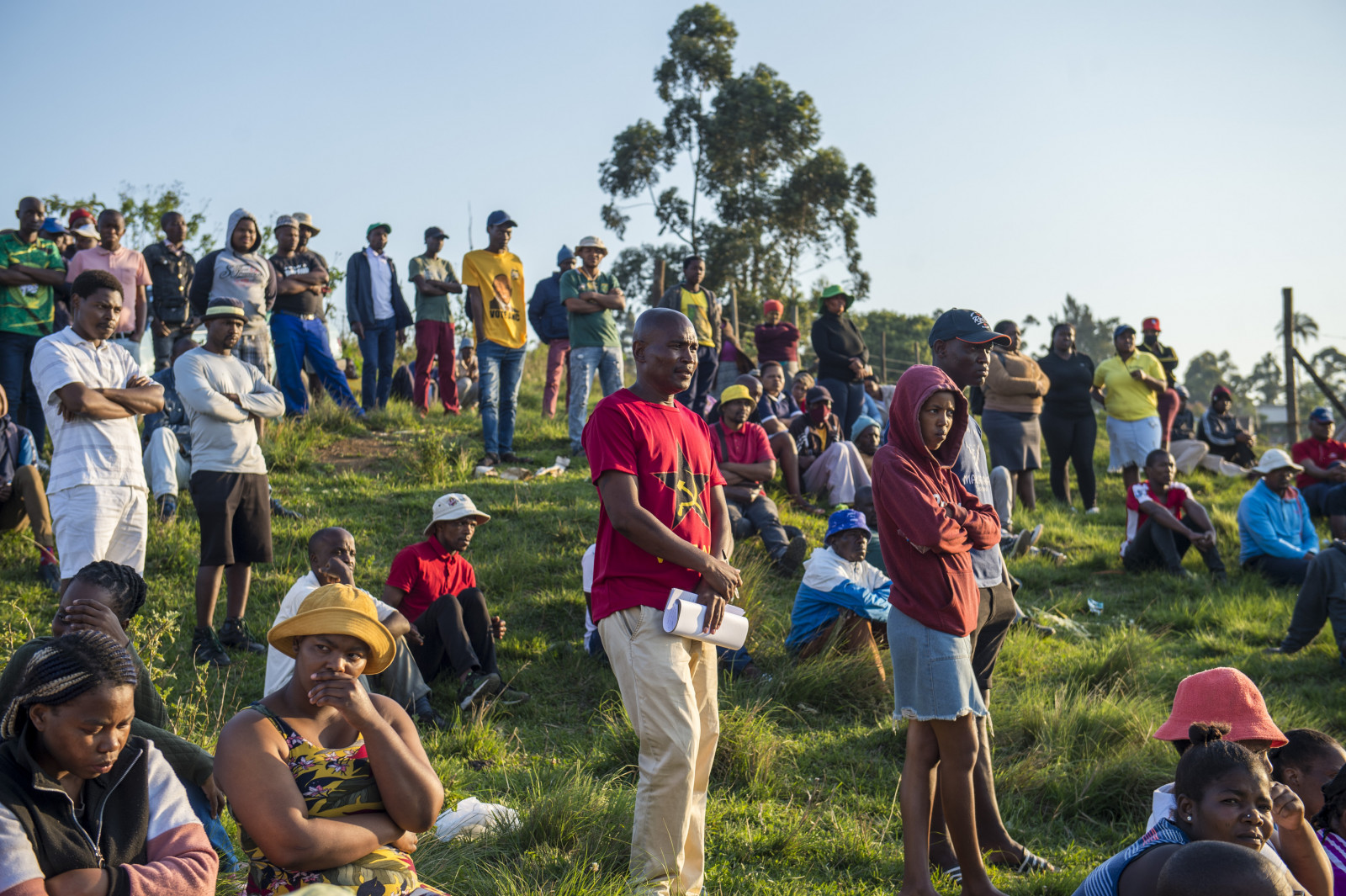

ANC Secretary General Fikile Mbalula has given ANC members who also hold SACP membership 10 days to decide which party they will campaign for in the coming local government elections. This is just one development among many as various actors try to realign electoral politics in advance of an election in which the ANC will take a massive hit.
The ANC will be destroyed in Durban where it is polling at well less than 10%. In Johannesburg it is unlikely to get above 40% of the vote and could go as low as 30%. There will be hung councils across the country and there is all kinds of manoeuvring going on as different parties try to position themselves to take advantage of the end of the ANC’s hegemony.
The SACP doesn’t feature as a force of any kind in opinion polls and when it has tried its luck in local by-elections it has been routed, at times struggling to get even a handful of votes. All indications are that it will have zero impact in the local elections.
Nonetheless, Julius Malema from the EFF and Solly Mapaila have posed for photographs together and are in discussion about working together. An SACP and EFF alliance would offer nothing to the EFF in terms of increasing its votes but makes sense for each party for very different reasons. For the SACP an alliance could be a useful bargaining chip with the ANC if it is able to bring the EFF into a coalition with the ANC. For the EFF, which is facing a steady decline in support, the alliance could be a route back into the ANC and some access to positions and power.
It seems that for both parties the real game is not to build a meaningful independent presence in local government, something that the polls show is just not possible but rather to be able to come into coalition with the ANC from a strong position.
The SACP is also linked to another attempt to realign electoral politics in South Africa. Late last year Irvin Jim threw a Molotov cocktail into the trade union movement by summarily announcing that Numsa would go back into Cosatu and thereby, the ANC, and with the support of the NGO Pan-Africa Today, facilitate a process to bring the EFF and the MKP back into the ANC.
Despite the detailed and thus far unanswered allegations of corruption, mismanagement and extraordinary authority raised against Jim by Ruth Ntlokotsi, the ANC and the SACP would, of course, be delighted to have Numsa pulled out of Saftu and brought back into Cosatu. Shortly after Jim’s announcement senior ANC figures began showing up at Numsa events and Mapaila is now a regular at events at The Forge, an events space in Johannesburg closely linked to Numsa and Pan-Africa Today.
It’s clear that, like the ANC, the SACP is already effectively connected to Numsa, leaving Saftu and Abahlali baseMjondolo as the only remaining mass-based organisations of the independent left.
There is a longer history to all of this. Since the late 2000s the ANC has been fragmenting, with a series of projects emerging out of that process, from COPE to the EFF, from NUMSA’s expulsion from Cosatu in 2013 and the later formation of Saftu, to the emergence of the MKP. Each was presented as a break. But what we are seeing now is that NUMSA and the EFF, in very different ways, are moving back towards the same centre of gravity. The language of rupture remains but the pull of the ANC and of access to the state, remains decisive.
But while the EFF and the MKP have been moving closer, the SACP does not appear to have any connection to the MKP. Malema has often been an opportunistic flip-flopper and so it’s not surprising that he is keeping the door open to a working arrangement with the MKP despite the fact that it is, to a strong degree, an ethnic party with far-right positions on traditional leadership and a range of social issues, including xenophobia. Insiders report that while the SACP is willing to work with the EFF despite its well documented corruption issues, it draws the line at the MKP’s ethnic politics and hard right positions on traditional leadership and xenophobia, not to mention its support for the brutal monarchies in Morocco and Eswatini.
While the project by Jim and Pan-Africa Today to bring the EFF and MKP back into the ANC would be very well received by its populist leaders in local and provincial government in Gauteng, it seems unlikely to win the approval of the SACP or the national leadership of the ANC. But if the MKP is jettisoned from the Numsa and Pan-Africa Today project, this could very well support the SACP’s project of building a relationship with the EFF in order to, down the road, strengthen the position of both parties in the ANC when coalitions must be formed. This could bring considerable resources into the project.
Coalition politics could, in principle, have opened space for more accountable local government. That is not what has happened. Instead we have seen unstable councils, opportunistic alliances and a steady loss of political clarity. Parties come together around positions and access to resources, not around programmes. Responsibility becomes diffuse, constantly shifting, and difficult for voters to pin down. There is no reason to think that the next round of coalitions will be any different.
The MKP has different fish to fry. It is sitting on 44% support in Durban and needs an alliance partner to govern. An alliance with the ANC could push it across the line but all indications are that it will prefer to work with the IFP to take control of the city. The MKP and IFP have, with the far right xenophobic organisation March and March, built a working alliance around xenophobia and it seems highly likely that Durban will be ruled by a Zulu nationalist IFP and MKP coalition after the elections.
What stands out most clearly is the absence of any serious attempt to build an independent left project rooted in sustained organising. At the same time there is a growing chorus of right-wing parties, including ActionSA and the Patriotic Alliance. Nothing comparable exists on the left. There is no formation doing the day-to-day work required to build mass support or to anchor itself in the struggles of ordinary people. The SACP remains a left party in a post-Stalinist mode but it has never done this kind of work in a sustained way. The result is a political field that is crowded but thin, with a right that is becoming more assertive and a left that remains organisationally weak.
Dr Buccus is senior research associate at ASRI and research fellow at UJ