Angel Reese, Izzy Harrison, And A League That Won’t Protect Its Stars
Izzy Harrison’s ejection for fouling Angel Reese resurfaced questions about whether the WNBA is doing enough to protect its stars.
 Black News
Pull up, Beloved.
If the collective side-eye of die-hard WNBA fans could be distilled into one message for the Tempo’s Isabelle “Izzy” Harrison, that was it.
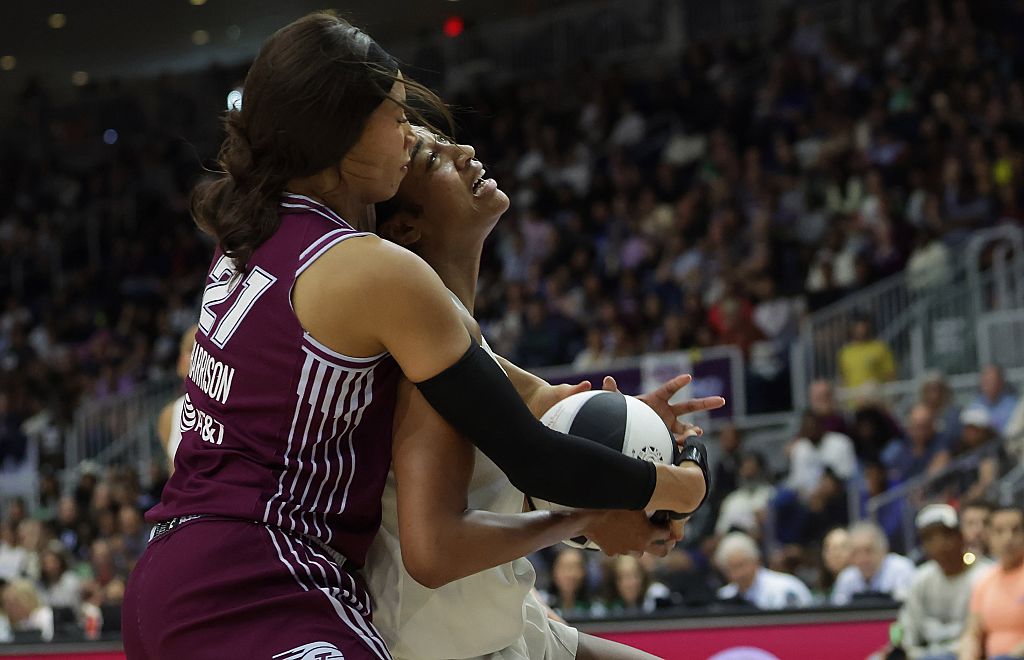
During a play in the Toronto Tempo’s matchup with the Atlanta Dream on Sunday, the veteran forward wrapped Dream star Angel Reese up from behind, dragged her to the floor, got ejected for doing so, and left the court laughing while Reese fought back tears as she made her way to the free throw line to attempt two shots.
Harrison had been hunting Reese all afternoon. From the early minutes of the game, she was draped onto Reese, body to body. The two traded shoves in the paint and exchanged words. Harrison played her so closely that some fans online surmised the Tempo forward had shown up forgetting she was there as part of a team with the mission of beating the Dream, instead focusing on walloping a single player.
Each no-call, and there were several, seemed to embolden Harrison. By the time officials finally blew the whistle on what would be her final play of the game, the Dream had a comfortable ten-point lead with a little over six minutes left in the third quarter. The flagrant 2 foul felt like the inevitable conclusion after all the rough, uncalled contact.
Fielding accusations of excessive physicality is not new for the WNBA. The league has amassed a reputation for it, with players grinding through bruises, hard fouls, and physical contact far more brutal than anything the men weather in the MNBA.
Last season, the contact grew punishing enough that Indiana Fever’s Lexie Hull played through two black eyes after a head-to-head collision, and Minnesota Lynx star Napheesa Collier excoriated league leadership over officiating she believed was inconsistent and put the players at risk of sustaining unnecessary injuries.
Post play in basketball has always been more physical, and the bigs absorb the contact that guards and perimeter players simply do not. Officials swallow their whistles more often on fouls between bigs under the basket. Each time the refs blow their whistles, the game slows to a crawl. A league chasing casual converts with short attention spans needs the floor open and the ball moving with highlight-worthy fast breaks and no-look passes from elite guards like Chelsea Gray and Olivia Miles.
The players being forced to eat the most uncalled contact are players like Reese and Las Vegas Aces’ star A’ja Wilson. Considered among the league’s best players overall, they have spent most of this season getting clobbered and mugged in the lane, while obvious slaps across their arms and other fouls are ignored.
In this game, Harrison was playing bully ball, forcing contact in ways that recalled the old-school Bad Boys mentality of the late-1980’s Detroit Pistons. It was a style she seemed determined to embody in her matchup with Reese.
The reaction to the play and Harrison’s ejection split fast and loud online. One camp called the play a dangerous, gratuitous play that could have seriously injured Reese, while the other defended Harrison, insisting the refs had no business tossing her and that the veteran was just matching the energy Reese had brought all afternoon.
It’s hard to imagine that the tension between the two players, which escalated to the point that one of them was ejected, materialized out of thin air or stemmed from rugged competitiveness. Harrison and Reese spent the 2024 season as teammates in Chicago, Reese’s rookie year and a late-career stop for Harrison.
Reese has spoken about how hard that year was, the usual rookie adjustment and transition period made more difficult by what she shared with reporters later, which was not having “a lot of vets” to lean on. No matter the particulars of their relationship then, perception took over the moment the infamous play on Sunday occurred.
Fans outraged at what they felt was another incident in a pattern of mistreatment towards Angel took matters into their own hands. A petition calling on the WNBA to address what they named as excessive physical play against Reese began circulating online, accumulating hundreds of signatures within hours.
I come to this story through a few different lenses, and they are not without contradictions. I am a Black woman first, a sports fan second, and an investigative journalist turned WNBA analyst third. Those categories in that order are important to note because they give you an idea of how I watched Sunday unfold and how I’ve digested it since.
The Black woman and the sports fan in me were, like many of the fans who lashed out at Harrison online, deeply disappointed, both in the foul itself and in the mockery she made of her exit.
I have followed Harrison throughout her career, and I was overjoyed when both she and her partner, Natasha Cloud, landed with one of my favorite teams, the NY Liberty. The pairing read as a great fairytale queer love story set against the backdrop of one of my favorite cities, and their arrival with the Liberty gave me hope they’d help anchor a back-to-back championship run, one that would have delivered Harrison her first WNBA championship ring.
This is where the lenses come back around. For a lot of us Black women, the play between Harrison and Reese was hard to watch in another way. The shared yet staggered history between two talented Black women, which left one in tears and the other laughing as she made her exit, was triggering. In their story, we as Black women recognize something many of us experience early in our careers and carry into every workplace we inhabit.
Too many of us are still the first. The first in the department, the first in the C-Suite, and often we are both the first and the only. The only Black woman in the office. In a leadership position. Forced to learn the ropes on our own.
Being the first should mean opening the door, inviting more Black women in, and holding it for those coming behind you. Sadly, many learn to guard the door instead, deciding that they want to be both first and last and are intent on keeping it that way. They view those coming behind them as a threat rather than as part of their legacy. I call those women “the onlies.”
Neither Reese nor Harrison was the first in a traditional sense, and I’m not arguing that Harrison wants to be an “Only”. After all, the WNBA is a league built by Black women, with Black women making up the majority.
What Sunday stirred in a lot of us was the “only” pattern. The elder who couldn’t abide by making room and mentoring, who had multiple opportunities to bring the younger woman along and chose to take her down in a cheap play instead. That is what the moment looked like to many of us who have been trained by our own workplaces to recognize that particular dynamic.
Some of this is plainly human. Nobody, in any field, looks forward to the day they’re replaced by the talent coming up behind them. A veteran who had watched a rookie inherit the spot and the acclaim she trained most of her life for feels it, no matter what race or gender either of them is.
No matter how you feel about what happened during the game, life and the WNBA season will move on as they always do. The Dream and the Tempo will meet again on June 22nd, and pretty soon, all that happened on Sunday will fold into a footnote attached to the longer season.
I hope that before it does, Izzy reaches out to Angel to apologize, out of an understanding that the play, no matter her intentions, has taken on a new life. As a veteran in the league, Izzy has an opportunity to step up for her former rook, smooth things over, and steer the public narrative in a healthier direction.
Whether Harrison does so or not, I’m holding onto a special wish for Angel. That the world stops putting her in positions where she is asked to be more resilient, to tough it out, dust herself off, be the bigger person, and maintain composure all because she was on the receiving end of attacks she has never deserved.
My hope is that she stands firm in the reminder that she has fans outside of basketball and beyond her social media timeline who are willing and ready to ride at dawn for her. Just this Spring, former First Lady Michelle Obama warned critics to leave Reese alone, “Don’t mess with this girl. Don’t mess with her spirit. Do not mess with this angel. Stop it. Just stop it.”
Reese has proven time and time again that she is committed to being a leader, showing up for her teammates, and knows how to bring other players along. Watch how she handles her own rookies, first off the bench when they do something right, first to coach them up when they fall short. Watch how encouraging she is with the Dream’s young center Madina Okot, the two of them trading easy, loving sisterly banter at the podium. Reese urges reporters to ease up on her rookie, while Okot shares she’s never nervous when her Angel is near.
In a game built on competition, in a league that keeps rewarding brutal physicality and mean-girl antics, Angel Reese keeps showing up as something rare. The two-time All-Star and reigning rebounding force remains a breath of fresh air for the league, a trailblazer, and harbinger of the prosperity still to come. Reese holds the door open for those coming up behind her, making it close to impossible to imagine a bright future without the light of an Angel leading the way.
SEE ALSO:
The Unraveling: How Reality Caught Up With The Cult Of Caitlin Clark
Parasocial Ball: The Price Of Proximity In The WNBA