Arts, Education, & Survival: How Edwin Freeman Turned A Life Shaped By Crack Era Into A Mission For The Youth
By Miles “Hollyhood” Casso Photos: Miles “Hollyhood” Casso Arts and education saved my life from the streets that claimed many peers. That journey led me to create Hip-Hop Harmony, guiding young scholars toward purpose through culture and creativity. — Edwin Freeman, Creator & Program Director. For actor, producer, director, and rapper Edwin Freeman, survival was never guaranteed. Growing up between Brownsville, Brooklyn and South Jamaica, Queens, Freeman came of age during one of the most turbulent periods in New York City history, the height of the crack era and the War on Drugs during the late 1980s and 1990s. These neighborhoods were deeply impacted by the drug epidemic, violence, and systemic neglect that devastated many Black communities across the country. Freeman also grew up during the mayoral administration of former New York City Mayor Rudy Giuliani, a period marked by extremely aggressive policing tactics. For many urban youth, particularly young Black men, the era was characterized by constant police stops, harassment, and allegations of police abuse and misconduct under controversial “zero tolerance” policies. “In those days you were dealing with pressure from both sides,” Freeman recalls. “The streets were dangerous, but at the same time young Black men were constantly dealing with aggressive policing. It was a very intense time to grow up in New York.” Freeman’s South Jamaica neighborhood was already known nationally long before hip-hop fully exploded. The community had been home to notorious drug figures such as Lorenzo “Fat Cat” Nichols and Howard “Pappy” Mason, whose influence during the crack era left lasting scars on the neighborhood. Yet the same community that struggled with crime and drugs also produced remarkable cultural talent. South Jamaica became the birthplace of influential hip-hop groups like Onyx and Lost Boyz, rap superstar 50 Cent and his collective G-Unit, global superstar Nicki Minaj, NBA champion Lamar Odom, and acclaimed actress Tichina Arnold. It was within this complicated environment, equal parts danger, culture, and creativity, that Freeman developed his passion for music and storytelling. “I watched a lot of my peers succumb to the streets,” he says. “Some went to prison for long stretches. Others lost their lives. I was with these guys every day. That could have easily been me.” Freeman believes something greater intervened. “Providence had something else in store for me.” A Door Opens Through Music In the mid-1990s, Freeman’s life began to change when he signed a record deal with Soundscope Records, a label owned by legendary rapper Chubb Rock. Freeman was introduced to Chubb Rock and the label’s co-owners Daniel “Diggi Dan” Salinger and Donald Jackler by T.J. “Killer Black” Johnson, the brother of Havoc from the legendary Queensbridge rap group Mobb Deep. Killer Black, who has since passed away, helped connect Freeman with the label at a pivotal moment in his life. Soundscope Records operated out of the basement of the legendary New York record store Rock and Soul, located on West 37th Street and 7th Avenue just steps away from Madison Square Garden, widely known as “The World’s Most Famous Arena.” For Freeman, the experience placed him directly inside the heart of New York’s music culture. Hip-hop had already shaped his worldview growing up in New York City, but the opportunity to record professionally provided a path away from the dangers surrounding him. By the late 1990s, Freeman began appearing in independent films while continuing his music career, gradually building a presence in both industries. The Atlanta Years In the early 2000s, Freeman relocated to Atlanta, a city rapidly emerging as the capital of Southern hip-hop. While living in Atlanta, Freeman recorded and released several independent mix-tapes and albums while networking within the music industry. During that time he built relationships with influential music figures including Philant “Big Phil” Johnson and Clay Evans, both of whom were affiliated with rap superstar T.I. and his influential label Grand Hustle Records. Johnson and Evans, who have both since passed away, were respected members of the Grand Hustle team and the broader Atlanta hip-hop community. Freeman describes the Atlanta years as a critical chapter of growth. “It was an environment where music and entrepreneurship were thriving. You were surrounded by people building something.” Return to New York and Breakthrough Roles By the mid-2000s Freeman returned to New York City, where his acting career began gaining momentum. He soon landed a principal role in the musical film Across the Universe, a production inspired by the legendary music catalog of The Beatles. Shortly afterward, Freeman appeared in the blockbuster hip-hop biographical film Notorious, portraying legendary New York DJ Mister Cee in the story of rap icon The Notorious
 Black News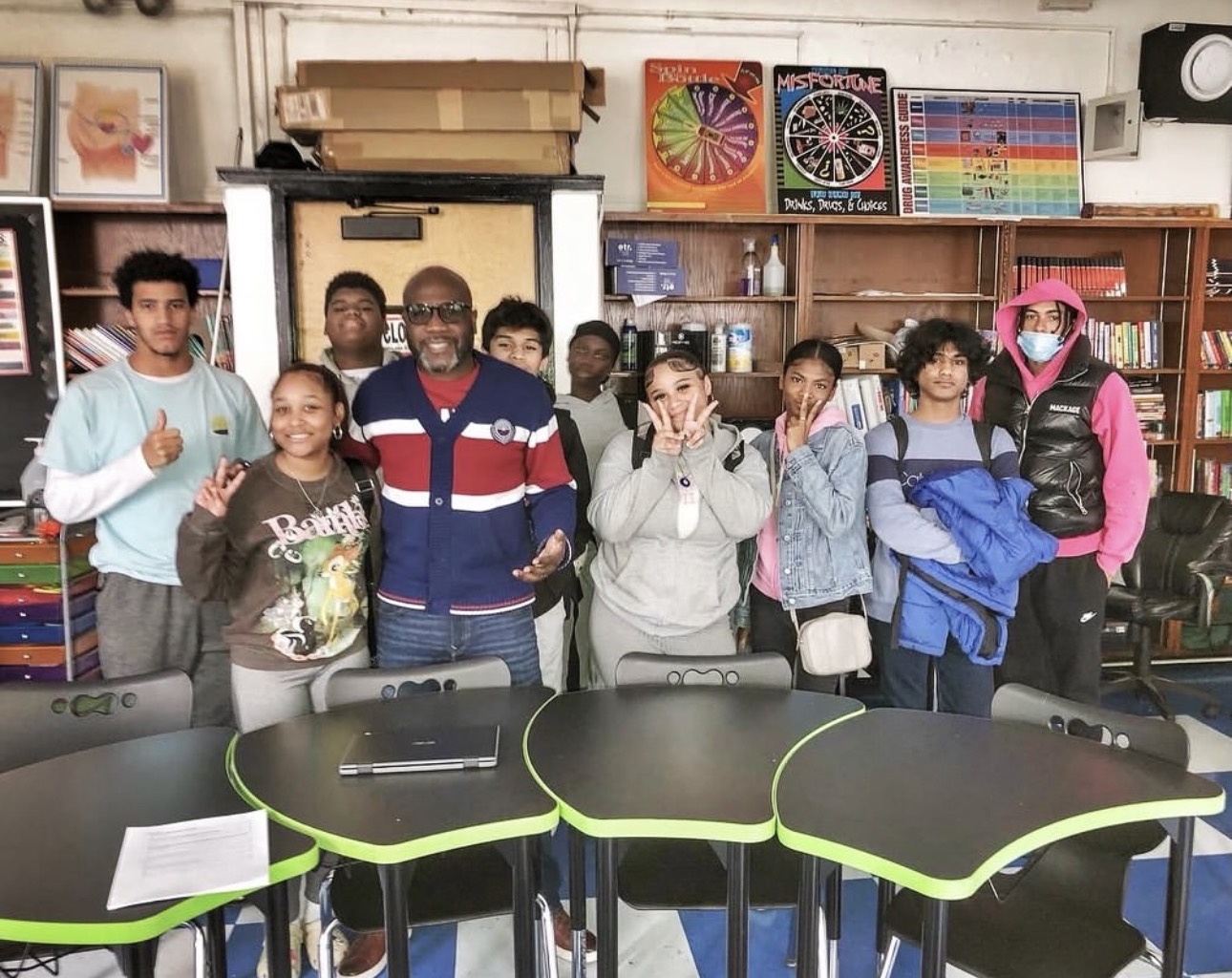
By Miles “Hollyhood” Casso
Photos: Miles “Hollyhood” Casso
Arts and education saved my life from the streets that claimed many peers. That journey led me to create Hip-Hop Harmony, guiding young scholars toward purpose through culture and creativity. — Edwin Freeman, Creator & Program Director.

For actor, producer, director, and rapper Edwin Freeman, survival was never guaranteed.
Growing up between Brownsville, Brooklyn and South Jamaica, Queens, Freeman came of age during one of the most turbulent periods in New York City history, the height of the crack era and the War on Drugs during the late 1980s and 1990s. These neighborhoods were deeply impacted by the drug epidemic, violence, and systemic neglect that devastated many Black communities across the country.
Freeman also grew up during the mayoral administration of former New York City Mayor Rudy Giuliani, a period marked by extremely aggressive policing tactics. For many urban youth, particularly young Black men, the era was characterized by constant police stops, harassment, and allegations of police abuse and misconduct under controversial “zero tolerance” policies.
“In those days you were dealing with pressure from both sides,” Freeman recalls. “The streets were dangerous, but at the same time young Black men were constantly dealing with aggressive policing. It was a very intense time to grow up in New York.”
Freeman’s South Jamaica neighborhood was already known nationally long before hip-hop fully exploded. The community had been home to notorious drug figures such as Lorenzo “Fat Cat” Nichols and Howard “Pappy” Mason, whose influence during the crack era left lasting scars on the neighborhood.
Yet the same community that struggled with crime and drugs also produced remarkable cultural talent.
South Jamaica became the birthplace of influential hip-hop groups like Onyx and Lost Boyz, rap superstar 50 Cent and his collective G-Unit, global superstar Nicki Minaj, NBA champion Lamar Odom, and acclaimed actress Tichina Arnold.
It was within this complicated environment, equal parts danger, culture, and creativity, that Freeman developed his passion for music and storytelling.
“I watched a lot of my peers succumb to the streets,” he says. “Some went to prison for long stretches. Others lost their lives. I was with these guys every day. That could have easily been me.”
Freeman believes something greater intervened.
“Providence had something else in store for me.”
A Door Opens Through Music
In the mid-1990s, Freeman’s life began to change when he signed a record deal with Soundscope Records, a label owned by legendary rapper Chubb Rock.
Freeman was introduced to Chubb Rock and the label’s co-owners Daniel “Diggi Dan” Salinger and Donald Jackler by T.J. “Killer Black” Johnson, the brother of Havoc from the legendary Queensbridge rap group Mobb Deep. Killer Black, who has since passed away, helped connect Freeman with the label at a pivotal moment in his life.
Soundscope Records operated out of the basement of the legendary New York record store Rock and Soul, located on West 37th Street and 7th Avenue just steps away from Madison Square Garden, widely known as “The World’s Most Famous Arena.”
For Freeman, the experience placed him directly inside the heart of New York’s music culture.
Hip-hop had already shaped his worldview growing up in New York City, but the opportunity to record professionally provided a path away from the dangers surrounding him.
By the late 1990s, Freeman began appearing in independent films while continuing his music career, gradually building a presence in both industries.
The Atlanta Years

In the early 2000s, Freeman relocated to Atlanta, a city rapidly emerging as the capital of Southern hip-hop.
While living in Atlanta, Freeman recorded and released several independent mix-tapes and albums while networking within the music industry.
During that time he built relationships with influential music figures including Philant “Big Phil” Johnson and Clay Evans, both of whom were affiliated with rap superstar T.I. and his influential label Grand Hustle Records. Johnson and Evans, who have both since passed away, were respected members of the Grand Hustle team and the broader Atlanta hip-hop community.
Freeman describes the Atlanta years as a critical chapter of growth.
“It was an environment where music and entrepreneurship were thriving. You were surrounded by people building something.”
Return to New York and Breakthrough Roles
By the mid-2000s Freeman returned to New York City, where his acting career began gaining momentum.
He soon landed a principal role in the musical film Across the Universe, a production inspired by the legendary music catalog of The Beatles.
Shortly afterward, Freeman appeared in the blockbuster hip-hop biographical film Notorious, portraying legendary New York DJ Mister Cee in the story of rap icon The Notorious B.I.G..
Freeman later appeared in the hit Marvel television series Luke Cage, portraying Young Pop in the critically acclaimed Harlem-centered drama.
Behind the Camera
Freeman expanded his work beyond acting, moving into directing and producing.
His documentaries Modern Day Slavery and Beats & Lyrics both earned critical recognition and awards for their powerful social commentary and exploration of music culture.
Helping Friends Reenter Society
By the late 2000s, Freeman began witnessing something that deeply affected him. Many of the young men he had grown up with were finally returning home from long prison sentences.
Rather than distance himself, Freeman chose to help. He assisted several friends with reentry into society, helping them find stability after years behind bars.
At the same time, he continued to mourn other friends who had been killed in the streets.
“That could have easily been me,” he says again.
The Power of Self-Education
Freeman credits reading as another major factor that shaped his survival.
He considers himself an autodidact, someone who has pursued knowledge through relentless independent study. Books exposed him to ideas, histories, and possibilities far beyond the confines of the neighborhoods where he grew up.
“Education opened my eyes to a world outside my neighborhood,” Freeman explains. “Once you realize how big the world really is, it changes how you move.”
Freeman consistently emphasizes the importance of both formal education and informal learning.
Hip-Hop Harmony: Turning Survival Into Service
These experiences eventually inspired Freeman to create Hip-Hop Harmony, a Social Emotional Learning program designed for New York City public school students from grades 1 through 12.
The program uses hip-hop culture as a teaching tool to help students develop life skills, emotional intelligence, and creative expression.
Freeman refers to the students as “young scholars,” reinforcing a mindset centered on growth and empowerment.
“It starts with self-love and respect,” he tells them. “Then that transcends to love and respect for your fellow students and the school faculty and staff.”
Hip-Hop Harmony aims to help young people avoid the traps that destroyed many of Freeman’s peers while empowering them to become the best versions of themselves.
The Freeman Foundation for the Arts
Freeman is also the Founder and Executive Director of The Freeman Foundation for the Arts, a New York City–based nonprofit organization that uses the arts as a form of advocacy to help improve the living conditions of urban youth while providing them with a creative platform to learn, develop, and express themselves.
A Life Redirected
From Brownsville to South Jamaica, from the crack era to Hollywood sets, Edwin Freeman’s story is one of resilience, transformation, and purpose.
The same culture that helped him survive, music, film, creativity, and education, has now become the foundation of the work he dedicates to the next generation.
For Freeman, the mission is simple. Ensure that the young scholars coming behind him have the guidance, opportunities, and inspiration that many of his peers never received.