Blaming the weather for the fire
Nigeria’s terrorism crisis has deeper roots than Tinubu admitted in London On March 19th, the president undertook a historic two-day trip to London, the first by a Nigerian leader in nearly 40 years. During the visit, Tinubu met with the UK Prime Minister and claimed that the Sahel and climate change were responsible for terrorism in Nigeria, implying that the country continues to struggle with terrorism partly due to environmental pressures and instability spilling over from neighboring Sahel countries. Since then, there has been some social media uproar, but does President Tinubu have a point, or is he completely wrong […] The post Blaming the weather for the fire appeared first on African Arguments.
 Black News
Nigeria’s terrorism crisis has deeper roots than Tinubu admitted in London
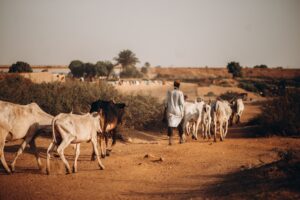
In Nigeria’s Sahelian north, climate stress is reshaping the movement of herders and their cattle.
On March 19th, the president undertook a historic two-day trip to London, the first by a Nigerian leader in nearly 40 years. During the visit, Tinubu met with the UK Prime Minister and claimed that the Sahel and climate change were responsible for terrorism in Nigeria, implying that the country continues to struggle with terrorism partly due to environmental pressures and instability spilling over from neighboring Sahel countries. Since then, there has been some social media uproar, but does President Tinubu have a point, or is he completely wrong about the situation? Politically, his claim might make sense, as he situates the insecurity within wider regional and global crises. Analytically, it could be problematic, as it risks oversimplifying a complex situation.
Such claims have been present in the political and policy space for years. However, climate change is not directly responsible for terrorism but instead creates an environment in which violent groups like Boko Haram and others in the Lake Chad Basin can recruit, move, and persist despite efforts by the state, regional forces, and non-state actors.
Tinubu is on firmer ground when he points out that the Sahel over the last few years has been the epicenter of terrorism. Terrorism in Nigeria cannot be understood in isolation from violent extremism in the Sahel. According to the 2026 terrorism index report, the Sahel accounts for nearly half of global terrorism-related deaths, and Nigeria currently ranks 4th on the Global Terrorism Index. The report highlights that weakening governance and regional and international counterterrorism efforts contribute to this situation.
However, the major problem is that his framing of the situation fails to account for key facts and instead serves as a convenient deflection. Terrorist activity in Nigeria did not originate in the Sahel. Boko Haram originated in Maiduguri, Borno State, and since the early 2000s, northeastern Nigeria has been its main base of operations. The insurgency began not as a result of climate change but rather due to political marginalization, corruption, poverty, weak state capacity, and repression in northern Nigeria. The World Bank has also warned against this simplistic explanation of climate change as a cause of insurgency, noting that the situation is much more complex and multidimensional. Decades of government neglect, extra-judicial killings, state abuse, and underinvestment in economic activities, education, and infrastructure created the conditions that violent groups have systematically used to recruit.
Where President Tinubu strays is on climate change. Scientific evidence does not point to a direct impact of climate change on conflict. Rather, it positions climate change as a factor that works alongside others, such as socioeconomic drivers, and is heavily conditioned by poverty, political marginalization, weak institutions, and dependence on climate-sensitive livelihoods.
North-eastern Nigeria borders the Lake Chad Basin, which has faced severe environmental stress for years, losing 90% of its water. Northern Nigeria has also been heavily impacted by floods and other climate shocks. According to the Internal Displacement Monitoring Centre, in 2024 alone, floods caused 121,000 displacements in Borno. In places like north-eastern Nigeria, particularly Maiduguri, climate change and insecurity work hand in hand, leading to the loss of lives, property, and disruptions to livelihoods for millions. As livelihoods collapse, families face challenges with mobility and social protection, fuelling resource competition between farmers and herders, especially in the middle belt, and leading to more annual loss of lives than Boko Haram does.
This is where climate change matters most. Climate change doesn’t single-handedly cause terrorism, but it acts as a multiplier. A large share of the population in the Lake Chad Basin works in the informal sector and engages in farming, fishing, and other agricultural activities. Environmental shocks such as drought, floods, and degradation severely affect fishing, farming, and livelihoods, intensifying the scramble for resources, driving displacement, placing families in vulnerable situations, and even helping violent groups like Boko Haram operate. UN Secretary-General António Guterres has described climate change as an “aggravating factor for terrorism,” as it creates conditions of poverty, desperation, and resentment that make people more vulnerable to recruitment by armed groups.
However, the presence of climate change and terrorism does not necessarily mean recruitment into Boko Haram. Where state capacity is weak or absent, environmental stress creates openings for armed groups. Armed groups step in where the state has not, and that is how climate pressure translates into recruitment. This is an indirect pathway, and it shows that climate change cannot replace politics; rather, it worsens the consequences of state failure. So Tinubu is not entirely wrong, but he is wrong in his attempt to externalize domestic failure.
Tinubu’s framing is problematic because it shifts responsibility for the crisis to the weather, climate, and the Sahel, portraying them as beyond the Nigerian government’s control. But in reality, the situation is closely tied to domestic politics: uneven development, a weak social safety net, lack of trust in government, and poor policies. Yes, climate stress may be external, but vulnerability is produced through politics. If climate stress is understood as a threat multiplier, then efforts would be directed toward investing in local livelihoods, protecting displaced populations, and rebuilding the social contract, especially in places under armed-group control. Nigeria cannot defeat terrorism by shifting responsibility but by addressing the social and political conditions that turn climate stress into violence.
None of this is to say that Tinubu is entirely wrong. A more accurate framing is that climate change is worsening the social and economic conditions that armed groups exploit, while regional instability is making those threats more mobile and dangerous. This is not the same as saying climate change is responsible for terrorism. The research is detailed. While climate change is the candle, state failure, poverty, and neglect ignite the flame, and owning up to these failures is a good start toward resolving the issue.
The post Blaming the weather for the fire appeared first on African Arguments.