Easting the West: A Conversation with Chenchen Zhang
At a time when right-wing populism appears to be rampaging through global politics, studies about its discourses and strategies remain thin and even marginal in the field of international relations. This is especially true for authoritarian states where far-right discourses are not so much about electoral competitions as about regime legitimation. Chenchen Zhang’s new book, […] The post Easting the West: A Conversation with Chenchen Zhang appeared first on Made in China Journal.
 Black News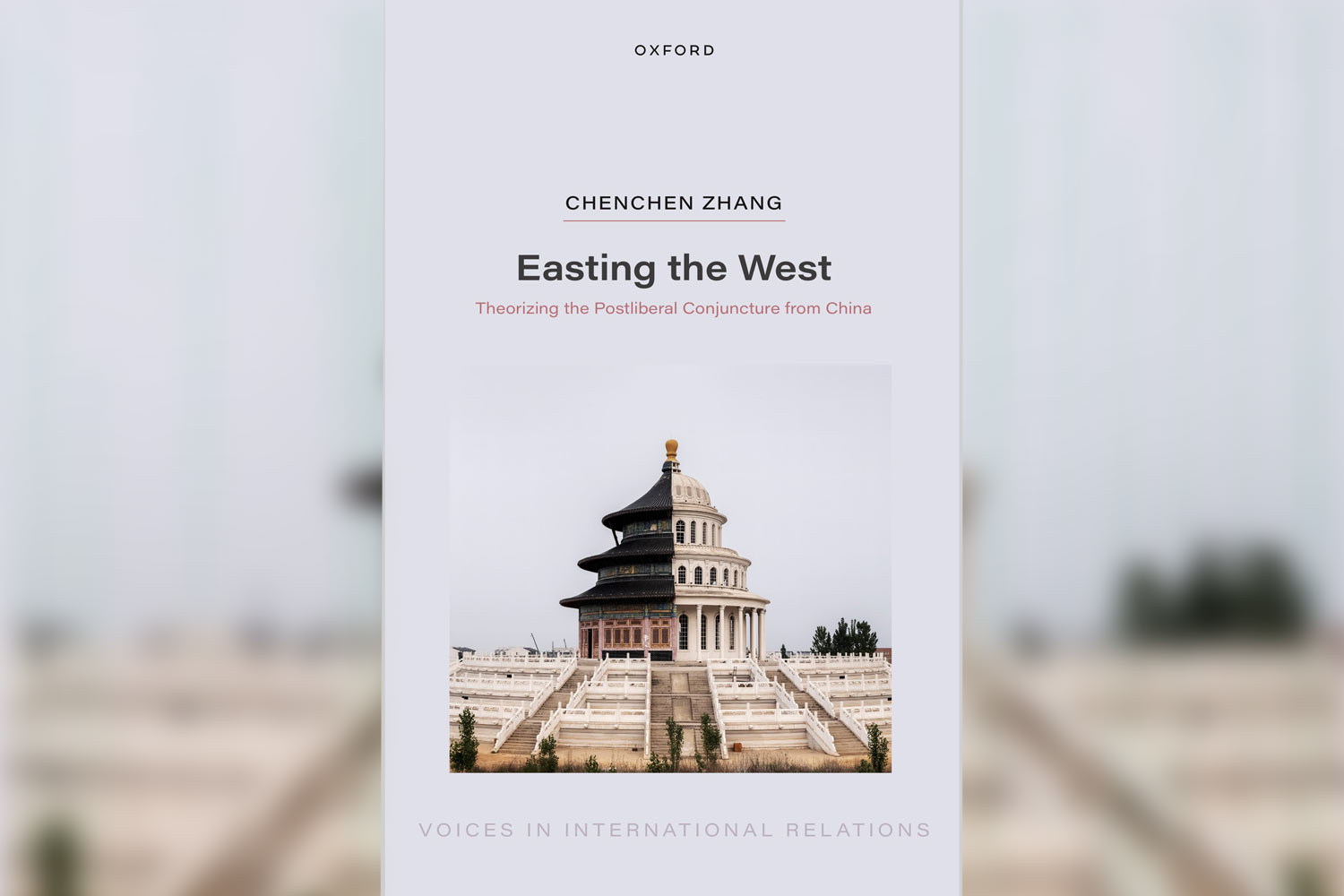
At a time when right-wing populism appears to be rampaging through global politics, studies about its discourses and strategies remain thin and even marginal in the field of international relations. This is especially true for authoritarian states where far-right discourses are not so much about electoral competitions as about regime legitimation. Chenchen Zhang’s new book, Easting the West: Theorizing the Postliberal Conjuncture from China (Oxford University Press, 2026), addresses such thinness and stares straight into the abyss of digital reactionary discourse in China. In the book, she analyses how the Chinese right appropriates the language of postcoloniality to reproduce racial and civilisational hierarchies and justify exclusion. The first part of the book reviews the historical development of Chinese discourses on the dichotomy of ‘China’ and ‘the West’, then the second part dives into several cases of reactionary discursive production in contemporary digital China. Grounded in intriguing—and sometimes painful—details, the book provides a deep and succinct critique of both the liberal order and the ‘postliberal’ right-wing ideologies purporting to challenge it.
Clyde Yicheng Wang: This is an extremely rich book examining many themes of the discourse of civilisational hierarchy in China and it includes many vivid, juicy details from the online discussions on platforms such as Zhihu, Bilibili, and Douban. A large part of these discussions comes from the cultural far right and involves unhinged misogyny, racism, and social Darwinism. Since we in academia are used to writing in an analytical and restrained manner, I would like to start with a more personal question: how do you feel when you observe these discussions and how do you deal with the (as I imagine) shock and anger upon reading them? I know that you sometimes engage in online discussions yourself and are subject to criticism and even personal attacks. How has this experience informed your writing, if at all?
Chenchen Zhang: This is an interesting question to start the conversation. Indeed, research on digital hate is not only an analytical challenge but also an ethical one. In recent years, ethical guidelines have increasingly emphasised the wellbeing of researchers themselves, recognising that prolonged exposure to hateful content can take an emotional toll. In my case, the project was not autoethnographic. Although I do occasionally participate in public discussions online and, like many academics, have been personally attacked, I did not participate in the discussions that form the data for this book. In that sense, I approached them primarily as an object of analysis. I also do not think this is unique to online research. Many of us who study politics, media, or public discourse constantly move between participating in public debates and stepping back to analyse them.
As for feelings of shock or anger, there certainly were moments like that when I first began working on these materials several years ago. Over time, however, one inevitably becomes somewhat desensitised. That is perhaps a danger in itself. But what struck me more was that much of the material I analysed may not immediately appear extremist, racist, or provocative within the context of contemporary Chinese social media. For both the speaker and the audience, statements such as ‘Europe is being Islamised’, that minority cultures should be transformed by whatever means necessary to achieve modernisation, that too much compassion leads to civilisational decline, or that structural redress hurts hardworking individuals may appear as perfectly reasonable observations rather than expressions of racism.
I do see in the material analysed in the book overt statements of biological racism that ascribe innate inferiority/superiority to groups, but what was analytically more interesting was how, in both China and elsewhere, digital reactionary discourse is sustained through more than just explicit hatred. Much of its power lies in making exclusionary ideas appear ordinary through humour, irony, ridicule, selective facts, and a cynical style of communication. Just today, for example, I came across a viral post on X by an anti-feminist influencer showing herself holding a baby with the caption: ‘Imagine how much propaganda it took to convince women that this is oppressive.’ Many of the examples discussed in the book work in a similar way by making the ‘enemy ideologies’ look self-evidently absurd. They are also often coupled with some kind of criticism of global inequality and white/Western dominance. So the book hoped to show the discursive and affective mechanisms that make exclusionary and racist ideas in digital culture appear normal, reasonable, and even righteous.
CYW: You noted that a key feature of the right-wing nationalist discourse against baizuo (白左, ‘white left’) was what you termed ‘realist authoritarianism’, which assumes a developmentalist binary between ‘values focused on economic and physical security and those on freedom and equality’ (p. 137). This forms a very interesting contrast with the discourse in American right-wing movements. While both emphasise security (‘law and order’, in the American context), the American right usually frames its opposition to social justice movements as an expression of freedom, rather than a rejection of excessive freedom. For the American right, it is usually the pursuit of equality that has repressed freedom and therefore Black Lives Matter and feminist movements are frequently described as ‘socialist’. In China, as you mentioned, many discussions also blame ‘welfarism’ for redistributing ‘hard-earned taxpayer’s money’ to ‘lazy people and foreigners’ (p. 150). In the Chinese context, are there any discussions that echo the freedom–equality trade-off theme? What do you think are the main commonalities and differences in the logic of the two versions of far-right discourse?
CZ: First, I don’t think there are ‘two versions of the far right’ as in one Chinese and one American. There are different ideological and discursive currents in both countries. In the thematic mapping of the anti-baizuo discourse in Chapter 6, one type of argument I identified was about ‘moral hijacking’ and ‘imposing views on others’, which is similar to the authoritarian charge that ‘social justice warriors’ are restricting others’ freedom. There is also the anti–Chinese Communist Party far right in China and among the Chinese diaspora, who are more sympathetic to libertarianism and more likely to liken social justice movements to far-left totalitarianism.
As for the state-aligned techno-nationalists, the concern with ‘excessive freedom’ is not necessarily incompatible with the accusation of ‘restricting freedom’. One could simultaneously claim that activists are given too much freedom to disrupt social order and that ‘political correctness’ is limiting individuals’ freedom. I noted in the book that Chinese techno-nationalists are different from, say, US traditionalists or the US religious right in that they are far less interested in defending ‘traditional values’ than defending techno-scientific modernity against what is seen as irrational ‘postmodern culture’. However, traditionalists and the religious right are not the only actors in the far-right world. In his study of the ‘anti-woke movements’ online, John Postill (2024) finds a mixture of Schmittians, atheists, and classic liberals with an emphasis on rationalism, which shares commonalities with the anti-baizuo discourse on Zhihu.
Compared with their Western counterparts, the ‘uniqueness’ of the nationalist cultural far right about whom I wrote is probably their strong identification with the state and national development, but I reckon this is more common in the postcolonial world. It’s interesting that you mention the anti-welfarist dimension, which is racialised (portraying foreigners and minority groups as ‘lazy’) and coexists with support for state intervention in economic and industrial development. This isn’t unusual in the context of East Asian developmentalism.
But another thing that could help us think about resonance despite structural difference is the idea of meritocracy. Surveys (Mazzocco and Kennedy 2024) find that the belief in meritocracy (the idea that ability, talent, hard work, and better education explain why people are rich) was exceptionally widespread in China between 2004 and 2014—possibly one of the highest in the world. Michael Sandel (2020) famously argues that the rise of right-wing populism in the United States is to do with the ‘tyranny of merit’, which produces resentment and humiliation among members of the dominant group under competitive individualism. In a separate paper, Zheng and I (Zhang and Zheng 2026) discuss meritocratic nationalism in China. We show that while majority men narrate enormous hardship and suffering under hypercompetitive education and economic systems, they also use the language of merit to justify hatred towards minorities and women, framing their success as undeserving and majority males as the true victims of a broken system. It is unsurprising that people such as Elon Musk, Donald Trump, and Nigel Farage have been claiming that equality initiatives are against meritocracy, employing the same discursive mechanism to reframe dominant-group men as victims and structural redress as undeserved favouritism.
CYW: Scholars such as Nancy Fraser (2019) have provided important critiques of neoliberal identity politics, arguing that it substitutes the pursuit of economic equality with that of merit-based recognition. I don’t think many Chinese right-wing supporters have read Fraser, but I’m curious about whether their anti-baizuo discourse makes any distinction between economic leftism and neoliberal progressivism. You mention that labour activism is also sometimes subject to criticism in anti-baizuo discourse. Yet, I assume the argument against labour rights is far more difficult to make in China, especially considering China’s claim to be a socialist country (and considering that, as you mention several times in the book, many right-wingers self-identify as ‘left’). Does anyone in the discussion try to resolve this logical tension?
CZ: This is a fascinating question. The first thing I would say is that, although online commentators may not have read critical theory (or radical conservativism), I take digital publics seriously as spaces where ordinary people are engaged in theorising the world. They may not have read Spengler (although some alternative intellectual types such as Liu Zhongjing are clearly well-read on Spengler), Schmitt, or Nietzsche, yet one repeatedly encounters arguments about societies becoming ‘too civilised’, unable to defend themselves against internal and external enemies, or that liberalism is about appeasing ‘the weak’. Many of the grassroots theorists behind ruguanxue (入关学) or ri’ermanxue (日耳蛮学)—vernacular geopolitical ‘theories’ or memes that I analysed in the book to illustrate the combination of anticolonial sensibilities and reactionary affects—may not have read postcolonial theory, but their claim that China has been rendered ‘barbarian’ according to Eurocentric standards of civilisation resonates with that, which is however redirected towards projects of alternative hierarchies rather than egalitarian or emancipatory politics. I want to acknowledge that ordinary people making sense of the world are theory-makers, including producers of reactionary ideologies.
I am also interested in how left and right critiques of liberalism converge in diagnosis while diverging in political direction. Fraser’s critique of neoliberal recognition politics is one example. Another is Wendy Brown’s (1993) famous essay ‘Wounded Attachments’, in which she drew on Nietzsche’s notion of ressentiment—that is, a reactive moral economy in which injury is converted to righteousness and revenge becomes a substitute for action—to argue that identity politics could become overly attached to its woundedness. More broadly, left critiques of identity politics have sought to redirect political energies from the recognition of injury towards transforming the social and economic structures that give rise to it.
What’s striking now is how much of the anti-woke discourse from the right has picked up the same diagnosis, such as the ‘grievance studies’ hoaxers, to say that progressive politics is Nietzschean slave morality. Rather than redirecting attention from recognition to structural transformation, these arguments seek to delegitimise the injuries themselves and deny the existence of structural oppression. Ironically, many of these same actors simultaneously cultivate their own politics of grievance and victimhood, which can also be analysed, as scholars have done, through the concept of ressentiment.
This is one of the reasons I find ‘postliberal’ a more useful word than ‘left’ and ‘right’ in certain places. Coming back to the context of digital China, within the anti-baizuo discourse, you often see a mixture of left and right narratives. There are narratives that say contemporary social justice movements in ‘Western societies’ are not the ‘real left’ and are a distraction from class struggles; and there are those that operate more explicitly in social Darwinist, anti-egalitarian registers. Similar ambiguities can be found elsewhere. A slogan such as ‘they got you fighting a culture war to stop you fighting a class war’ circulates in digital space across very different political orientations and can be mobilised for quite different purposes.
On the point about labour activism, it is surprisingly easy to discredit this with the language of authenticity as well as the authoritarian hostility to activism as a political form. It’s the same with the discussion of environmental politics. Commentors may not object to the importance of environmental protection itself, and China’s global leadership in green industries is clearly a source of pride, but there is strong contempt for contentious forms of environmental activism, which are dismissed as performative, ‘attention-seeking’, disruptive, and ineffective. Environmental protection is valued insofar as it is delivered through state-led technological development and national strength, rather than through grassroots mobilisation or public protest.
The authenticity claim, of course, accuses these grassroots movements—whether feminist, labour, or environmental—of being instruments of foreign intervention. One influential online left (网左) commentator, for example, produced an extensive critique of what he called ‘white feminism’ and ‘white labour movements’ (‘white’ here seems to mean counter-revolutionary, as in ‘white terror’, as opposed to ‘red’). The central claim was that these grassroots movements not guided by the state are supported by foreign imperialists, serving the interests of Western imperialism and global capitalism. We have discussed elsewhere the use of anti-imperialist and anticolonial discourse in authoritarian and reactionary politics across different parts of the world (Altinors et al. 2026).
CYW: You mentioned that the reactionary discourses in China rely on ‘an imagination of global conservative solidarity’ (p. 189). What does this entail? Do they consider themselves part of a global movement and have they developed a sense of internationalism of mutual support? Furthermore, who is included in this imagination: Does it focus on powerful ‘allies’ such as Elon Musk and does it extend to ordinary Americans wearing MAGA hats? While they criticise the baizuo for pointing fingers at China and/or oppressing the Chinese ‘model immigrants’, what do they say about the anti-Chinese racism of the American far right? Do they tend to justify such racism or do they feel betrayed?
CZ: The quote you mentioned is from a specific case study of the debates about the 2024 Paris Olympics opening ceremony. In that case, I was referring to how conservative commentators cite the global backlash—with many critics denouncing the spectacle as excessively ‘woke’ and accusing it of mocking Christianity—to come at Chinese supporters of the show, making a claim to the effect of ‘the whole world hates it, only the Chinese zhiren [殖人, “colonised person”] like it’. Elsewhere I talk about converging postliberal sensibilities and transversal alignment, which is not a purposeful, coordinated, or interest-based alignment but rather tactical, contingent, and affective. I don’t think conservative nationalists consider themselves part of a global movement, but they do make analogies between ‘ordinary Americans’ (especially the figure of the redneck) and themselves when some kind of common victimhood is useful for the argument.
The paper on meritocratic nationalism mentioned above studies the online backlash against a Tibetan cyber star named Ding Zhen, whose accidental rise to fame and subsequent endorsement by the state were seen by many Han Chinese male netizens as ‘unfair’ and a betrayal of meritocracy. In this, a popular answer analogises the disappointed Han male with an imagined American white man, portrayed as a fellow victim of ‘political correctness’. More interesting examples are probably found in the phenomenon of digital regionalism, which I was introduced to by Mingqiu Zheng. In narratives of regionalist grievance around the Central Plain and Shanhe Sisheng (山河四省, the provinces of Shandong, Shanxi, Henan, and Hebei), people invested in regional victimhood compare these regions to the ‘left behind’ heartland of the United States being exploited by affluent coastal areas and themselves to the rednecks being looked down upon by coastal elites. Still, these sympathetic projections and imaginations can coexist with strong anti-Americanism when it comes to foreign policy interests and geopolitical rivalry.
As for nationalists’ attitudes towards the anti-Chinese racism of the American far right, their attitudes towards Trump are illustrative. The logic of the anti-baizuo and Trump-appreciating nationalists is that while the far right displays blatant racism, the liberals and the left are more despicable for their hypocritical racism. What’s worse about the latter, they believe, is that they are particularly discriminatory against the hardworking, high-achieving Chinese and yet favour other minoritised groups, while also discriminating against majority men. They also tend to be convinced by the ‘meritocracy’ claim made by the likes of Musk and Farage, given what I said earlier about the belief that structural redress is unfair for hardworking individuals.
There are of course other reasons for Chinese nationalists to find Trump more likeable than Democratic presidents. Some are pleased by the impression that Trump’s policies inadvertently make China stronger, hence the nickname ‘Chuan Jianguo’ (川建国, literally ‘Trump builds the nation’). Others appreciate the absence of the agenda of human rights and democracy promotion associated with neoconservative foreign policy—often understood as a kind of condescending moralism.
Postcolonial ethnonationalism thus both condemns white supremacy, when it perceives itself as its victim, and sustains its own formulation of racial hierarchies, whereby reproducing narratives of reverse racism and white male victimhood from the perspective of fellow majority men. When postcolonial nationalists focus on global power relations, they criticise inequalities and Western dominance; when they focus on what holds together a civilisation, nation, or ‘race’, those on the right conclude that the baizuo culture is destroying civilisational confidence and coherence, lamenting the decline of the other, not without a sense of schadenfreude, from the perspective of a fellow ‘great civilisation’.
CYW: Towards the end of the book, in the section titled ‘Unlearning Binaries’ (Chapter 7), you shed some positive light by discussing recent feminist movements in China, emphasising their solidarity with Palestinians in the ongoing genocide in Gaza. The section shows that it is possible to oppose the hypocrisy of the US-led liberal international order without embracing authoritarianism (and vice versa). This is also a powerful callback to the end of the Introduction, where you provided subtle criticism of Noam Chomsky. Unfortunately, as the quote on page 211 says, ‘picking sides’ has become the norm. For many people, picking a side is not only easier than problematising all sides, but it also may feel more ‘empowering’. It could bring a sense of hopelessness to know that there is no powerful actor doing the right thing. Herbert Marcuse said (at the end of One-Dimensional Man) that critical theory remains loyal to those who give their life to the ‘Great Refusal’, that it remains negative and holds no promise. I want to end with the question of where critical studies such as yours could lead us. Do you consider this book to be part of Marcuse’s tradition? Or is it aiming to make a more positive intervention in the ills of our time? How should we counter the feeling of hopelessness when facing those ills?
CZ: This is a great closing question. Marcuse followed this line about the Great Refusal with a Walter Benjamin quote about hope (‘It is only for the sake of those without hope that hope is given to us’). I will, however, mention a contemporary feminist writer, Lola Olufemi (2021: 11), who wrote this in a book called Experiments in Imagining Otherwise:
no poetry and no hope as an empty gesture of optimism. hope as a riot or uprising or revolution or many other names. simply, steal everything, burn everything. hope as commitment to see through around and beyond unending misery. hope to abandon hope when hope fails.
Separated by a century, Lu Xun said ‘the illusoriness of despair is just like that of hope’. I like that Olufemi’s willingness to ‘abandon hope when hope fails’ resonates with Lu Xun’s refusal to treat hopelessness as more truthful than hope, and both, I think, caution against letting an abstraction about the future, whether optimistic or pessimistic, become a substitute for action.
So, I might be in ‘Marcuse’s tradition’ in the sense of being in solidarity with those who refuse without any guarantees, but the distinction between ‘negative critique’ and ‘positive intervention’ is a false one. In the spirit of Olufemi and Lu Xun, if hope is action and despair is as illusionary as hope, then you act, or refuse, or stay inside the disastrous moment, which is already the doing and the intervention.
The last chapter discusses feminist and Palestine solidarity organising in the Chinese diaspora as a generative site for critique and solidarity rooted in interconnected structures of injustice and contexts of struggles. It does not mean that this subject positioning (oriented towards critiquing multiple power structures) necessarily emerges from diasporic conditions. Nor does it mean the subject positioning only emerges in diasporic spaces—far from it. However, following Gayatri Gopinath (2005), I like to think of this location as a vantage point. It is perhaps from the vantage point of ‘impossible subjects’ that we ‘can and must’ reimagine many of the questions shaping the postliberal conjuncture differently.
References
Altinors, Gorkem, Priya Chacko, Miri Davidson, Aliaksei Kazharski, Sivamohan Valluvan, and Chenchen Zhang. 2026. ‘The Uses and Abuses of the Anti-Colonial in Global Reactionary Politics.’ International Political Sociology 20(2): olag012.
Brown, Wendy. 1993. ‘Wounded Attachments.’ Political Theory 21(3): 390–410.
Fraser, Nancy. 2019. The Old Is Dying and the New Cannot Be Born: From Progressive Neoliberalism to Trump and Beyond. London: Verso Books.
Gopinath, Gayatri. 2005. Impossible Desires: Queer Diasporas and South Asian Public Cultures. Durham, NC: Duke University Press.
Mazzocco, Ilaria, and Scott Kennedy. 2024. ‘Is It Me or the Economic System? Changing Evaluations of Inequality in China.’ Big Data China, 9 July. Washington, DC: Center for Strategic and International Studies. bigdatachina.csis.org/is-it-me-or-the-economic-system-changing-evaluations-of-inequality-in-china.
Olufemi, Lola. 2021. Experiments in Imagining Otherwise. London: Hajar Press.
Postill, John. 2024. The Anthropology of Digital Practices. London: Routledge.
Sandel, Michael J. 2020. The Tyranny of Merit: What’s Become of the Common Good? London: Penguin.
Zhang, Chenchen, and Mingqiu Zheng. 2026. ‘The Tyranny of Meritocratic Nationalism: Unpacking the Online Backlash Against a Tibetan Cyberstar.’ Nationalities Papers [first view]. doi.org/10.1017/nps.2026.10129.
The post Easting the West: A Conversation with Chenchen Zhang appeared first on Made in China Journal.