Europe’s strongest military sends another military equipment convoy into North African nation the US is warning citizens to avoid
A second Russian naval convoy has delivered armored vehicles and logistical supplies to eastern Libya, expanding foreign military movement in a region where the U.S. actively warns its citizens against all travel.
 Black News
A second Russian naval convoy has delivered armored vehicles and logistical supplies to eastern Libya, expanding foreign military movement in a region where the U.S. actively warns its citizens against all travel.
- A second Russian naval convoy has delivered armored vehicles and logistical supplies to eastern Libya.
- Satellite imagery and open-source intelligence confirmed the presence of three Russian ships.
- The Italian military detected the Russian convoy in the central Mediterranean.
- Neither Russian nor Libyan officials have commented on who will receive the supplies or their intended purpose.
Russian military naval convoy arrives in Libya with heavy equipment
A secondary Russian military fleet has docked at the port of Tobruk in eastern Libya after traveling across the central Mediterranean.
DON'T MISS THIS: A powerful Gulf nation and other foreign networks allegedly fuel high-tech drone warfare in Northeast Africa as UN probe warns of possible war crimes
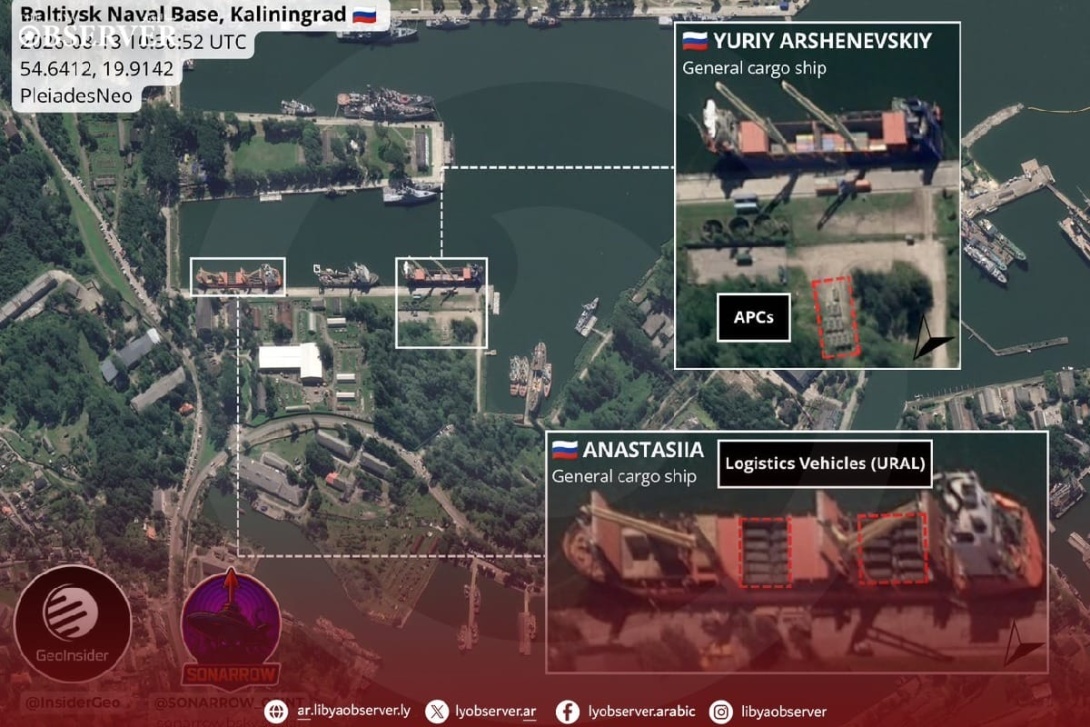
Satellite imagery confirmed that the naval force included cargo and landing ships delivering armored personnel carriers, supply trucks, and mine-resistant ambush-protected vehicles.
Italy detects Russian convoy in the central Mediterranean
A September 13 Sentinel-2 satellite image, analyzed by open-source intelligence groups Sonar and GeoInsider, reveals the locations of three ships.
According to Libya Observer, "An Italian Air Force P-72A maritime patrol aircraft detected a naval convoy in the central Mediterranean on September 10, according to the specialist website Itamil Radar."
DON'T MISS THIS: North African country with 6 Russian military bases denies allowing Ukraine to use government-controlled territory to attack Russian oil tankers
"At the time, the three vessels had stopped transmitting their public data through the Automatic Identification System, through which ships report their identity, position, speed, and course to other vessels and coastal stations"
Neither Russian nor Libyan officials have released formal statements detailing the intended recipient or purpose of the armaments.
It is worth noting that Russia moving arms to the North African nation of Libya is not new.
Just a few weeks ago, Business Insider Africa reported that the U.S. detected Russia rapidly accelerating its efforts to strengthen its military presence in Libya by expanding operations across six strategic airbases.
According to the official public website for United States federal legislative information, the U.S. believes that Russia’s growing ties and military supplies are meant to weaken Western influence in Africa and portray Western nations as unreliable security partners.
U.S. warns citizens to avoid travel to unstable Libya
Amid growing security concerns and foreign military activity, the U.S. State Department maintains Libya at Level 4: "Do Not Travel," representing the highest warning level in the American travel advisory framework.
American authorities cited severe dangers stemming from volatile political instability, sudden armed clashes between factions, criminal smuggling networks, and unmapped landmine fields.
DON'T MISS THIS: A European military power deepens military ties with Russia-backed Libya as defence cooperation expands across North Africa
Business Insider Africa Reported that "the US Department of State has maintained Libya at Level 4 of its travel advisory system, the highest level, urging US citizens not to travel to the country due to ongoing security risks".
Officials specifically warned that "US citizens could be among those targeted for kidnapping".
Because the United States does not operate an active embassy in Libya, federal authorities emphasized that their ability to assist Americans in emergency situations remains severely limited.
Hence, the U.S. government has declared that any of its citizens who still choose to travel to Libya despite this warning should have a personal plan for emergency evacuation.