How Marko Stout’s Art Melds New York Sensibility and Modern Glamour
For sculptor Marko Stout, art and cultural expression aren’t limited to the art gallery; they can be found in the nightclub, on the runway, and in a Manhattan mansion. In New York City, pop culture has always had a touch of glamour, and glamour has always had a touch of pop. From the pop art […] The post How Marko Stout’s Art Melds New York Sensibility and Modern Glamour appeared first on Time Africa.
 Black News
For sculptor Marko Stout, art and cultural expression aren’t limited to the art gallery; they can be found in the nightclub, on the runway, and in a Manhattan mansion.
In New York City, pop culture has always had a touch of glamour, and glamour has always had a touch of pop. From the pop art masterpieces of Andy Warhol to the subway graffiti art of Keith Haring, and from Jean-Michel Basquiat’s use of both text and graffiti to Jeff Koons’ use of consumer products, polished metals, and kitsch, the artists of NYC have never been afraid to blend art and popular culture. Neither is Marko Stout, painter and multimedia artist turned fashion designer and sculptor.
One of the contemporary artists on the scene, Stout has devoted the past decade to developing his own aesthetic from the decor, fashion, and lifestyles of Manhattan. The inspirations for his art can be found in the elegant interiors of the nightclub and the seaside mansion, and his colors and sense of movement seem intended to evoke the late-night ambiance of the city.
Stepping Beyond the Art Gallery
Where Haring painted on subway walls, Stout imprints his art on photographic prints, in fashion, and in the dance and chatter of the nightclub and the celebrity fashion show. Rather than rejecting glamour as commercial or shallow, Stout treats glamour as a serious subject. He finds in it the voice of contemporary desire and a vehicle for expressing and shaping the evolving identities of the New York City nightlife and celebrity culture.
For Stout, the art gallery is not the only place to hold an exhibit; a bar or a fashion show can be part of the same cultural ecosystem, a place where people come to see and be seen, a place where the shape of a gown or the shape of a photo can shape culture. For Stout, luxury aesthetics aren’t tawdry; rather, they are a way that real aspirations are communicated, negotiated, and embodied. While other contemporary artists are chasing visions of reality, Marko Stout wants to capture the performance because it is in the performance that culture tells its story.
Capturing Tales of Branding and Desire
What interests Marko Stout most is social performance. His most recent series, “The House of Hunter,” holds up a different mirror to Manhattan culture. In this case, the avatar of Manhattan is not a dilettante or a Broadway starlet but a dog. Specifically, the artist’s own canine companion, a Shiba Inu named Hunter.
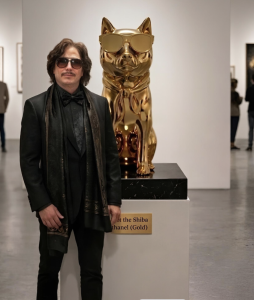
Hunter appears in a series of sculpted images worked in gold, often accessorized with designer shades, fine silk scarves, and meticulously styled clothing. The pieces are posed in a deliberately artificial style intended to mimic the photography of a luxury campaign or a fashion magazine spread. Pushing just to the edge of kitsch without toppling fully into it, Stout uses tailored silhouettes, metal finishes, sharp angles, dramatic shadow play, and striking color choices that appear to be taken directly from New York nightlife in some cases, and from haute couture runways in others.
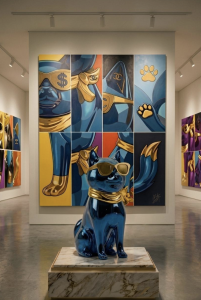
A Shiba Inu in Gold
The sculpted representations of Hunter don’t suggest a toy or cartoon, so much as an artifact produced specifically to exist and hold meaning in this cultural moment and no other. Viewers find themselves wondering whether to approach the Shiba Inu as a luxury fashion mascot, a collectible item, a commentary on high-status culture, or all of the above. For a generation for whom the Shiba Inu itself can evoke multiple cultural contexts and social-media memes, Stout has chosen to treat his subject matter with an air of sincerity rather than mere irony. As he shows Hunter in image after image, one gets the sense that he is truly entranced by the way that the Manhattan nightlife and luxury culture expresses the desires and drives of contemporary culture, just elevated to a particular height or exaggerated to a particular extreme.
Perhaps this is why Stout’s work, with its gold, slick surfaces, and shimmering materials, has been capturing the attention of the nontraditional art world. His work, though presented in three dimensions, captures the digital aesthetic, the quick visual appeal of images normally consumed through a screen. If there is a boldness to its project, it may be found in that insistence that online and offline spaces, and that gallery, bar, and fashion show can all serve as common meeting places where matters of cultural and artistic value can be expressed and discovered.
TIME Africa stage were not involved in the creation of this content.
The post How Marko Stout’s Art Melds New York Sensibility and Modern Glamour appeared first on Time Africa.