Juneteenth Marks A Freedom That Arrived Late And Remains Incomplete
From Reconstruction to affirmative action, gains for Black Americans have a history of triggering efforts to repeal them.
 Black News
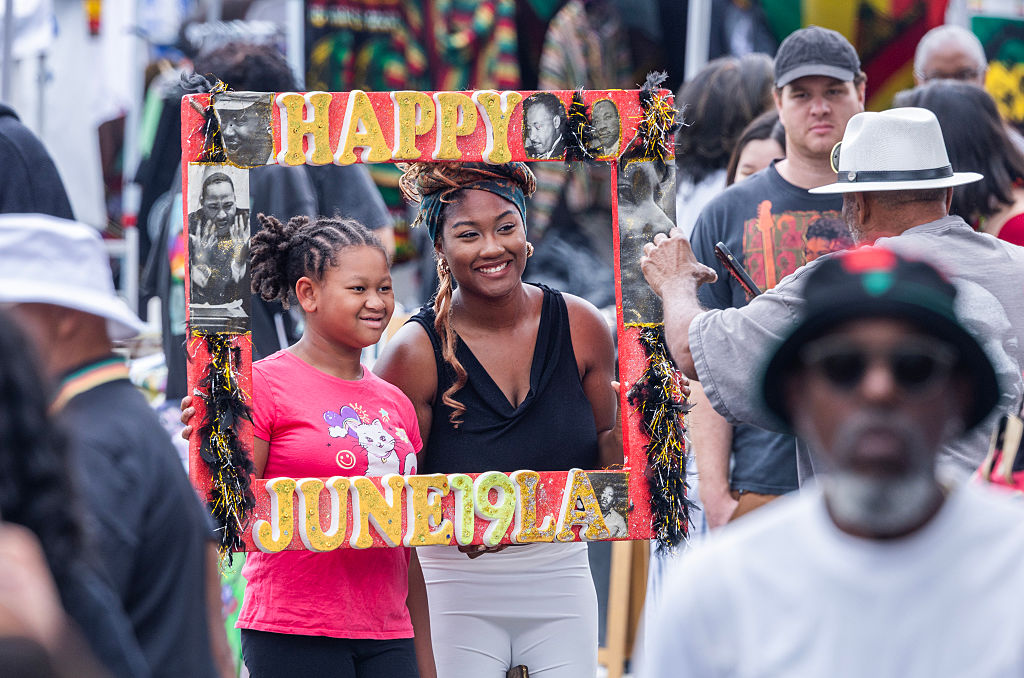
Juneteenth asks something more of us than a barbecue and a day off work. It asks us to hold the arrival of freedom in 1865 alongside the long and unfinished record of people who have spent the years since defending it, a fight that still has no finish line.
By the time Congressman John Lewis died in 2020, he had spent more than half a century fighting for the liberation of Black Americans. It was a fight that took him clear across the Edmund Pettus Bridge in 1965 and into the room where he watched the Voting Rights Act being signed into law, only for him to live long enough to see significant portions of that same law dismantled in a fraction of the amount of time it took to get the legislation in place.
Lewis was the youngest speaker at the March on Washington in 1963, standing alongside Martin Luther King Jr. to demand the right to vote for Black Americans. He would outlive King by more than half a century, spending the rest of his life fighting for freedom and justice even as he had come to understand that freedom is elusive.
It should come as no surprise, then, that near the end of Lewis’ life, he wrote: “Freedom is not a state; it is an act. It is not some enchanted garden perched high on a distant plateau where we can finally sit down and rest. Freedom is the continuous action we all must take, and each generation must do its part to create an even more fair, more just society.”
As we commemorate Juneteenth as a federal holiday for just the sixth time, Lewis’ words should serve as a reminder that in 1865 the hard fought battle for freedom wasn’t over when, on June 19, 1865, federal troops arrived in Galveston, Texas carrying word that the last enslaved people in the Confederacy were free, two and a half years after Lincoln’s Emancipation Proclamation had declared them so. Texas had refused enforcement of the proclamation, forcing a quarter of a million people to remain enslaved until that day.
Within months, Black Codes swept across the South, with vagrancy laws and labor contracts enacted and engineered to rebuild plantation economics under new legal language. White southern plantation owners feared that the end of slavery meant the loss of labor and that those newly freed would flee the rural South for cities. And so began the first of many iterations of a cycle of perpetually contested freedom, where every gain has been met with swift and deliberate efforts to claw it back and erect new barriers in its place.
Legal scholar Derrick Bell called this pattern “interest convergence,” and believed the rights of Black Americans are recognized and protected only for as long as doing so serves the broader interest of those in power, and that those rights are walked back the moment it no longer does. He claimed this theory showed up as, “temporary ‘peaks of progress,’ short-lived victories that slide into irrelevance as racial patterns adapt in ways that maintain white dominance.” ‘
Reconstruction offers perhaps the clearest early illustration of Bell’s theory. The 13th, 14th, and 15th Amendments abolished slavery, granted Black Americans citizenship and the right to vote, and enforced them with federal troops. Sixteen Black men served in Congress during Reconstruction and Louisiana elected its first Black governor along with three Black lieutenant governors. When Reconstruction ended, Southern states moved quickly to neutralize those amendments through poll taxes, literacy tests, and grandfather clauses. The estimated 130,000 registered Black voters in Louisiana in 1896 plummeted to around 1,000 by 1904.
Black voter registration wouldn’t surge again across the South until the Voting Rights Act of 1965 restored and federally protected Black Americans’ right to vote. Then, in 2013, the Supreme Court gutted the law’s enforcement provision.
The same pattern of gains secured and then diluted within a generation has reasserted itself again under the current administration, where the rollback of civil rights protections has reached well beyond the ballot box and into the labor force, the funding behind scientific and historical research, and it has permeated the culture and institutions created to accurately capture the country’s history.
Anti-DEI executive orders have landed hardest on Black women, whose employment rate fell by 1.4 percent in 2025, to 55.7%. This marked the sharpest one-year declines among any group in the past quarter century, a drop driven in large part by federal workforce cuts and a wave of corporations abandoning their diversity programs, bolstered in 2020, which had started to lift Black women’s representation in the higher echelons of corporate America.
The rollbacks have extended into research and the data that have long made the case for equity-based policy and hiring, with NIH and NSF freezing or terminating thousands of grants in 2025 alone. Many of them funded studies on the economic, social, and health disparities facing Black communities, including grants held by researchers at Howard University and other historically Black colleges and universities.
A $2.4 million study on Black maternal health at the University of North Carolina aimed at understanding why Black women in this country die from pregnancy-related complications at roughly three times the rate of white women was canceled in the middle of its research. Without studies and data like this, disparities become invisible, and much of the proof that additional resources need to be directed towards them disappears.
Culture and history have also been targets. In January, the National Park Service removed an outdoor exhibit about slavery, one of many exhibits stripped from national parks under executive order, and courts have since ordered them restored, while a statue of Confederate General Albert Pike that protesters had pulled down and set on fire on Juneteenth several years ago was put back up in a park in downtown Washington, D.C.
Last year, President Trump skipped the traditional Juneteenth proclamation, and presumably at his behest, the Interior Department dropped both Juneteenth and Martin Luther King, Jr. Day from the National Park Service’s list of fee-free admission days, replacing them with June 14, which happens to be Trump’s birthday.
University of Pennsylvania historian Dr. Mary Frances Berry has witnessed the law open and close around Black Americans’ freedoms and rights for more than half a century. During the Carter administration, she became the country’s first Black woman to serve as the Assistant Secretary of Education, overseeing programs she witnessed future administrations dismantle.
Dr. Berry has cited the Bakke affirmative action case as instructive in conversations about rollbacks and the mentality behind reverse discrimination that often drives attempts to reverse equality for Black people.
According to Dr. Berry, “If people can define you, they can confine you.” In other words, whoever sets the terms of the debate controls the language and wins before the argument begins. It’s the ultimate shell game. Call affirmative action preferential treatment, and anyone who benefits from it already looks guilty of taking something they don’t deserve. Dr. Berry explains further that, “If you [claim] reverse discrimination against somebody, it already sounds like a bad thing is happening, and you don’t focus on what the [original] injustice was.”
The Supreme Court’s 1978 decision in Bakke banned rigid racial quotas in college admissions, but still allowed race to count in as one factor of many, a compromise that opened the door to nearly five decades of rollbacks.
By 1979, backlash against affirmative action was already in full swing: Black college enrollment was falling, Black unemployment was rising, and people who’d gotten jobs through civil rights and affirmative action programs found themselves stuck, unable to get hired or promoted, accused everywhere of benefiting from reverse discrimination. Sound familiar?
In addition to being a noted historian, Dr. Berry is also an unrelenting activist who helped found the Free South Africa Movement and has been arrested multiple times for her activism. She was in South Africa to greet Nelson Mandela when he walked free in 1990 after spending twenty-seven years in prison for his work against apartheid.
Dr. Berry believes that attaining justice takes time and progress is incremental, but you keep fighting no matter how long it takes, saying “Each generation has a responsibility to make a dent in the wall of injustice.”
Dr. Berry understands that activists often disagree about the direction of a movement, the work isn’t always popular, and so she has little interest in waiting for consensus. As she once put it, “If Rosa Parks had taken a poll before she sat down on the bus in Montgomery, she’d still be standing up. But, she didn’t take a poll. She knew what was necessary to be done, and she did it. So I didn’t take polls either.”
If Rosa Parks, the woman considered the mother of the civil rights movement, and Dr. Mary Frances Berry, a civil rights historian who has worked tirelessly to fight for the rights of Black Americans, never took a poll before acting, then, on a holiday representing our freedom, neither should we.
SEE ALSO:
BLD PWR Is Bringing A 3-Day Juneteenth Celebration To Houston
How To Celebrate Juneteenth While Civil Rights Are Under Threat