Spain Dismantles One of the Mediterranean’s Most Dangerous Migrant-Smuggling Networks
The transnational network used high-speed boats to transport drugs to Algeria before returning with dozens of migrants in perilous journeys that generated more than €24 million Spain’s Interior Ministry has announced the dismantling of one of the largest and most dangerous criminal networks specialising in maritime migrant smuggling across the Mediterranean. The operation was jointly […] ظهرت المقالة Spain Dismantles One of the Mediterranean’s Most Dangerous Migrant-Smuggling Networks أولاً على African Percentions.
 Black News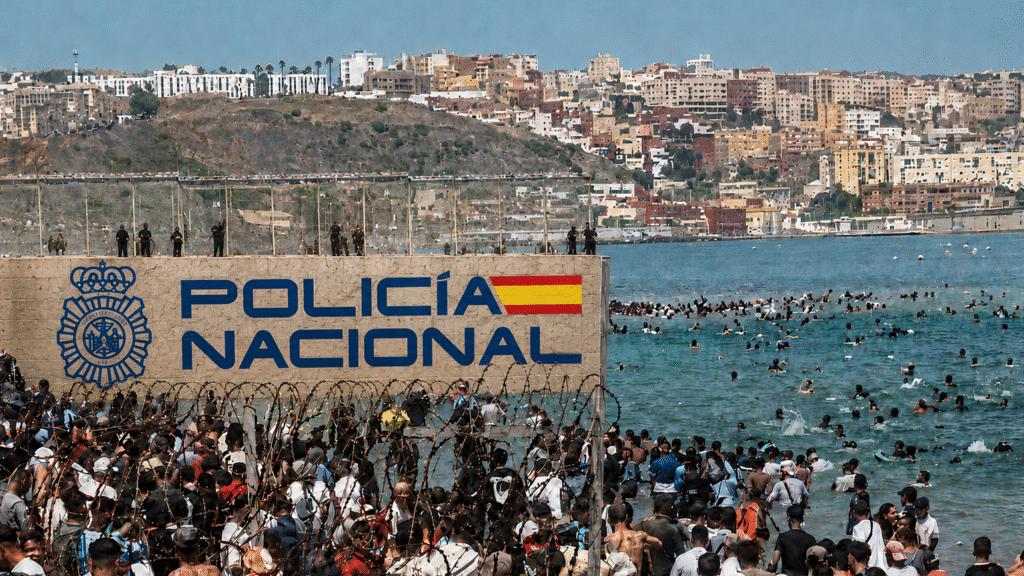

The transnational network used high-speed boats to transport drugs to Algeria before returning with dozens of migrants in perilous journeys that generated more than €24 million
Spain’s Interior Ministry has announced the dismantling of one of the largest and most dangerous criminal networks specialising in maritime migrant smuggling across the Mediterranean.
The operation was jointly conducted by Spain’s National Police and Civil Guard, with support from the European Union Agency for Law Enforcement Cooperation, Europol.
According to the official statement from Spain’s Interior Ministry, the network is suspected of organising at least 64 sea crossings through which more than 2,000 migrants were irregularly brought into Spain, generating profits exceeding €24 million.
78 arrests and 18 high-speed boats seized
The investigation, known as Operation Salem, led to the arrest of 78 people: 77 in Spain and one in Algeria. Twenty-seven suspects were remanded in custody.
Those arrested included four senior leaders classified by the authorities as “high-value targets”, as well as the network’s alleged “hawaladar”, who managed its financial infrastructure through the informal hawala money-transfer system.
More than 180 officers participated in the final phase of the operation, with support from French, Portuguese and Polish police. Investigators also identified operational links in France, Portugal, Italy and Poland.
The official statement did not mention Albanian participation in the operation. Nor was the network smuggling migrants into Sweden. Its destinations were the Spanish coastal areas of Almería, Cartagena, Murcia and Alicante, as well as the island of Ibiza.
Profiting in both directions
The network operated what investigators described as a “double-flow” system, generating profits on both the outbound and return journeys between Spain and Algeria.
High-speed boats left Spain carrying synthetic drugs, particularly MDMA, commonly known as ecstasy, for distribution in Algeria and other North African countries.
On the return journey, the same boats carried migrants seeking to reach the Spanish coast, allowing the network to profit from both drug trafficking and migrant smuggling.
The organisation charged up to €12,000 per migrant and transported as many as 50 people on some journeys, generating hundreds of thousands of euros from a single crossing. It also made additional profits from drug trafficking and the illicit supply of fuel to high-speed boats.
Boats worth more than €5 million
Authorities seized 18 high-speed boats measuring between eight and 14 metres and fitted with three or four powerful engines. Their combined value was estimated at more than €5 million.
The network also possessed an advanced logistical infrastructure that included transport and surveillance vehicles, safe houses, encrypted communication systems, satellite phones, GPS devices, satellite antennas and an extensive fuel storage and distribution network.
Investigators said the organisation had a three-tier hierarchy. The first level was responsible for leadership, planning and financing; the second comprised pilots, transporters and operational managers; and the third included recruiters, lookouts, fuel suppliers, financial managers and frontmen used to conceal the network’s activities and proceeds.
Migrants packed into boats and tied down
Spain’s Interior Ministry said migrants were transported in extremely dangerous conditions. They were packed into boats travelling at high speed through rough seas, often without lights or life jackets.
During some journeys, members of the network tied migrants down to prevent them from falling overboard, illustrating the severe danger and abuse faced by those under the organisation’s control.
Their ordeal often began long before they boarded the boats. Many travelled across several African countries to reach Algeria’s coast, where they were held in overcrowded and unsanitary makeshift accommodation while waiting to depart.
Violence, threats and international criminal connections
Spanish authorities described the organisation as one of the most complex, active and dangerous transnational criminal networks detected in the Mediterranean.
The network allegedly used threats, extortion, assaults and kidnappings to control both its own members and the migrants it transported. It also trained boat pilots to confront Spanish security forces when intercepted at sea.
Investigators uncovered links to the so-called “Mocro Maffia”, a collection of organised crime networks operating mainly in the Netherlands and Belgium, as well as Marseille’s criminal underworld in France. Instructions related to control, retaliation and settling scores were allegedly issued through these contacts.
Drugs, weapons and cash seized
Security forces conducted 17 searches at properties in Almería, Murcia, Cartagena and Alicante. They seized:
- 15,000 MDMA tablets.
- 61 kilograms of cannabis resin.
- 500 grams of cocaine.
- 40 grams of methamphetamine.
- €26,675 in cash.
- A .38-calibre revolver, ammunition and an imitation submachine gun.
- Four vehicles and 725 litres of fuel.
- Communication, geolocation and specialised technical equipment.
Authorities also ordered the precautionary freezing of bank accounts, properties and vehicles linked to the network’s leaders.
The suspects face charges including membership of a criminal organisation, human trafficking, drug and weapons trafficking, illegal transport and storage of fuel, robbery, threats, extortion, unlawful detention, smuggling and money laundering.
Investigation launched in 2023
The investigation began in 2023 and identified an Algerian-led network operating through organised structures in Andalusia, Murcia, Valencia and the Balearic Islands, with branches in several European countries.
The authorities described it as the largest Algerian-origin organisation detected in the Mediterranean for smuggling people aboard high-speed boats.
The case highlights the growing importance of the migration route from Algeria to mainland Spain and the Balearic Islands. This became one of the European Union’s fastest-growing migration routes during the first half of 2026, despite an overall fall in arrivals to Spain.
Official figures covering the period up to 15 May 2026 showed that total maritime arrivals in Spain fell from 14,203 to 6,782 compared with the same period in 2025. By contrast, arrivals by sea to mainland Spain and the Balearic Islands rose from 3,377 to 3,755, reflecting a partial shift in pressure from the Atlantic route towards the western Mediterranean.
No established operational link to the Ceuta events
The network’s dismantling was announced only days after the mass crossings into Ceuta, but the available official information does not establish a link between the organisation and those events.
The investigation began in 2023, and most arrests took place before the Ceuta influx. The network operated primarily along the maritime route between Algeria, Spain’s eastern coast and the Balearic Islands, rather than at the land border between Morocco and Ceuta.
Nevertheless, both cases reveal a common feature of the migration crisis: smuggling networks’ ability to adapt to security measures, exploit migrants’ desire to reach Europe and turn extremely dangerous journeys into a multimillion-euro transnational business.
ظهرت المقالة Spain Dismantles One of the Mediterranean’s Most Dangerous Migrant-Smuggling Networks أولاً على African Percentions.