Sponsored Content | German Diplomacy: No Future Without a Culture of Remembrance
Holocaust education has long been a cornerstone of Germany’s civic culture. It is also a foreign policy instrument—a way of projecting credibility, training international partners, and sustaining memory across generations. The post Sponsored Content | German Diplomacy: No Future Without a Culture of Remembrance appeared first on Moment Magazine.
 Black News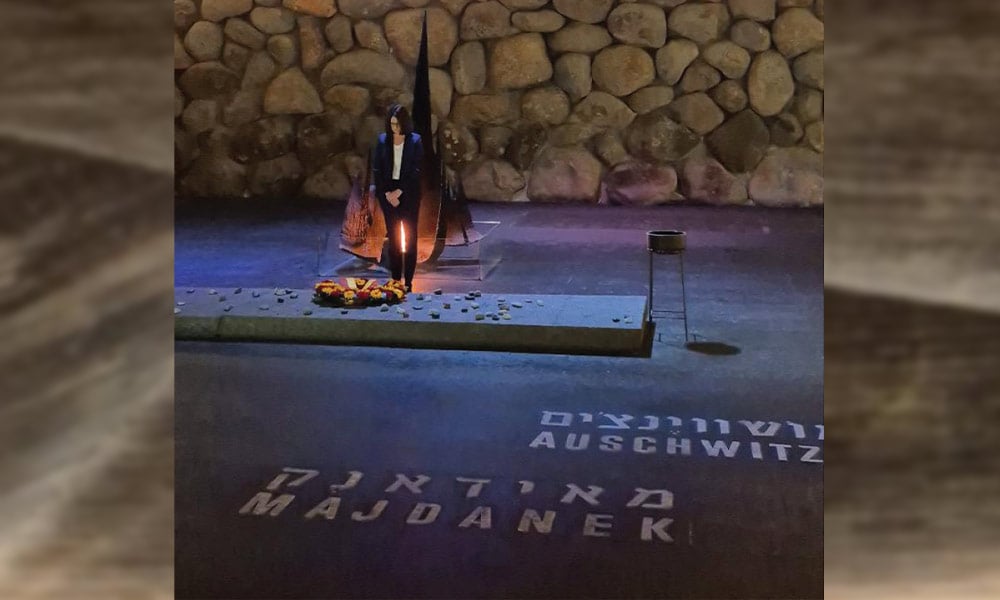
There is a moment from 2022 that stays with me. It was just shortly after Russia’s brutal invasion of Ukraine. A frail woman named Sonya, weighing barely 66 pounds, arrived on a stretcher at a senior living facility in Berlin’s Marzahn district. She had been evacuated from the war zone near Kyiv by the Jewish Claims Conference and the American Joint Distribution Committee. It was not her first evacuation. In 1941, as a two-year-old, she had fled the Wehrmacht and the Einsatzgruppen. Now, eight decades later, she was seeking refuge—of all places—in Germany.
That Sonya and nearly a hundred other Holocaust survivors made that choice is one of the most historic statements ever delivered on a country’s transformation. It is also a reminder of why the work this office does—sustaining trust, building partnerships, fighting hatred—is not diplomatic protocol. It is a moral obligation at the heart of Germany’s foreign policy.
A Foreign Policy Rooted in Historical Responsibility
Germany is conducting foreign policy unlike any other country. Its engagement with the Jewish world is not one file among many—it is structural. The acknowledgment of German responsibility for the Holocaust, institutionalized in the 1952 Luxembourg Agreement with Israel and the Claims Conference, was not merely a postwar settlement. It was the founding act of a foreign-policy culture built on accountability rather than denial.
That culture expresses itself in concrete institutional terms. Within the Federal Foreign Office, the Special Representative for Relations with Jewish Organizations, Issues Relating to Antisemitism, International Sinti and Roma Affairs, and Holocaust Remembrance has a mandate that is simultaneously diplomatic, educational, and moral: engaging Jewish communities worldwide, coordinating within European and multilateral frameworks, supporting Holocaust remembrance—and fighting antisemitism worldwide as a threat to liberal democratic order.
This work is complemented domestically by the role of the Federal Government Commissioner for Jewish Life in Germany and the Fight against Antisemitism, currently held by Dr. Felix Klein. Where the Commissioner focuses on Germany’s internal dimension, the Special Representative operates internationally—a division of labor reflecting a shared conviction: antisemitism, like all forms of organized hatred, does not stop at national borders.
What distinguishes Germany’s approach is not only commitment but architecture. The German government has built structures—within government, across agencies, and in partnership with civil society—that enable us to respond to antisemitism in a proactive, systematic, and coordinated way. That institutional readiness itself lends credibility to our foreign policy.
The Transatlantic Dimension
The relationship with American Jewish organizations sits at the center of this diplomatic landscape. The American Jewish Committee (AJC) was the first major international Jewish organization to engage with the Federal Republic of Germany after World War II—a decision of extraordinary moral weight, grounded in the belief that the surest way to defeat fascism was to strengthen democracy in Germany. The AJC’s Berlin office, the Lawrence and Lee Ramer Institute for German-Jewish Relations, remains one of the most vital bridges between the American Jewish community and the German state. Through leadership exchanges, high-level policy dialogues, and media engagement, it keeps German and European commitments to Jewish life and Israel’s security credible in Washington and New York.
Fostering close ties with other Jewish organizations, some with German roots, such as B’nai B’rith, which was founded almost 200 years ago by German Jews who have immigrated to the United States, or the Leo Baeck Institute in New York, with which we maintain a long-standing cooperation, also strengthens exchange and understanding.
The Claims Conference, headquartered in New York, is the other indispensable American partner to the Special Representative. Annual negotiations between the German government and the Claims Conference determine compensation and restitution for Holocaust survivors worldwide. They are not ceremonial conversations but real support: home care, medical assistance, and counseling for an aging survivor population. German-negotiated funds sustain the network of social welfare agencies across the former Soviet Union—ones that cared for survivors like Sonya before Russia’s invasion forced their evacuation westward.
The German-U.S. dialogue on Holocaust issues—conducted between the State Department and the Federal Foreign Office, with input from the U.S. Holocaust Memorial Museum and the German Foundation Memorial to the Murdered Jews of Europe—is another pillar of this work. Together, our two governments have developed tools for Holocaust education, strategies to counter denial and distortion, and training programs for security officials, including Holocaust history in the curriculum at the George C. Marshall European Center for Security Studies, which reaches military and civilian personnel from more than 30 countries.
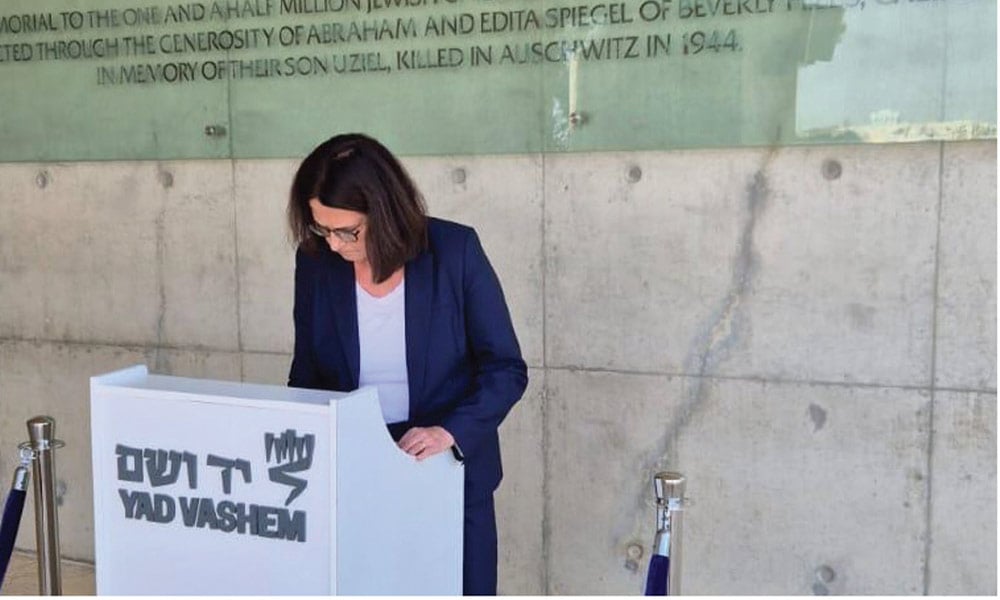
Courtesy German Foreign Service.
October 7 and the Fracturing of a Postwar Assumption
On October 7, 2023, Hamas launched the deadliest attack on Jews since the Holocaust: more than 1,200 people murdered, hundreds taken hostage. From a foreign-policy perspective, the attack was not only an atrocity against Israel, it was a seismic event in the global landscape of antisemitism—one whose aftershocks continue to reshape the environment in which this office operates.
What October 7 also brought into sharp relief was the breadth and diversity of antisemitism today. Israel-related antisemitism—hostility toward Jews expressed through the demonization, delegitimization, or double standard applied to the Jewish state—has proven not to be the province of any single milieu. It is present across the far right, in parts of the left, in some Muslim communities, and also somewhat in the mainstream of society. This is not a fringe phenomenon. It is a widespread challenge that requires responses calibrated to its many forms.
October 7 shattered the comfortable assumption that antisemitism was a fading relic of the past, receding as survivors aged and democratic norms consolidated. Instead, it revealed antisemitism to be a living, adaptive force—amplified by social media and capable of erupting with startling speed in societies that believed themselves to be inoculated against it. For Germany, this has meant a significant recalibration: The domestic and global fight against antisemitism is no longer a matter of historical remembrance alone. It is a present-day security and democracy issue.
Germany has responded by deepening collaboration with international partners on monitoring, legal frameworks, and public diplomacy. We are co-funding the development of the European Network on Monitoring Antisemitism, producing transnationally comparable data as a first pilot project across Germany, Austria, and Poland. We supported the OSCE’s Turning Words into Action program, alongside the United States and Canada. And we have worked to ensure that the International Holocaust Remembrance Alliance’s working definition of antisemitism—which Germany has formally adopted—becomes a common reference point for governments navigating the post-October 7 landscape.
Multilateral Engagement: International Holocaust Remembrance Alliance and Global Cooperation
Germany was among the founding members of the International Holocaust Remembrance Alliance (IHRA) in 1998. The IHRA represents the most sustained attempt to institutionalize cooperation on Holocaust remembrance and antisemitism at the intergovernmental level, and Germany has been actively supporting this international institution from the beginning, notably through the Global Task Force Against Holocaust Distortion, during the German chairmanship of the IHRA five years ago.
My office plays an active role in implementing Germany’s policy against antisemitism and in support of Jewish life across Europe—including by implementing the EU Strategy on Combating Antisemitism and Fostering Jewish Life and through foreign policy. This includes funding international projects to sustain the memory of the Shoah, support Jewish cultural life globally, and develop concrete tools for governments facing rising hatred. In July 2024, Germany endorsed the Global Guidelines for Countering Antisemitism, a landmark framework launched in Buenos Aires and subsequently embraced by dozens of states and multilateral organizations. The Guidelines call on governments to denounce antisemitism swiftly and without politization, to adopt national action plans, and to build coalitions across borders—principles that align directly with Germany’s own approach.
It Is About Education
Holocaust education has long been a cornerstone of Germany’s civic culture. It is also a foreign policy instrument—a way of projecting credibility, training international partners, and sustaining memory across generations.
The German school curriculum mandates Holocaust education from the eighth or ninth grade, embedded not only in history but in literature, ethics, religion, and civic education. German diplomatic missions extend this culture internationally. To this end, all the German states and other institutions cooperate with Yad Vashem. The underlying philosophy matters. It is not enough to convey facts and statistics. What matters is giving a face to all the Jews who have been persecuted and murdered—entering their biographical worlds before persecution, not only during it. This means building empathy across time, not merely assembling evidence of the atrocity. It also means confronting the question Elie Wiesel posed at Buchenwald in 2009, in reference to Cambodia, Rwanda, Darfur, and Bosnia: Has the world learned its lesson? The honest answer, in the current climate, must be: not yet. But learning remains the task.
The Paradox and the Promise
Stuart Eizenstat, longtime U.S. Special Adviser on Holocaust Issues, described the evacuation of survivors like Sonya to Germany as a multiple paradox of history. Survivors who once fled the Wehrmacht, some later liberated by the Red Army, now found themselves fleeing their former protectors—and seeking safety in the country that once had persecuted them.
That Sonya came to Germany, and found comfort and care there, is not a cause for self-congratulation. It is a responsibility. Germany’s engagement with Jewish communities worldwide—through compensation negotia-tions, educational programs, diplomatic partnerships, multilateral frameworks, and institutional funding—rests on an understanding that remembrance is not a completed project. It is an ongoing practice, requiring active maintenance, especially in an era when antisemitism is surging, when the last survivors are leaving us, and when democratic societies face the test of whether they can hold onto the commitments they made in the rubble of 1945.
My work as the Special Representative—maintaining relationships with the AJC, the Claims Conference, and the U.S. Holocaust Memorial Museum; supporting international frameworks; funding projects across the globe that keep the memory of the Shoah alive and the fight against contemporary Jew hatred active—proceeds from a simple premise: Germany’s historical responsibility is not a burden to be managed. It is a commitment to be honored, generation after generation.
Christina Beinhoff is the Special Representative of the Federal Foreign Office for Relations with Jewish Organisations, Issues Relating to Antisemitism, International Sinti and Roma Affairs, and Holocaust Remembrance; Director-General of the Federal Foreign Office for Culture and Society
Opening image: Ambassador Beinhoff pays her respects at Yad Vashem to those murdered in the Shoah. Courtesy German Foreign Service.
The post Sponsored Content | German Diplomacy: No Future Without a Culture of Remembrance appeared first on Moment Magazine.