The Unraveling: How Reality Caught Up With The Cult Of Caitlin Clark
Caitiin Clark’s public unmasking leaves the WNBA in a slow-motion Milli Vanilli moment, exposing the unearned currency of its manufactured basketball star.
 Black News

Zora Neale Hurston once wrote, “There are years that ask questions, and years that answer.” For Indiana Fever guard Caitlin Clark, her fervently loyal fans, and the WNBA leadership that prematurely crowned her the face of its league, this year is shaping up to be one of those years that answers.
In Clark’s case, the question for many WNBA aficionados has not been whether she’s a good player. Bad basketball players don’t make it to the WNBA. The question has always been whether she has the work ethic, skill, temperament, and staying power to become a champion and one of the greatest women’s professional basketball players.
For seven years, spanning her college career and into the WNBA, Caitlin Clark has been the subject of a carefully constructed mythos framing her as the greatest women’s basketball player of all time without giving her a chance to earn it.
This media spectacle – built by the league, elevated by media outlets, and amplified and fiercely protected by her loyal fanbase – has been reinforced by major brand deals and seemingly unlimited league resources positioning her as the singular face of women’s basketball.
Increasingly selective highlight reels have captured her volume scoring and elite passing while purposely rendering her defensive errors, temper tantrums, flopping, and decisionmaking failures invisible by conveniently leaving them on the cutting room floor.
This season, it’s nearly impossible to watch a WNBA broadcast without being force fed multiple ads that feature Clark. No matter who the Fever are playing, on-air commentators spend the bulk of their time focusing narrowly on Clark even when her teammates and peers are outperforming her.
Now with the third year of her professional career underway, formidable cracks are starting to form. Faced with elite defenses from competitors that exposed her weaknesses, Clark’s latest performances have laid bare her biggest vulnerability; an indifferent and indignant attitude toward shifting her strategy.
Previously, her high-flash logo range style of play made her incredibly easy to package into highly entertaining bite sized clips tailored for incurious fans with short attention spans.
Last week, her petulant temper tantrums combined with poor execution on offense and defense played out in front of massive national tv audiences, causing that curated veneer to suddenly collapse. It resembled a slow-motion Milli Vanilli moment for the WNBA. A sudden public glitch in the matrix emerged that exposed the chasm between the league’s manufactured illusion of who they desperately need Clark to be and the raw, unedited reality of the overrated talent she is.
This unmasking drew rare but sustained critiques from WNBA fans and the very national media outlets that had long protected and reinforced the untouchable facade they dutifully built around her.
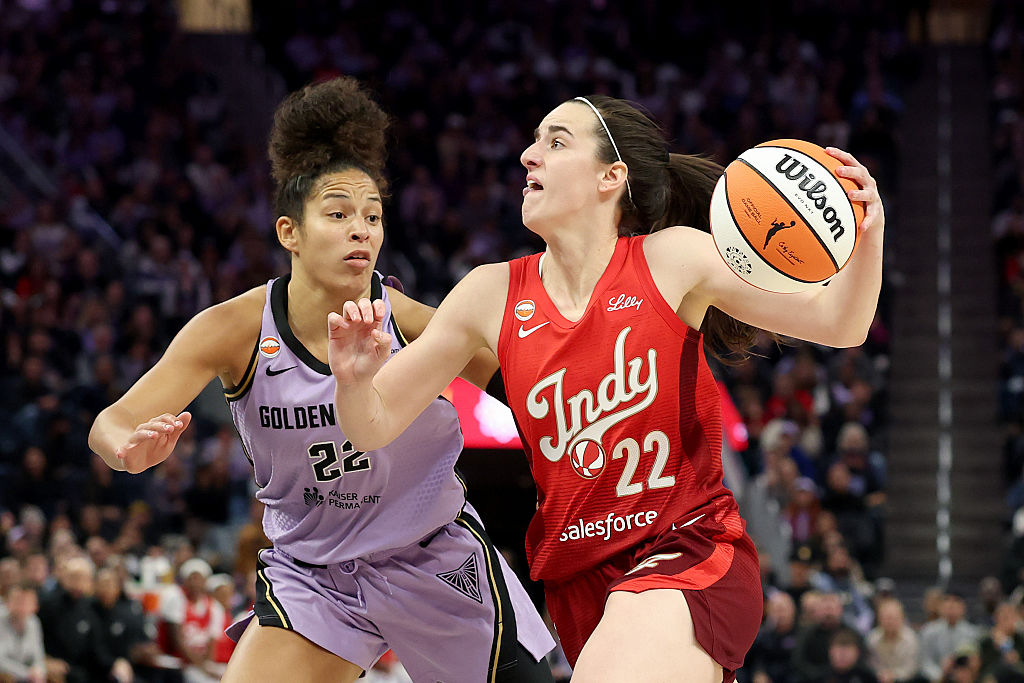
After the game against the Golden State Valkyries, reporter Nancy Armour wrote a biting column for USA Today hinting that the honeymoon period for Clark’s fanbase appeared to be over. Armour’s headline described Clark as “electric and exhausting – sometimes in the same quarter.” The piece itself cited Clark’s “histrionics over calls and the disrespect toward the refs.”
During the game, Clark exaggerated being fouled and flopped in a feeble attempt to elicit foul calls from the referees. Armour called that out, too, saying flopping was one of Clark’s popular go tos, but her acting was so bad that “even a C-list actor would find [her flops] cringey.”
Valkyries’ fans pulled no punches. They booed Clark throughout the game.
In the Saturday night marquee matchup between the Indiana Fever and the Portland Fire, the Fire held Clark to just 6 points. She made just one shot from the field and four points from the free throw line. The Fire went on to win the game by 16 points.
Analysts and basketball aficionados agree that Clark’s scoring slump stems from opponents adjusting to exploit her defensive weaknesses. This season, Clark has faced a league-high 42 isolation plays, more than double the 19 of the next-closest player, Olivia Miles.
For many die-hard women’s basketball fans, especially Black fans, there has been no honeymoon period with Caitlin Clark. The recent response to Clark’s shortcomings has been a vindication. We never bought into the foundational premise that she had the skill or talent to be crowned as the face of the league.
What Black women have recognized in her from the very beginning is something we encounter with glaring regularity: white mediocrity moving through spaces built by Black excellence, receiving advancement and protection as a right for just existing, rather than something that is earned through excellent performance.
Research on workplace dynamics clearly shows this pattern. When evaluating leadership potential, observers perceive white people as more effective than their non-white peers because whiteness aligns with the prototype of competence and leadership.
Clark’s glaring defensive flaws and high rate of turnovers, anchored by her circus-style hero ball, make her an unlikely centerpiece for a championship team. Yet, despite falling short of the WNBA’s lofty expectations, Clark has built a multimillion-dollar empire supported by a fanbase captivated more by her white entitlement than a genuine love of the game. For these fans, Clark is a living symbol that whiteness remains a sufficient currency even when individual performance fails to justify the reward.
Clark’s fanbase is drawn to her entitlement, weaponized through constant grievances and a blatant disrespect for Black players designed to mask her athletic shortcomings. She represents a symbol of unyielding whiteness that doesn’t have to bend, apologize, or defer to Black women’s excellence.
Clark has behaved poorly during games and is often rewarded with protection and given the benefit of the doubt. When she’s made poor decisions on the court or missteps in public statements, they are framed as learning moments for a young player. When she shows a lack of effort or grit, it is twisted into a lack of confidence in her team, their abilities, or the fault of bad coaching.
Journalists criticizing Clark face aggressive pushback from her uncritical media allies and hostile fanbase. Cari Champion, who accused the league of “blatant favorism” toward the Fever guard, openly likened the resulting fan harassment to a mob mentality.
Clark’s temper tantrums during games are often interpreted as a reflection of her passion for the game, and her entitlement is seen as her birthright for just showing up in a league where she is a racial minority. If she gets cooked on defense or has a terrible shooting night as she did on Saturday, the immediate narrative is that the refs are out to get her, her teammates are failing her, or the rest of the league (and any W fan who dares to critique her) is jealous of her, unfairly targeting her, or racist.
Even Clarks’ coaches receive fan backlash. After a viral video showed Fever coach Stephanie White shouting at Clark during a timeout during Saturday’s game, fans positioned Clark as the victim and demanded White’s firing, even after both women downplayed the moment.
Clark’s on-court tantrums and negative body language have been a regular occurrence since college and high school. The behavior was so persistent that UConn coach Geno Auriemma famously passed on recruiting Clark to her dream school.
Former NFL quarterback Tim Tebow is a cautionary tale the WNBA should have studied before deciding to go all in on Clark. Like Clark, he was drafted into the pros following a legendary college career, instantly framed by the media as a transcendent, beloved star. But, there was a catch: Tebow lacked the skill set needed to be a championship contender. Once it became clear his play did not match the manufactured hype, he bounced from roster to roster, and the cultural phenomenon that had elevated him evaporated, his fanbase disappearing along with it.
Neither the Fever nor the WNBA has a strong incentive to hold Clark accountable. The massive mythos they’ve built around her has trapped them in golden handcuffs. Because the historic financial windfall and maintaining the surge in popularity is their first priority, they remain constrained by a player who may lack the temperament, skill, or work ethic to ever carry a team to a championship or live up to the hype the league created for her.
Many of the players that have been considered the true GOATS of women’s basketball – Lisa Leslia, Maya Moore, Sheryl Swoopes, Diana Taurasi, and A’ja Wilson– all won championships within their first four years of playing in the WNBA. Barring a drastic evolution in her on-court game it’s hard to see her joining that elite circle as a starter, rendering her GOAT billing nothing more than premature marketing.
By throwing their full weight behind a player who skates on white entitlement and openly disrespects her Black colleagues, the league has activated a fanbase invested in grievance rather than women’s basketball. This lucrative but temporary constituency relies entirely on a symbolic player.
Once Clark retires, many of her fans will leave unless there’s a replacement who carries that exact same entitlement and resentment toward Black excellence. The very entitlement that attracted them will justify their exit, making Clark an unsustainable anchor and unsound investment for the future growth of the league or for women’s basketball.
When this inevitable mass exodus happens, those fans will weaponize their departure the same way they did their arrival – using it as “proof” that Clark was the greatest to ever play, and that the league she singlehandedly built will now crumble without her, and them.
In truth, the biggest success story belongs to the WNBA, which successfully engineered the myth of an elite player who never truly existed. Because there are no DNA do overs with people, this manufactured empire has morphed into a house of cards. They’d be wise to start shifting their resources to players who represent the future of the league in temperament and ability.
This season, the Indiana Fever will become the first team in league history, and the only WNBA team this season, to have all 44 games broadcast on national tv. This unparalleled exposure gives the WNBA a golden opportunity to shift the spotlight to players like A’ja Wilson, Angel Reese, Raven Johson, Azzi Fudd, and Paige Bueckers, who possess the all-around talent, competitive fire, sportsmanship, and work ethic that Clark lacks.
The league has had the answer all along. Now, with the cracks in the cult of Caitlin Clark widening and her fanbase spiraling, the WNBA has to decide what kind of league it wants to be and what kind of players it wants its next generation of fans to look up to.
The first step? Confronting the reality that their great white hope has officially become the great white nope. For a league that bet its entire future on the wrong player, getting this next phase of the league’s growth right is crucial. The clock is ticking.
SEE ALSO:
Caitlin Clark Was On Stage With Country Music Singer Morgan Wallen
An Open Letter To Caitlin Clark From A Black Woman Who Loves The WNBA