Trinidad To Provide Ferry to Temporarily Move Goods Between Countries
CASTRIES, St. Lucia, CMC – Trinidad and Tobago is to provide a ferry temporarily to transport mainly cargo among several Caribbean Community (CARICOM) member states as the region accelerates work towards establishing an affordable intra-regional ferry service. St. Lucia’s Prime Minister Phillip J Pierre told a news conference following the 51st Caribbean Community (CARICOM) summit […]
 Black News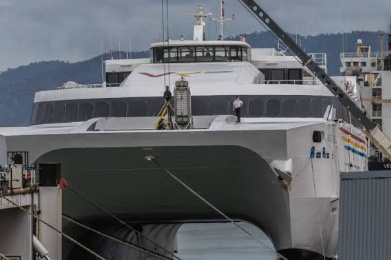
CASTRIES, St. Lucia, CMC – Trinidad and Tobago is to provide a ferry temporarily to transport mainly cargo among several Caribbean Community (CARICOM) member states as the region accelerates work towards establishing an affordable intra-regional ferry service.
St. Lucia’s Prime Minister Phillip J Pierre told a news conference following the 51st Caribbean Community (CARICOM) summit on Wednesday that the issue had been discussed during the four-day meeting.
“We also accelerated work towards establishing an affordable intra-regional ferry service that will improve travel, facilitate trade, strengthen food security, and make our community more connected,” he added.
Pierre, who is chairman of the 15-member grouping, reiterated that “we made further progress towards the free movement of CARICOM nationals with additional member states advancing towards full participation.
The CARICOM Single Market and Economy (CSME) allows for the free movement of goods, skills, labour and services across the region.
Barbados’ Prime Minister Mia Mottley said that as the region moves towards helping reduce the cost of living, as oil prices continue to fluctuate mainly due to conflicts in the Middle East, Trinidad and Tobago has indicated a willingness to use one of its ferries to help move cargo among some regional countries.
“This is a work in progress, and it also involves the fact that some ports in the southern Caribbean-and this is the proof of concept-will first be in the southern and Eastern Caribbean, but it requires us to also assess whatever infrastructural arrangements might be needed at the port, or whether ramps can be used,” said Mottley, who has responsibility fr the CSME in the regional quasi-cabinet.
She told reporters that Trinidad and Tobago’s Prime Minister Kamla Persad-Bissessar offered her colleagues one of five ferries pending the private sector’s efforts to obtain a vessel of its own within another year.
Mottley said that she would soon be holding talks with Persad-Bissessar, her St. Vincent and the Grenadines counterpart, Dr Godwin Friday “to see how best we can utilise one of the Trinidad vessels as a proof of concept while the private sector procures”.
Mottley said she would be working with colleague leaders to formulate treaty arrangements for mutual recognition of licenses and insurance to allow cargo vehicles to move from one member state to another.
She hoped that the regulations could be put in place within the next three months.
On Tuesday, the chief executive officer and technical director of the CARICOM Private Sector Organisation (CPSO) Secretariat, Dr Patrick Antoine, told the Caribbean Media Corporation (CMC) that within the last two weeks, both Prime Ministers Mottley and Friday “have had two engagements with the private sector” on the ferry situation, insisting “it is not pie in the sky.
“It is an arrangement which requires that the framework to move people, goods easily, including vehicles, be put in place. It is a framework which, unfortunately, the election cycles in the countries because of the sort of leadership which the heads intended would be provided by various ministers.”
He said that the meetings did not take place but remains confident that “we now have good, confident reason to believe that we will have these meetings in the short run”.
He said that three firms have actually prepared ”and in two instances have actually been able to identify financing subject to a number of these protocols to move people, to move goods, to move vehicles, to get the kind of facilitation required to make the service work effectively, put in place.
“I think that’s really where we are, and that’s where we want to be focused now,” Antoine said, telling CMC that he had been informed that Barbados and Jamaica are “going to be very busy with this matter within the next three months.
“The CPSO is supporting the process with the data and the analysis, and, of course, we are always connected to the private sector. We are connected to the three private sector players that will play a big role in actually introducing the service across the community, Antoine added.