Trouble the Water: The Birth of the Spirituals
Editor's Note: Santi Elijah Holley has been awarded one of two No Depression Reporting Fellowships to write four in-depth features on a topic deeply impacting roots music today. The Reporting Fellowships kick off with this historical piece introducing spirituals as a foundational form of American roots music.
 Black News


Editor's Note: Santi Elijah Holley has been awarded one of two No Depression Reporting Fellowships to write four in-depth features on a topic deeply impacting roots music today. The Reporting Fellowships kick off with this historical piece introducing spirituals as a foundational form of American roots music. Stay tuned for more from both No Depression Reporting Fellows into 2027.
On the night of Thursday, August 4, 1966, a large crowd of people gathered inside the New Friendship Missionary Baptist Church on the South Side of Chicago for a rally sponsored by the Chicago Freedom Movement. Launched the year before by the Southern Christian Leadership Conference (SCLC) and the Coordinating Council of Community Organizations (CCCO), the Chicago Freedom Movement hoped to carry the momentum of the civil rights movement — which had been thus far concentrated in the South — up north into Chicago, addressing issues particularly plaguing Black Americans in northern cities, such as segregated and substandard housing, and income and employment disparities. Using similar nonviolent tactics employed in southern campaigns, including rallies, marches, and boycotts, the Chicago Freedom Movement has been called “the most ambitious civil rights campaign in the Northern United States.”
The multiracial, though predominately Black, crowd inside New Friendship had come to hear speeches by Jesse Jackson and educator and activist Albert Raby, but they’d come especially to hear from the most prominent voice of the civil rights movement, Martin Luther King, Jr. Over the previous days, the marchers had been confronted by local, racist, White mobs, who attacked them with cherry bombs, bottles, and bricks, leading to over two dozen injuries. That night, King was tasked with reassuring his supporters to carry on their important work, despite the escalating acts of violence against them. The stakes couldn’t have been any higher.
King approached the pulpit, nearly obscured by a jumble of microphones and stands, and looked down at his notes. He seemed to hesitate for a moment, as though apprehensive about his ability to reassure the large, battered crowd before him. Just then, a voice rang out from the side of the stage: “Ohhh Joshua fit the battle of Jericho! Jericho! Jericho!”
All at once, the people inside the church rose to their feet and began clapping their hands and singing along: “Joshua fit the battle of Jericho, and the walls came tumblin’ down!”
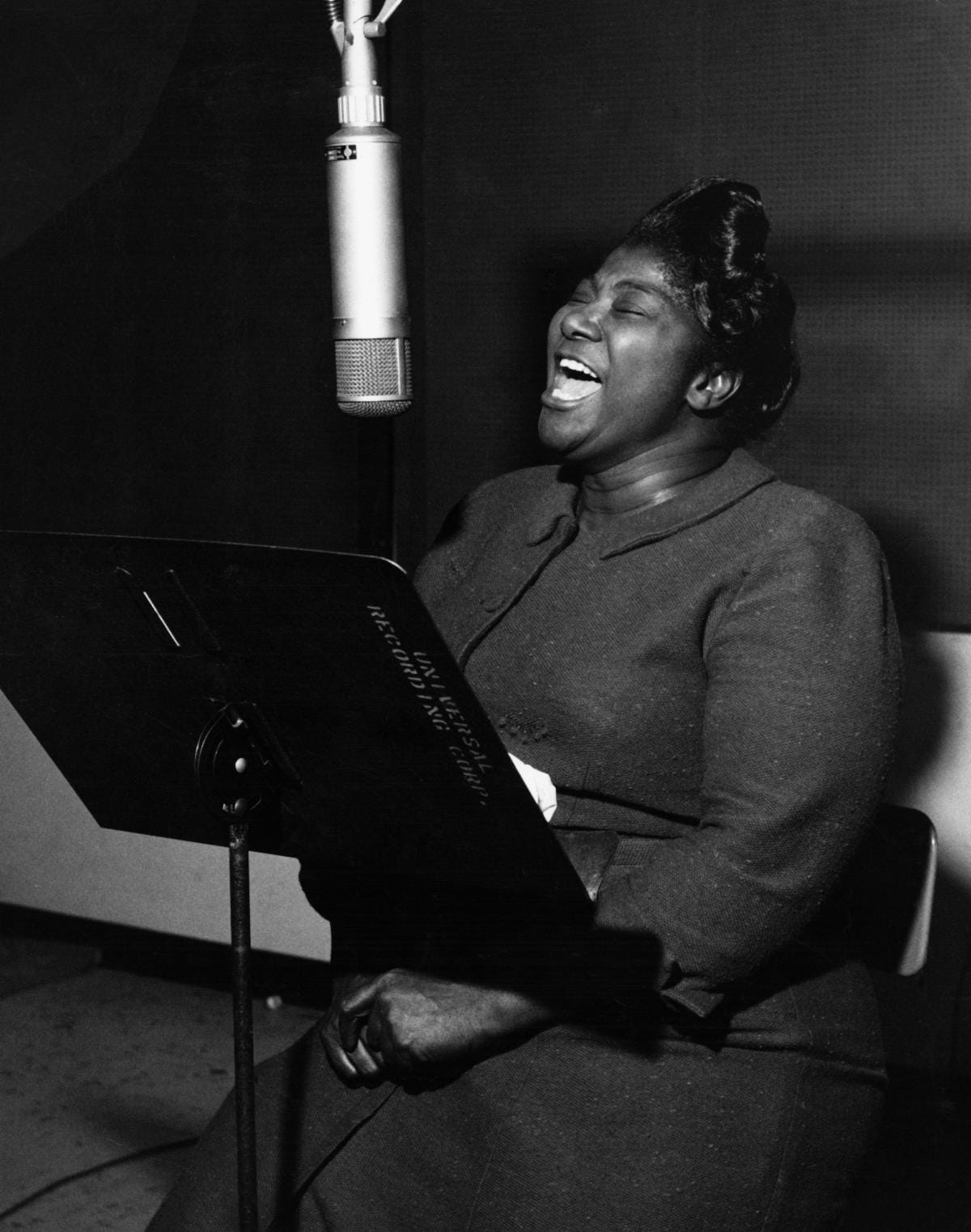
A small, subtle smile appeared on King’s face, and he gave a quick nod, glancing over to his left, where gospel singer Mahalia Jackson led the nearly 2,000 civil rights activists and supporters in the classic African American spiritual.
When the song ended, King appeared revitalized, recharged. He recognized that he had been assigned the role of the biblical Joshua, and Chicago (and wherever else racial segregation exists) was a brutal Jericho, whose walls will collapse only through the power of their shouts.
King then looked with confidence out at the audience. “I think I can say,” he began, “concerning this great gospel singer in our midst — our dear friend, my great friend Mahalia Jackson — that a voice like this comes only once in a millennium.”
Jackson’s seemingly spur-of-the moment decision to come to King’s aid by striking up the old familiar spiritual, was not the first time she’d used her powerful voice in the service of the freedom struggle. Hailed as the “Queen of Gospel,” Jackson had sung at numerous civil rights demonstrations and fundraisers for already a decade, beginning with the 1956 Montgomery bus boycott. For Jackson and many other Black Americans, gospel music wasn’t simply an entertaining musical performance, in praise of some abstract and distant God up in heaven, but a commentary on things happening in present that directly affected themselves and their neighbors. Joshua not only fought at Jericho; he continued to lead the fight in Birmingham, Selma, Memphis, Atlanta, Newark, Detroit, and Chicago. God didn’t only come to Daniel’s aid when he was thrown into the lions’ den; he would come to the aid of Black people suffering from racist discrimination and abuse.
Gospel music was a living soundtrack to the Civil Rights Movement, giving strength and encouragement to marchers as they faced White mob violence; to college students as they were dragged out of diners and lunch counters; and to men, women, and children brutalized by police batons, firehoses, and snarling dogs.
Jackson wasn’t the first singer to connect gospel music to the fight for civil rights and racial equality. She and the other gospel music stars of the day, including Clara Ward and The Staple Singers, were carrying on a centuries-long tradition of reinterpreting and reimagining biblical-era stories to speak out against modern injustices. From the moment that the first enslaved Africans were brought in chains to North America, Black men and women composed and sang religious songs about freedom, justice, and dissent. Black religious songs are America’s original songs of rebellion, accompanying meetings, rallies, marches, sit-ins, union organizing, and worker strikes — and they continue to inspire and inform protest music today.