UK asylum claims by Saint Lucian nationals rise alongside CIP expansion
An analysis of publicly available data related to Saint Lucia’s Citizenship by Investment Programme and asylum claims in the United Kingdom show a strong relationship in timing, while regional trends suggest the need for closer scrutiny Citizenship by investment (CIP) programmes allow foreign nationals to obtain citizenship in exchange for financial contributions to a country’s […] The article UK asylum claims by Saint Lucian nationals rise alongside CIP expansion is from St. Lucia Times.
 Black News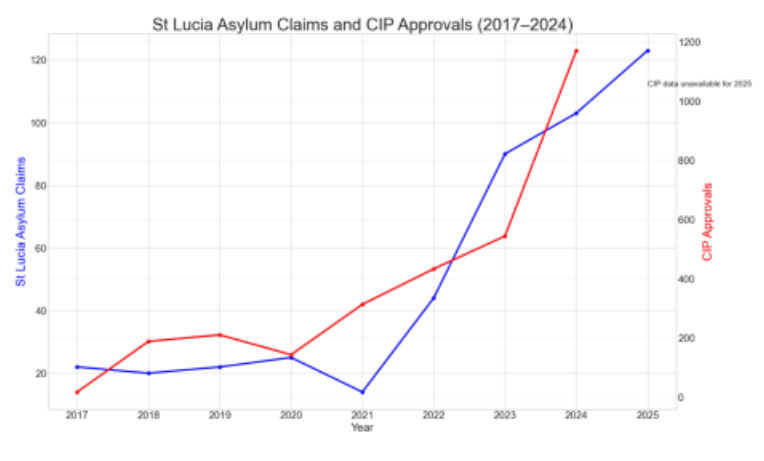
An analysis of publicly available data related to Saint Lucia’s Citizenship by Investment Programme and asylum claims in the United Kingdom show a strong relationship in timing, while regional trends suggest the need for closer scrutiny
Citizenship by investment (CIP) programmes allow foreign nationals to obtain citizenship in exchange for financial contributions to a country’s economy. Several Caribbean states operate such programmes, including Antigua and Barbuda, Dominica, Grenada, Saint Lucia, and St Kitts and Nevis. Applicants typically qualify through contributions to national development funds or investments in approved real estate projects. These programmes have attracted international attention because citizenship provides access to the mobility privileges attached to passports, including visa-free travel. Investor citizenship schemes have therefore been criticised for turning nationality into a market transaction in which states exchange citizenship for capital.
The commercialisation of citizenship has raised wider policy concerns. Critics argue that granting citizenship for economic reasons alone, without meaningful identity links or genuine ties to the country, can create distrust and tension between states. European policy discussions have similarly warned that visa-free travel arrangements may come under pressure when citizenship is granted in exchange for pre-determined payments or investments without a genuine link to the country issuing the passport. Such reviews have also noted that many successful applicants come from countries whose nationals normally require visas to enter Europe, and that applications may include multiple family members, meaning the number of passports issued can exceed the number of principal applications.
Recent developments in the United Kingdom have made these concerns more immediate in Saint Lucia’s case. In March 2026, the UK introduced a visa requirement for Saint Lucian nationals travelling as visitors. The policy cited migration pressures, noting that 360 Saint Lucian nationals claimed asylum in the UK between January 2022 and December 2025, a high figure relative to Saint Lucia’s population of roughly 180 000. It also pointed to rapid growth in Saint Lucia’s CIP programme, reporting 5 642 applications in 2023 and 2024 combined, representing a sharp increase in application volumes.
The UK policy statement further said that this expansion directly coincided with an increase in people using Saint Lucian passports to enter the UK and then either claim asylum or work illegally. While trends moving together do not by themselves prove causation, the overlap is significant enough to warrant closer examination. Against that background, this analysis examines Saint Lucia’s citizenship-by-investment programme, introduced in 2016, and considers
whether observable trends in CIP approvals correspond with changes in asylum claims made by Saint Lucian nationals in the United Kingdom.
Asylum claims made in the United Kingdom by Saint Lucian nationals rose sharply from 5 in 2010 to 123 in 2025. Over the same broad period, Saint Lucia’s Citizenship by Investment Programme (CIP), introduced in 2016, expanded rapidly, with approvals rising especially after 2021 and reaching more than 1 100 in 2024.
From 2017 to 2024, the overlap between the two trends became especially visible. Annual data plotted in the analysis show both CIP approvals and asylum claims moving upward in the later years of the period. The relationship was also statistically strong, with the report finding a Pearson correlation of 0.88 between CIP approvals and asylum claims.
Saint Lucia asylum claims in the United Kingdom and Citizenship by Investment approvals, 2017– 2024. CIP approval data for 2025 were not available at the time of analysis.
The strength and timing of this pattern make the relationship difficult to dismiss. The findings do not prove on their own that CIP expansion caused the increase in asylum claims, but they do indicate that the connection is substantial enough to merit serious attention. The issue is especially relevant because recent UK policy has itself pointed to the rapid expansion of Saint Lucia’s CIP programme and its overlap with increased use of Saint Lucian passports by people later detected claiming asylum or working illegally.
At the same time, Saint Lucia’s increase did not occur in complete isolation. Other Eastern Caribbean countries also recorded notable rises in asylum claims over the same long period. St Vincent and the Grenadines rose from 5 claims in 2010 to 92 in 2025, while Grenada rose from 2 to 78. Barbados, Dominica, Antigua, and St Kitts and Nevis also showed increases, though at lower levels.
That regional comparison adds important context, but it does not erase Saint Lucia’s specific pattern. Rather, it suggests that two things may be true at once: broader regional migration pressures may be affecting several Caribbean countries, and Saint Lucia’s own trajectory may still deserve separate attention because of how closely its rise in asylum claims tracks the expansion of CIP approvals.
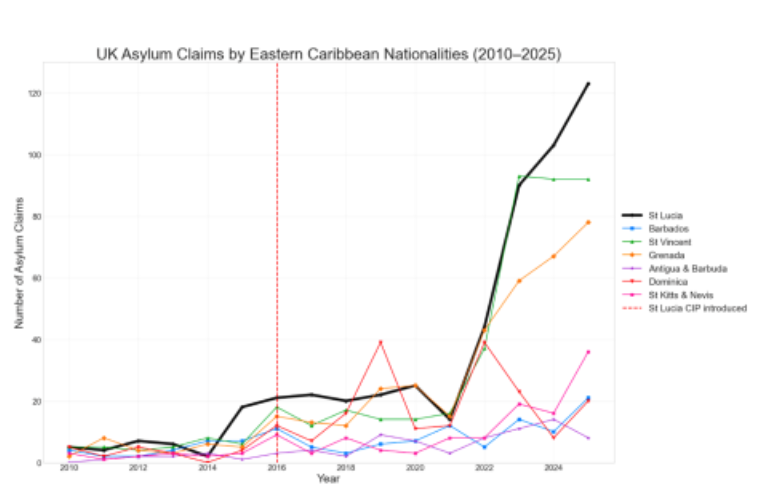
Trends in asylum claims made in the United Kingdom by selected Caribbean nationals, 2010– 2025.
The main limitation is that the asylum data identify claimants by nationality, not by place of birth or route to citizenship. This means the dataset cannot directly show whether those claiming asylum as Saint Lucian nationals obtained citizenship through the CIP programme. The report also notes that 2021 appears as an outlier, when asylum claims declined even as CIP approvals continued rising, likely because of pandemic-related disruption to travel and migration.
Even with those limitations, the findings point to more than a vague coincidence. They show a clear and substantial overlap between the expansion of Saint Lucia’s CIP programme and the rise in asylum claims by Saint Lucian nationals in the United Kingdom. The available data stop short of proving direct causation, but they do support the view that the link is important, plausible, and worthy of closer examination if more detailed migration and citizenship records become available.
Source: Analysis based on publicly available UK asylum statistics and Saint Lucia CIP approval data.
Arvanni Sonny is a senior at Arizona State University pursuing a Bachelor of Science in Data Science through the computer science pathway. Her work focuses on the intersection of computer science and data analytics, using data-driven approaches to uncover patterns, analyse trends, and contribute to more evidence-based discussions around complex policy issues.

The article UK asylum claims by Saint Lucian nationals rise alongside CIP expansion is from St. Lucia Times.