US courts Mali, Niger and Burkina Faso as Russia expands Sahel footprint
The United States is trying to rebuild ties with Mali, Niger and Burkina Faso as Russia expands its Africa Corps across the Sahel, raising the stakes in one of Africa’s most volatile but resource-rich regions.
 Black News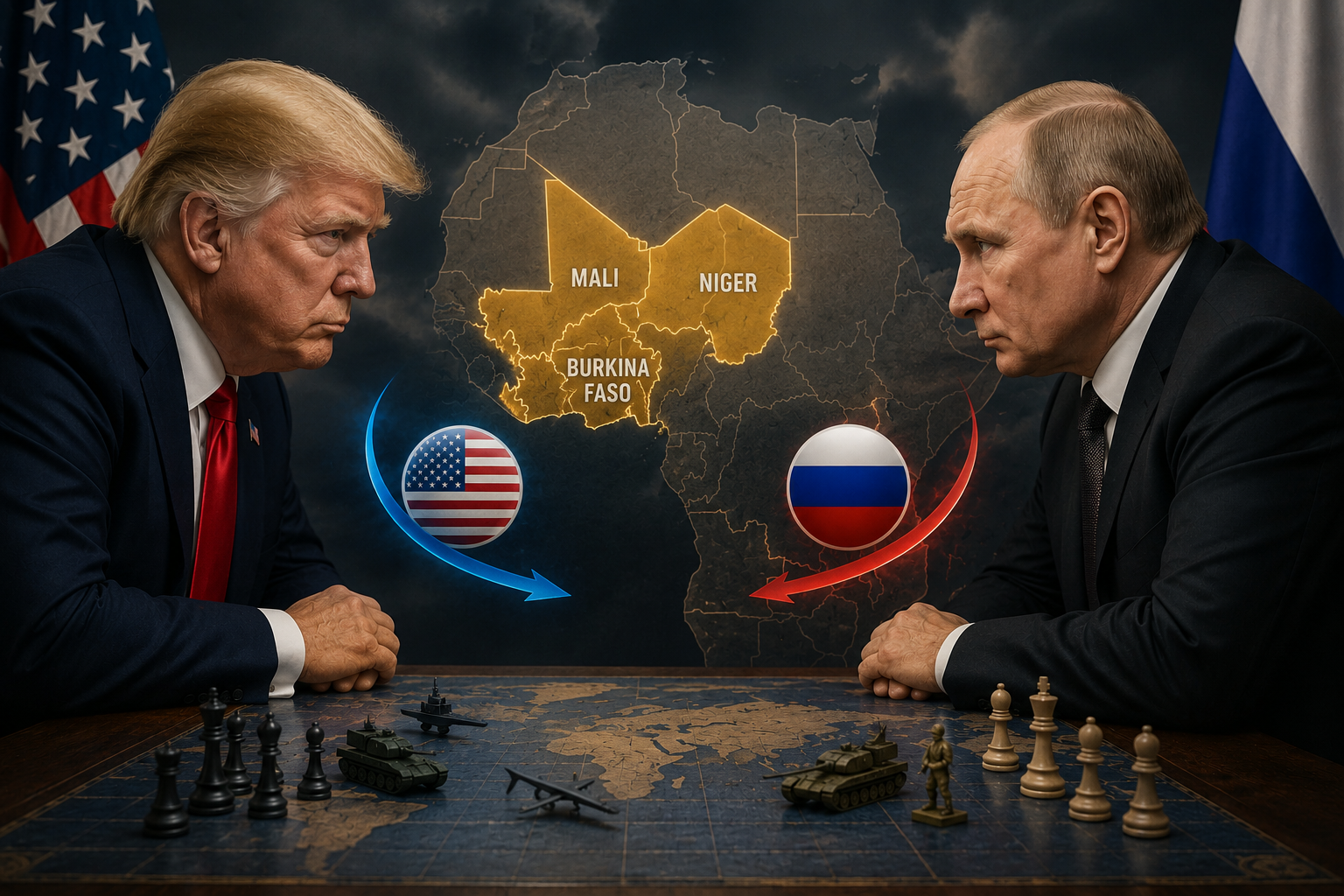

The United States is trying to rebuild ties with Mali, Niger and Burkina Faso as Russia expands its Africa Corps across the Sahel, raising the stakes in one of Africa’s most volatile but resource-rich regions.
- The US is seeking to rebuild ties with Mali, Niger and Burkina Faso as Russia deepens its military presence across the Sahel through Africa Corps.
- Washington is shifting from prioritising democratic reforms to focusing on security cooperation, counterterrorism and access to strategic minerals.
- The move reflects growing competition with Moscow for influence in one of Africa's most unstable yet resource-rich regions.
- For the junta-led Sahel states, the rivalry offers greater leverage to balance relations with global powers while advancing their own interests.
The shift marks a major change in Washington’s approach to the three junta-led countries, which have moved away from France, cut ties with several Western partners, and built a new regional bloc known as the Alliance of Sahel States.
For years, US policy in the region was shaped by pressure for democratic transition after coups in Mali, Burkina Faso and Niger between 2020 and 2023.
But under President Donald Trump, Washington is now placing more emphasis on security cooperation, counterterrorism and economic interests.
Nick Checker, a senior official at the US State Department’s Bureau of African Affairs, recently visited Bamako, where he met Mali’s Foreign Minister Abdoulaye Diop.
Ahead of the visit, the bureau said on X that the US wanted to “chart a new course” in relations with Mali and reaffirmed Washington’s respect for the country’s sovereignty.
It also said the US looked forward to consulting with other governments in the region, including Burkina Faso and Niger, on “shared security and economic interests.”
This shows that Washington is no longer treating the Sahel mainly as a democracy file. It is now seeing the region as a security, migration, minerals and influence battleground.
![Burkina Faso, Mali and Niger are partnering with Russia to develop the Sahel’s first shared telecommunications satellite, aiming to boost digital connectivity, security and regional economic integration. [Getty Images]](https://ocdn.eu/pulscms/MDA_/60ebbb56f3a15d9896f1b56db8fea169.png)
The US had in March neared a deal with Mali to resume intelligence operations, including aircraft and drone flights over Malian territory, to monitor jihadist groups linked to al-Qaeda.
The move followed Washington’s decision to lift sanctions on three senior Malian officials previously targeted over their links to Russia’s Wagner Group.
That would be a significant reversal for the US, which lost access to its drone base in Niger after the country’s 2023 coup and the subsequent collapse of security relations with the junta.
Mali, Burkina Faso and Niger have all turned more openly to Moscow since breaking with France and other Western partners. Russia has since repositioned its presence through Africa Corps, a state-controlled structure that has taken over much of Wagner’s role in the region.
The Associated Press reported that Wagner announced its withdrawal from Mali in 2025, but Russia’s Africa Corps remained in the country, signalling a shift from mercenary branding to a more direct Russian state-backed military presence.
Moscow has also pledged military support to the AES countries’ joint force, which was created to fight jihadist groups across the central Sahel.
Mali has been battling jihadist groups since 2012. The conflict has spread across borders into Niger and Burkina Faso, killing thousands, displacing millions and weakening state authority in large parts of the region.
AFP recently reported that at least 15 drivers were killed in an attack on a fuel tanker convoy in Mali.
The attack was linked to a bigger blockade by the al-Qaeda-linked Group for the Support of Islam and Muslims, known as JNIM, which has targeted supply routes and increased pressure on Mali’s economy.
“The United States sees how the jihadists are settling in the Sahel,” a diplomat at the US Embassy in Bamako told AFP on condition of anonymity.
A Malian diplomat also said that the US envoy had “come to make an offer of services to AES countries to see under what conditions the United States can get involved in the fight against jihadists in the Sahel.”
Russia is also using the worsening insecurity to present itself as a more reliable partner than the West.
After an attack on the airport in Niger’s capital, Niamey, in January, Russia said its forces had worked with Niger’s army to repel the assault.
“The African Corps of the Russian Defence Ministry and the Armed Forces of Niger jointly repelled the attack, neutralised about 20 terrorists and seized the attackers’ belongings and weapons,” Russia’s Foreign Ministry said in a statement.
![The head of head of Niger's military government General Abdourahamane Tiani (C), Malian Colonel Assimi Goita (3rd R) and Burkina Faso's Captain Ibrahim Traore (2nd R) arrive ahead of the Confederation of Sahel States (AES) summit in Niamey on July 6, 2024. [Photo by -/AFP via Getty Images]](https://ocdn.eu/pulscms/MDA_/423e6e36be06004a23484a1867a2685d.jpg)
Russia added that it “will continue to make a constructive contribution to strengthening regional security, including assistance aiming to boost the combat readiness of national armed forces, by training service personnel and law enforcement officers.”
Mali is a major gold producer and is becoming more important in lithium. Niger holds large uranium reserves, while Burkina Faso is one of West Africa’s biggest gold producers.
These resources are attracting more attention as global powers compete for access to minerals needed for energy, defence, technology and industrial supply chains.
But the US faces a difficult balancing act. Re-engaging the juntas may give Washington a way back into the Sahel, but it could also weaken its democracy and human rights message.
Massad Boulos, Trump’s senior adviser for Arab and African affairs, told Le Monde in October that democracy is “appreciated,” but is no longer a condition for relations.
That position has drawn criticism. “Unfortunately, it is not democracy or human rights that matter to Donald Trump’s administration,” Reed Brody, one of the lawyers for Niger’s deposed president Mohamed Bazoum, told DW.
Bazoum has remained in detention since he was overthrown in Niger’s 2023 coup.
“It is clear that the Americans are not concerned about democracy in the Sahel right now,” Ulf Laessing, director of the Sahel programme at the Konrad Adenauer Foundation, told DW. “They have adopted a pragmatic stance.”
For the AES governments, this shift gives them more room to bargain. They can engage Russia, open talks with the US, reject French pressure, and still present themselves at home as defenders of sovereignty.
France has withdrawn militarily from Mali, Burkina Faso and Niger, while Burkina Faso recently cut diplomatic ties with Paris. Other European countries remain involved through development programmes, but their political influence has weakened sharply.
Russia is offering security support. The US is testing a pragmatic reset. Europe is losing leverage. And Mali, Niger and Burkina Faso are using the rivalry to expand their options.