Watershedding not cool
It is a really bad idea for a number of reasons. It can damage infrastructure, result in inequitable access to water and contamination of the water supply
 Black News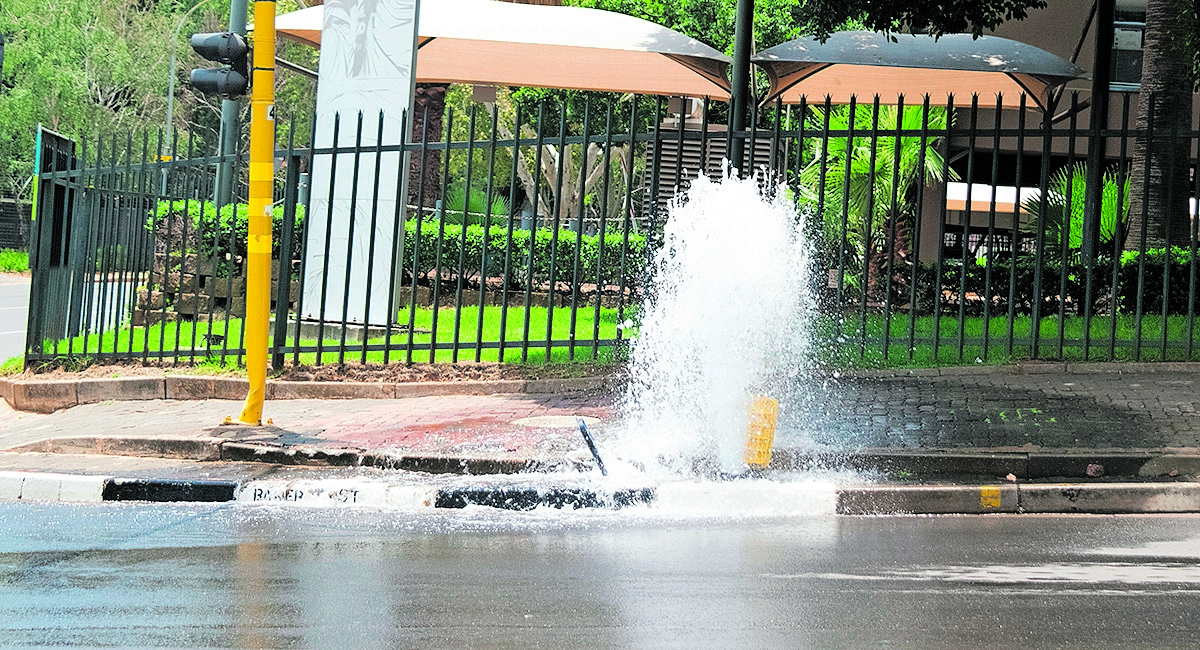


There has been an increasing amount of commentary on the inevitability of “watershedding”, as if this is as easy to implement as loadshedding for electricity.
Hot take: it isn’t.
While loadshedding causes numerous problems such as reducing the viability of businesses, damaging appliances if there is a surge when power turns on and loss of perishables if fridges and freezers are off too long, the issues with turning water on and off are more complicated and harder to manage.
In simple terms, if you turn electricity off, it goes off at every point of use simultaneously. When it turns on, it turns on for everyone – give or take a few complications such as power surges. Water is different. Water is incompressible so if pipes are full and pressure is applied, in an idealised situation, pressure should spread evenly. However, it is not that simple as there is variable friction in the pipes, there can be air pockets and parts of the system may drain out more than others.
A water system is also fragile under repeated closure and opening.
One example of the risks of shutting off a water system is causing more leaks. A rapid drop in pressure can cause water hammer, a shockwave that can be damaging. You can experience this on a small scale at home when you close a tap too fast and feel or even hear a pounding in the pipes. At the level of large-scale reticulation, water hammer can be very destructive.
Another big problem with leaks is that a pressurised system stays relatively clean because the pressure pushes away from a leak. Take the pressure away and contamination has no barrier to making its way into the system. It is even possible that the effect of draining the system causes negative pressure (suction), which sucks contamination in through the leak in the water pipe. Dragging in environmental contamination defeats the object of water purification, which removes not only solid dirt but sanitises the water with chlorine gas. While the residual chlorine in the pipes should remove any small quantity of bacteria, it is not sufficient to sanitise a large-scale ingress of contamination. This becomes even worse when the water leak is proximal to a sewer leak.
As seen at the consumer level, this leak problem manifests as obviously dirty water that is unfit to drink or wash or – worse – water that looks clean but is contaminated with harmful bacteria.
Another big issue with turning off a large part of a water system is that it drains and refills unevenly, meaning that some areas have water for a large part of the supposed outage (maybe even the entire period) and others are without water for longer than the planned outage. If watershedding is on a high-frequency schedule such as one day on, one day off, some areas end up getting no water at all or only a trickle.
Besides bacteria, other harmful environmental contaminants could find their way in through a leak. That is another whole story; I focus here on bacteria since they form part of routine testing.
The two types of bacteria routinely tested for are coliforms and E. coli (full name: Escherichia coli). Why these two specifically? They are indicators.
Bacterial testing is usually done by placing a sample on an agar layer on a petri dish (a plastic disc with raised edges). Agar is a gel derived from seaweed and it is treated with a growth medium to feed bacteria and can be designed to change colour when specific bacteria multiply. The same petri dish can be used to test for both coliforms and E. coli; the two come up as different colours. Each dot that appears on a test corresponds to growth of a large number of bacteria and is called a colony forming unit (CFU). Counting CFUs provides an indication of the level of contamination. The water testing standard in South Africa is that up to 10 CFUs of coliforms is acceptable; no E. coli should be found.
Coliforms are a diverse class of bacteria and are found widely in nature, including in untreated water. Testing for coliforms is an indicator of whether chlorination has worked as designed and also tests for whether contamination has entered the pipes after treatment. Most coliforms are harmless; only a small fraction can call illness. The purpose of testing for them is to indicate whether other possibly more harmful bacteria have escaped chlorination.
E. coli is a type of coliform so why test for it separately? E. coli is present in the gut of all warm-blooded animals including humans. Mostly, it is beneficial, playing a crucial role in digestion. A few strains of E. coli are harmful and can cause illness – sometimes severe illness. However, this is not the primary reason for testing for E. coli. Because it is found in all guts of warm-blooded animals, it is an indicator of faecal contamination – fancy terminology for shit in the water.
Faecal contamination is bad news because of many other harmful bacteria that can be spread this way including cholera, typhoid and hepatitis A. This is why there is no permissible safe level of E. coli in a water sample. It’s not the E. coli that is the biggest cause for concern but what may be there that is not included in the test. Testing for E. coli is sufficient in general because as soon as you know there is faecal contamination, the risk of other waterborne diseases escalates. If there is no measurable E. coli, the risk of such diseases is acceptably low.
So back to watershedding: this is a really bad idea for a number of reasons. It can damage infrastructure, result in inequitable access to water and contamination of the water supply. The real issue here is failure of a key component of municipal infrastructure management, meter reading. If meters were read regularly, penalty charges could be imposed for excessive consumption, particularly at times of shortage when water restrictions are in effect. Instead, with widespread lack of reading, collective punishment of the entire community is used by turning off water for everyone.
The government keeps talking about Back to Basics. What is needed is not talk but action. Where meter reading has failed, this should be remedied. And no, smart meters are not the answer.
Philip Machanick is an emeritus associate professor of Computer Science at Rhodes University and a PR councillor for Makana Citizens Front