Balaka youth reap from agriculture
If you were to ask Chipiliro Baluwa, aged 27, about agriculture, he would tell you: Farming is not just an activity for the tired and retired. The youth have to be into it. It just doesn’t come out of the blues for him. That kind of knowledge has established him as one of the motorcycle … The post Balaka youth reap from agriculture appeared first on Nation Online.
 Black News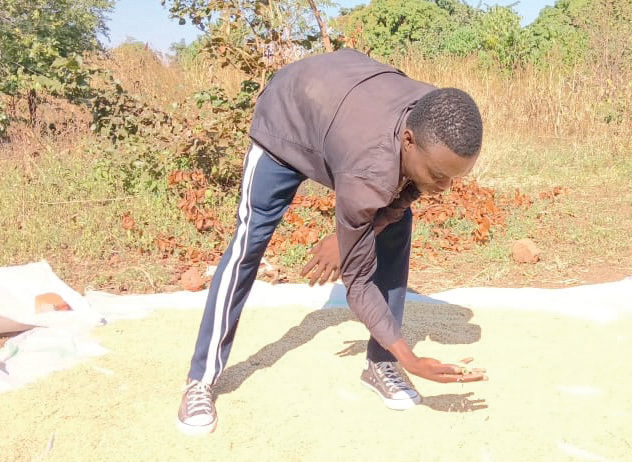
If you were to ask Chipiliro Baluwa, aged 27, about agriculture, he would tell you: Farming is not just an activity for the tired and retired. The youth have to be into it.
It just doesn’t come out of the blues for him. That kind of knowledge has established him as one of the motorcycle taxi operators in Balaka.
Growing cotton, soya beans, pigeon peas and maize, his life changed last year when he bought a motorbike to beef up his profits.
“We were trained to appreciate that agriculture is more than tilling the soils and harvesting. I invested in agriculture, and here I am, from selling groundnuts, people today know me as a kabaza operator from the proceeds of farming,” says the 27-year-old.
He owes it all to a connection with the National Smallholder Association of Malawi (Nasfam), who bought his 27 bags of groundnuts.
“I can say more. I have learned to take farming as an enterprise. I just have to calculate my marginal returns and here I am, forging ahead,” he says from a pigeon pea garden in T/A Nsamala’s area in Balaka.
Baluwa said he was also trained by Rumark in agro-dealership. “I have a certificate from that training. The plan is that I should grow my business further and venture into agro-dealership,” he said.
Balaka district youth network chairperson Paul Naphwiyo attributes the wholesome farmer that Baluwa has become as a result of the various organisations implementing the Youth Entrepreneurship for the Future of Agriculture (YEFFA) project, which is funded by Agra.
He observed that while the National Youth Council of Malawi (NYCOM) trains the youth in soft skills in agriculture and business, Rumark offers training in agro-dealership while Nasfam provides the market.
“We have a network of 14 youth clubs in over 50 group village heads within the district. They learn business management and proper farming methods. They have to know there is more than just growing maize, pigeon peas and groundnuts. I wish the government would open more loans for the youth to grow even more,” said Naphwiyo.
As part of the project, NYCOM trained 45 youth leaders (21 females and 24 males) in Balaka from T/As Mpoto, Nsamala, Nkaya, Chakanza, Phimbi, Mgomwa, Mbera, Sawali, Makwinja, Kapalamula, Kalembo, Amidu, Chimatilo and Balaka Town.
According to Naphwiyo, the training targetted youths who are holders of the Malawi Schools Certificate of Education and have smartphones. “They need to record data and show commitment to train others,” he added.
One beneficiary, 27 year-old Happy Austin who grows groundnuts in Kapalamula Village, said keeping records has helped him calculate marginal returns.
“I am now able to calculate profits by analysing what I put into farming and what I get after selling,” he said.
The training is focused on mindset change, soft skills, and entrepreneurship, giving participants hands-on skills in problem solving, decision making, communication, and identifying viable agribusiness opportunities. Similar sessions have also taken place in Salima and Nkhotakota.
Like Baluwa, one of the beneficiaries is Faith Dindani, aged 21. Hailing from Chimbalanga Village in T/A Nsamala’s area in Balaka. Being young, her mind changed late last year.
“Normally, we depended on organic fertilizers. But then, we learned how to cultivate with inorganic fertilizers and here I am: On a field I used to reap three bags of maize, now I have 35 since I learned how to make mbeya fertilizer,” beams the girl, who also grows cotton, groundnuts and pigeon peas.
Going down the village, less than a kilometre, you find 28-year-old Kondwani Mandalasi, in a rice field where he has harvested eight bags. He will tell you one thing: Avoid post-harvest losses, at all cost.
“I have learned how to avoid post-harvest losses, not only for rice, but also for soya beans and millet which I also grow. I store my produce in Pics Bags which allows me to sell at higher prices during the lean period,” he said.
Mandalasi cited rice, which is fetching K750 per kilogramme, will shoot to over K1 500 in December when he plans to sell.
From Kapalamula Village, youths like 33-year-old Yvonne Matope and Evelyn Kachinangwa are trained under clubs like Miyoka. In separate interviews, the two say the training offered new insights on how they view agriculture.
“I now understand the importance of value addition. I no longer sell raw soya beans. I process it into cooking oil. Now I am also able to make business plans which I am sure will help me grow the business until I get certification from the Malawi Bureau of Standards,” Matope said.
Under the project, which will run up to 2027 from 2024, the youth leaders will now mobilise and mentor their peers in their communities on life skills, business idea development, planning, and entrepreneurship.
To ensure quality and expand reach, NYCOM is conducting spot checks alongside district youth offices in Ntcheu, Ntchisi, Dowa, Mchinji and Kasungu, observing sessions and supporting youth leaders to strengthen delivery.
The project is also linking youth to practical agricultural experiences through demonstrations on community demo plots supported by agricultural advisors. So far, outreach has reached 1 247 youths in Ntcheu and 678 across Dowa (170), Ntchisi (443) and Mchinji (65), bringing the total to over 1 900 young people equipped with skills and opportunities to transform their communities.
According to NYCOM’s Felix Chiyenda, catalysing improved youth response and participation in agriculture project the organisation is running targets to reach 439 448 youths in 13 districts covering four ADDs, Kasungu, Lilongwe, Salima and Machinga, where Balaka is located.
“NYCOM equips participants with soft skills and entrepreneurial knowledge and helps foster a youth-friendly ecosystem within the agriculture sector,” he said.
The post Balaka youth reap from agriculture appeared first on Nation Online.