MUNA are still choosing each other
As the band’s latest album, Dancing on the Wall, grapples with queer desire, political upheaval and life under late-stage capitalism, MUNA reflect on maturing, mutual aid and the friends who help us become ourselves. The post MUNA are still choosing each other appeared first on BRICKS Magazine.
 Black News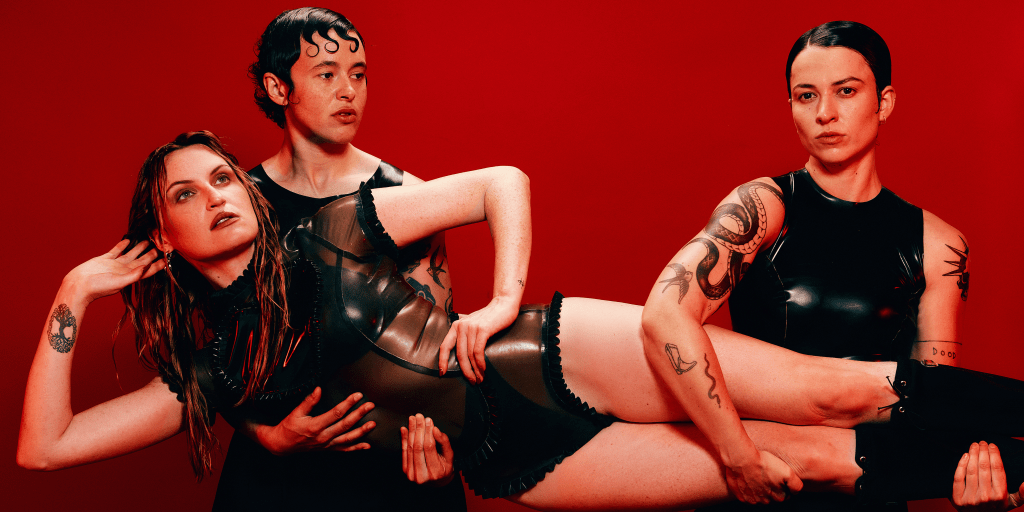
PHOTOGRAPHY Saskia Kovandzich
CREATIVE DIRECTION Tori West
CREATIVE DIRECTION & PRODUCTION Chiara Maculan
FASHION Baillie Jones
MUA Charlie Fitzjohn
HAIR Naz Sömnez
LIGHTING TECH Alfie Bungay
SOCIALS Rachelle Cox
FASHION ASSISTANT Nadia Oualnan
PHOTOGRAPHY ASSISTANT Marcie Docherty
SPECIAL THANKS TO Huxley
“When I think about these two, they’re actually not my friends,” says Josette Maskin of her MUNA bandmates, before adding, “Not in a mean way.” It’s an unexpected answer; after more than a decade together, most bands tend to lean heavily on the language of friendship. It is a convenient shorthand for the intimacy required to survive long years of relentless touring, late-night recordings, and growing up in public. But when Maskin tries to describe her relationship with Katie Gavin and Naomi McPherson, the word no longer feels sufficient. “They are,” she continues. “But we’ve moved into this other territory of commitment. We’re family.”
It’s a distinction that proves surprisingly revealing over the course of our call. Much of the conversation around MUNA’s fourth album, Dancing on the Wall, has focused on queer rage. Critics have rightly picked up on its exploration of desire, political frustration and the impossible contradictions of living through a period defined by overlapping crises. Sonically, this translates across thirteen exhilarating tracks that marry their instinct for euphoric pop hooks with a growing willingness to sit with uncertainty, rather than resolve it.
The album was written amid a ruthless news cycle. As Gavin, McPherson, and Maskin headed into the lab to record, they were also processing deportations, genocide, climate anxiety, and the increasingly surreal reality of existing within late-stage capitalism. “We’re going to the studio, and we’re hearing about ICE kidnapping people,” says Maskin. “We’re just normal people going through whatever the hell all of this is. We’re existing within the context.” She also recognises the dissonance of trying to process collective suffering while inhabiting a life that, by many measures, remains fortunate. “We live in Los Angeles, where things are beautiful, and we live beautiful lives.”
“And also hellish at times,” McPherson interjects.
“You’re just trying to make the best songs that you can, and then you have an album, and you have no idea what the overall message is,” Gavin reveals. “You figure it out as it comes out, and people respond to it.”


Katie wears playsuit: FINLEYS HOUSE, boots: ANCUTA SARCA, earrings: ALEXANDER MCQUEEN
Josette wears top FINLEYS HOUSE, trousers: SANDRO , loafers: DUKE & DEXTER
Contradiction sits at the centre of the record. Dancing on the Wall never attempts to resolve the tension between desire and despair. Instead, it insists that both can exist simultaneously. “We’re not going to win the revolution by trying to shove down all of our human feelings, and we’re also not going to win the revolution by only despairing,” Gavin asserts.
“The despair is there, and it’s natural, and it’s actually necessary to feel,” she continues. “But it’s a balance, right? We have to let ourselves feel the painful feelings, but we also can’t let go of desire, pleasure and fun. Connection is what’s going to carry us through in a lot of ways.” Speaking to the band from their respective homes in Los Angeles, what lingers isn’t anger so much as an appreciation for the relationships that have shaped them, inspired them, and made them feel a little more understood.

The despair is there, and it’s natural, and it’s actually necessary to feel, but it’s a balance, right? We have to let ourselves feel the painful feelings, but we also can’t let go of desire, pleasure and fun. Connection is what’s going to carry us through in a lot of ways.
Katie Gavin
Admittedly, I might have been feeling a particular kinship to the trio while speaking to them from a London heatwave. ‘It Gets So Hot’, the album’s opening track, captures the feeling of being simultaneously turned on, overwhelmed and deeply concerned about the future of the planet (reader, it was 33 degrees).
Throughout Dancing on the Wall, desire is tangled up with identity, aspiration and self-discovery. Nowhere is that more apparent than on the album’s third single, ‘Wannabeher’, a gleeful ode to the uniquely queer experience of wanting to be someone and wanting to be with them at the same time. Inspired in part by Bikini Kill’s ‘Rebel Girl’, the song explores a feeling that many LGBTQIA+ people encounter long before they have the language to describe it.
Sometimes, queer attraction isn’t really about romance at all, but about recognition. Maskin remembers experiencing that sense of understanding almost immediately when she first met McPherson while at college. “Growing up, I think we were attracted to each other because we saw parts of each other in ourselves,” she says. “Naomi was the first queer person that I met where I was like, ‘Oh, you’re me, and I’m you.‘”
Growing up, I think we were attracted to each other because we saw parts of each other in ourselves. Naomi was the first queer person that I met where I was like, ‘Oh, you’re me, and I’m you.‘
Josette Maskin

McPherson relates this to the “golden shadow”, a concept they recently encountered while listening to a Jungian psychology podcast: “They were talking about this idea where you might have a best friend who has these traits that you want to express in yourself, but just more actualised.”
Before MUNA became role models for its devoted teenage listeners, they were young sapphics searching for figures who could help them imagine their future. Noting The Indigo Girls, St Vincent, and Tegan and Sara, the trio recall some of their earliest golden shadows; artists who embodied qualities they would later recognise in themselves. For Gavin, Tracy Chapman offered a particularly important example. “Tracy, I think, was a cool example of presenting in a way that’s not for the male gaze, and if your songs rip enough, it really doesn’t matter.” Others, she actively avoided: “I took special care not to listen to Ani DiFranco when I was in high school. I was afraid.”
The mention of “high school” quickly spirals the conversation into a chaotic tribute to another queer icon in many sapphic coming-of-age stories: substitute teachers, or anyone with what the band describe as “elementary school art teacher energy”.
“All English subs who had braids in their long hair,” McPherson declares, “you are queer elders, whether you are straight or not.”
“A straight girl with a kooky vibe can be a queer elder,” chirps Gavin.
“It’s like a hacky joke, at this point,” laughs McPherson. “If you loved certain teachers a little too much, search within – you might be queer.”


Katie wears dress: TTSWTRS, heels: LEO PROTHMANN, Glasses: GENTLE MONSTER, earrings: ALEXANDER MCQUEEN
Josette wears suit: EUDON CHOI, shirt: COPERNI, shoes: ANCUTA SARCA, glasses: GENTLE MONSTER, tie: ROKIT
Beneath the jokes, the band keep returning to the same idea: identity is rarely formed in isolation. We become ourselves through other people. The difference now, more than a decade into MUNA, is that they are no longer searching for those figures in quite the same way. The musicians all entered their thirties during the gap between albums, and the self-destructive chaos that once characterised young adulthood feels increasingly distant, albeit not entirely absent.
“I really hope that I’ve become more gentle,” says Gavin. “More gentle with myself, and then in turn, more gentle with others.” This lesson emerged from confronting her own self-hatred. “It’s not just worthy to work on for yourself,” she explains. “It’s worthy to work on because you will treat other people that way if you get close enough to them.”

I was not happy in my twenties. I don’t think your twenties are very kind to anyone. I feel more myself now than I ever have, and I’m a little less afraid.
Naomi McPherson
McPherson agrees. “I was not happy in my twenties,” they say. “I don’t think your twenties are very kind to anyone.” Today, they feel something closer to comfort. “I feel more myself now than I ever have, and I’m a little less afraid.”
Maskin describes a similar shift. “I’m a mentally ill person, which I think I have to relearn all the time,” she shares. “But I think the highs and lows of that mental illness are maybe a little bit less extreme. I have more compassion for the specialness that I have learned about myself, and my special little brain.” The chaos hasn’t disappeared entirely – if anything, she’s simply found a better place to put it. “The cool thing about being able to perform in a band is I can still tap into the absolute mayhem that exists within myself that’s very childlike, but it’s in a way that’s not as destructive. Now, it’s all on the stage.”


MUNA’s songs have long soundtracked the messier corners of queer romance. Across four albums, they’ve written about crushes, heartbreak, obsession, devotion, situationships and the people we can’t quite let go of, all with exact emotional candour and their signature unapologetic horniness. Yet speaking to the band now, there’s a sense that age has shifted their perspective. The feelings remain fertile songwriting material, but their willingness to centre themselves within the chaos is less so. When asked about the current state of queer dating, Maskin laughs. “It seems like a fucking mess.”
McPherson is more analytical: “I think in general, dating for everyone, including straight people, is really hard, because the internet and dating apps have made everyone cowards.”
The less bureaucracy involved, the more chance you have of actually improving someone’s material conditions. The closer you can get to mutual aid, the better.
Naomi McPherson
According to MUNA, one of the defining challenges facing modern relationships is not a lack of desire, but a lack of practice. “People aren’t accustomed to having hard conversations,” says McPherson. “They haven’t had practice. I think people are so isolated, and I think a lot of people don’t even have that many friends, which truly makes me very sad.”
It is this sentiment, of lost or missed connection, that increasingly shapes how the band think about community more broadly. The trio recently used the release of ‘Big Stick’ to raise funds for Pal Humanity, a mutual aid organisation led by two Palestinian female doctors supporting communities in Gaza. “It’s reaffirmed a notion that I already had,” says McPherson. “The less bureaucracy involved, the more chance you have of actually improving someone’s material conditions. The closer you can get to mutual aid, the better.”
“Doing that kind of work helps you develop a sense of creativity and agency,” Gavin adds. “You can do things in creative ways to try to help.” The experience has also deepened her appreciation for the band’s audience. “I’m just so grateful to our fans,” she says. “They’ve been so generous with those efforts, because I’m very aware that we’re asking a specific group of people [for donations]. It’s a lot to fundraise, and I know it’s coming from people of all different economic backgrounds, but it gives me a lot of faith in people. They’ve just been so generous and responsive.”


Katie wears dress: MYAT, boots: COUREGGES, shorts, tights & gloves: STYLIST’S OWN
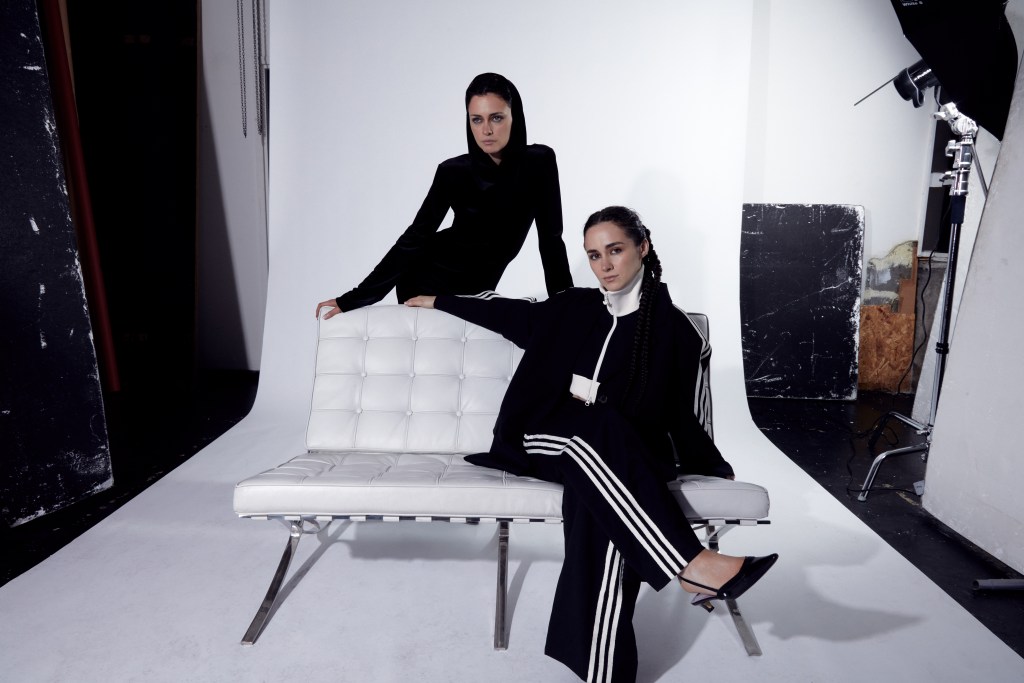
Josette wears vest: JIL SANDER, jacket: ADIDAS, trousers: DANIEL W. FLETCHER, trainers: ADIDAS
For our BRICKS digital cover shoot, it felt only natural to take inspiration from the alluring and impossibly stylish trios from ’90s and early noughties films and TV shows. Unsurprisingly, the band had no difficulty channelling the simultaneously sensual yet defiant energy of those characters on set. “Sometimes you have some of the hottest friends of all time,” McPherson jokes. “Which is, in some ways, exactly my experience.” The band recently rewatched Charlie’s Angels while on tour and became slightly obsessed with it. “That movie was inappropriately hot,” says Maskin.
“We are so lucky to have movies where beautiful ladies are allowed to shine,” adds McPherson. But Gavin ponders the message at the core of the 2000s flick. “Sometimes your friends can save you,” she says, before adding, “And sometimes you really are getting beaten up together.”
Choosing them, and being forced to choose them, in a way, has been the gift of my life. I’m being witnessed until I guess I’m no longer being witnessed by them.
Josette Maskin
While MUNA are often discussed through the lens of romance, friendship may be the great love story running through their work. This is not friendship as a brief flirtation with platonic intimacy, but as lifelong devotion. It’s the kind built slowly over years, through perseverance, trust and the decision to keep going together – something they almost didn’t do, after being dropped by their previous label during Covid before being quickly picked up by Phoebe Bridgers’ Saddest Factory Records. “Choosing them, and being forced to choose them, in a way, has been the gift of my life.” Maskin pauses. “I’m being witnessed until I guess I’m no longer being witnessed by them.”
“Whether we go blind,” McPherson offers.
“Or we die,” Maskin replies.
“One of those things is inevitable,” McPherson grins. “Whoever dies first loses the game…”
“Loses the game!” shouts Maskin. “It’s the final game.” They dissolve into laughter. For all of Dancing on the Wall’s rage, uncertainty and existential dread, perhaps this is the clearest expression of who its makers really are: three people who have spent long enough witnessing one another’s lives that the future can only be imagined collectively.
Enjoyed this story? Help keep independent queer-led publishing alive and unlock the BRICKS Learner Platform, full of resources for emerging and aspiring creatives sent to you every week via newsletter. Start your 30-day free trial now.
The post MUNA are still choosing each other appeared first on BRICKS Magazine.