By the Numbers African Americans Should be Extinct
*If history were told from the vantage point of the oppressed rather than the oppressor, the American narrative would read very differently. It would not begin in 1492, nor would it center on conquest as discovery. Instead, it would acknowledge a far deeper, more complex human story—one in which people of African descent are not […] The post By the Numbers African Americans Should be Extinct appeared first on EURweb | Black News, Culture, Entertainment & More.
 Black News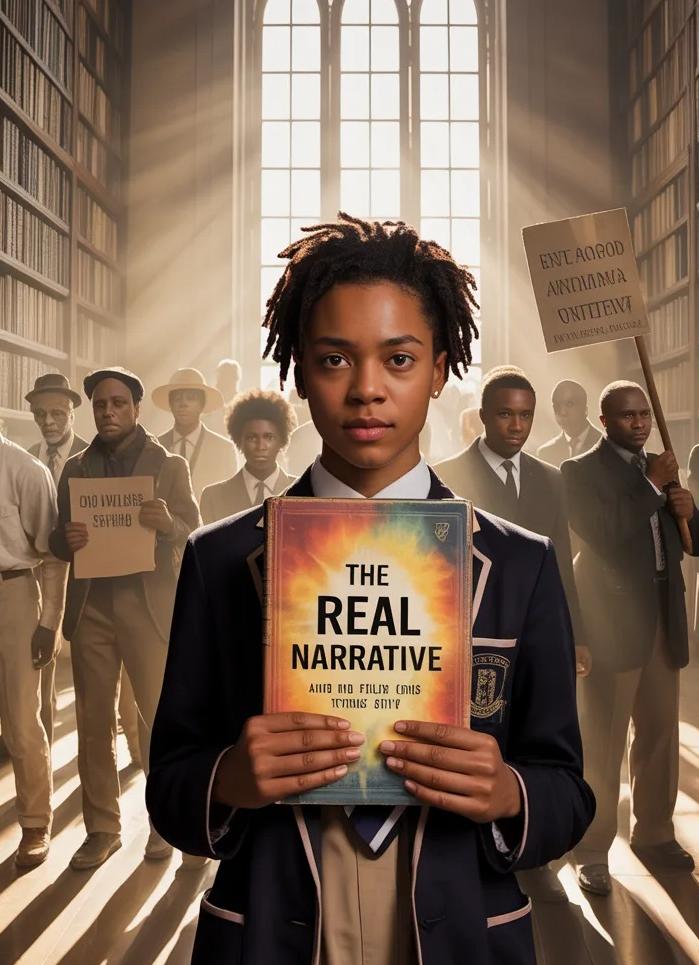
*If history were told from the vantage point of the oppressed rather than the oppressor, the American narrative would read very differently. It would not begin in 1492, nor would it center on conquest as discovery. Instead, it would acknowledge a far deeper, more complex human story—one in which people of African descent are not footnotes, but foundational. That reframing matters because the story we are told shapes the limits of what we believe is possible.
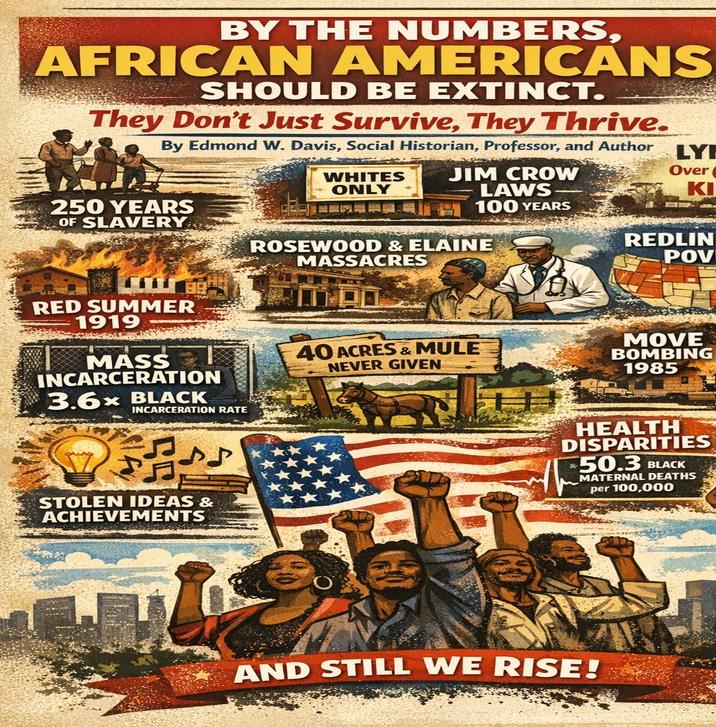
Let me be clear: the argument that Black Americans “should be extinct” is not a literal wish—it is a historical observation rooted in brutal reality. When you examine the full scope of what African-descended people in America have endured—centuries of chattel slavery, followed by legalized segregation, racial terrorism, economic exclusion, mass incarceration, and systemic disenfranchisement—you are forced to confront a staggering truth. No other population in modern history has survived such a sustained, multi-generational assault on its humanity at this scale.
And yet, here we are.
That alone should shift the conversation.
Consider the timeline. Slavery in what became the United States lasted roughly 250 years. After that came nearly another century of Jim Crow laws, lynchings, and state-sanctioned racial violence and murder with no accountability. It was not until the passage of civil rights legislation in the 1960s—barely sixty years ago—that Black Americans were legally recognized as full citizens under the law. Sixty years. That is not ancient history; that is living memory.
I was born in 1976, a bicentennial baby, and I will turn 50 this year. Within my own family lineage, I am among the first generations born with full legal recognition as a human being in this country. Let that sit with you. My mother’s family can trace our family back to the early 1800s—to an enslaved ancestor in Pennsylvania. My grandparents’ man had parents. Which means our presence here predates many who claim deeper roots in that land. Yet, despite that longevity, the full rights of citizenship are a recent inheritance.
So when people ask, “Why can’t Black communities just come together?” or “Why aren’t there more thriving Black neighborhoods?”—the question itself reveals historical amnesia. You cannot ignore the fact that for the overwhelming majority of our time in America, Black advancement was not simply discouraged—it was systematically destroyed. Wealth was stolen. Communities were burned. Education was denied or distorted. Families were separated. Progress was punished.
And still, we are here.
Statistically, Black Americans make up roughly 14% of the U.S. population. But numbers alone do not capture influence. From music to language, from fashion to food, from sports to global culture—Black Americans have shaped the very rhythm of modern life. Our creativity has become the world’s template. Our resilience has become its quiet backbone.
There is a paradox in that reality. The same society that has historically marginalized Black people has also consumed Black culture at an unprecedented rate. Our style is imitated. Our language is adopted. Our swag is duplicated, Our innovation is monetized. Yet, too often, the people behind that influence remain undervalued, misunderstood, or excluded.
This is not accidental. It is structural.
But here is the deeper truth—the one I tell my students, the one I want young people to internalize: the fact that you exist is extraordinary.
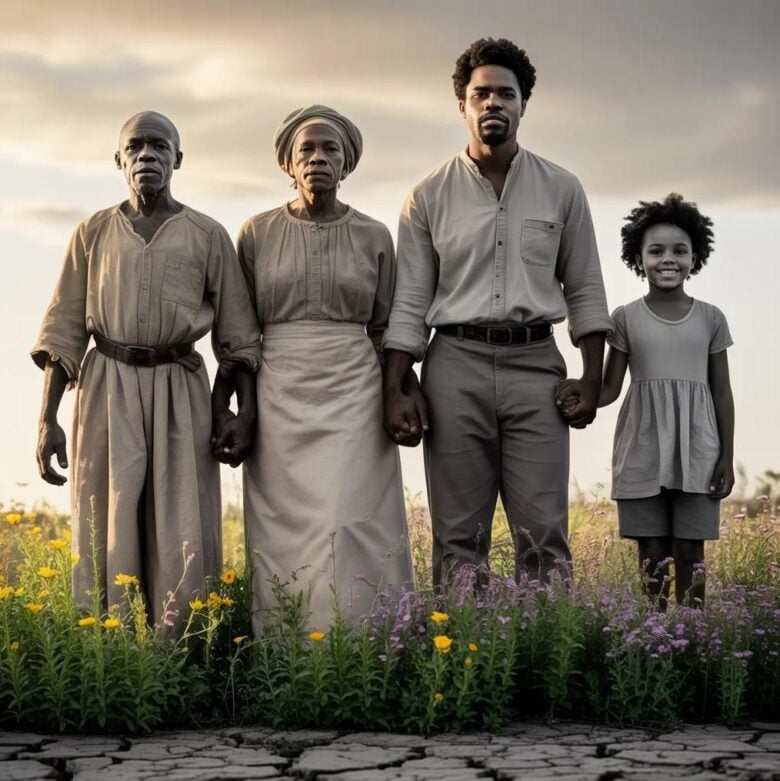
You are the product of survival against overwhelming odds. You are here because generations before you endured what should have been unsurvivable. That is not weakness—that is legacy. That is power.
Do not let anyone convince you that your identity is a deficit. Do not let narratives—whether from media, institutions, or even misguided voices within our own communities—reduce you to a problem to be solved. You are not a problem. You are proof.
Proof that resilience can outlast oppression.
Proof that culture can flourish even under constraint.
Proof that history, no matter how distorted, cannot erase truth entirely.
This is not about elevating one group above another. It is about correcting a narrative that has long been imbalanced. Every people has its gifts. Every culture has its contributions. But the story of Black Americans is uniquely marked by endurance under conditions designed to erase us.
And that is why the phrase “we were never meant to survive” carries weight. Because historically, the systems were aligned against our survival. The expectation—whether spoken or unspoken—was disappearance.
Instead, we persisted.
We built.
We created.
We influenced the world.
So, the call to action is not rooted in anger—it is rooted in awareness. Know your history. Question incomplete narratives. Take pride in who you are, not as a reaction to oppression, but as a recognition of truth.
And to the next generation: do not run from your identity. Do not dilute it. Do not apologize for it. Embrace it. Refine it. Use it as a foundation to build something even greater.
Because if history has proven anything, it is this:
We were never meant to survive.
But surviving was only the beginning.

ABOUT THE AUTHOR:
Edmond W. Davis is an American social historian, international speaker, and Amazon #1 bestselling author. He is a global authority on the Tuskegee Airmen and serves as the founder of the National HBCU Black Wall Street Career Fest. A native of Philadelphia, PA, and currently residing in the Little Rock, Arkansas, area. Davis is committed to cultural empowerment and educational equity through storytelling and civic engagement. Davis was a grand marshal at the 38th Annual African American History Month Celebration Parade.
(If You Like/Appreciate This EURweb Story, Please SHARE it!)
MORE NEWS ON EURWEB.COM: The Divided Fourth: Why Some African Americans Opt Out of Independence Day | VIDEO
We Publish Breaking News 24/7. Don’t Miss Out! Sign up for our Free daily newsletter HERE.
The post By the Numbers African Americans Should be Extinct appeared first on EURweb | Black News, Culture, Entertainment & More.