Can Promoting Peace Become An Organizing Principle Inside America’s Warmongering Government?
By Robert C. Koehler Photos: Wikimedia Commons It’s hard to avoid noticing, and internally screaming over, the Trump administration’s proposed military budget upgrade to $1.5 trillion annually – as though the present trillion-dollar annual gift to the end of the world weren’t enough. It’s not just the proposed taxpayer bleed. It’s the collective assumption that “self-defense” requires an ever-present readiness to kill lots of people – and beyond that the utter certainty that we have soulless enemies out there who want what we have, hate our freedoms and will take what they can the moment we relax. This is just the way it is. No questions allowed. And our enemies aren’t pussycats. One of them, for instance, is China. Indeed, as Megan Russell of CODEPINK writes: “U.S. lawmakers have been using China as a military budget increaser and ultimate policy-generator for years. Competition with Beijing is invoked to justify military expansion, new regional alliances, AI weapons development, semiconductor restrictions, and rising nuclear expenditures. In Washington, framing a policy as necessary to ‘counter China’ has become one of the quickest ways to secure bipartisan support. As a result, the ‘China threat’ rhetoric proliferates while the military budget skyrockets.” “A quick way to secure bipartisan support” – that says it all. Nothing holds a country together like a good enemy. This is who we are; this is the identity we’re stuck with. We unify when we fight. Apparently that’s at our political core, which is why any cries for peace – which is oh, so complex – are ignored, belittled and virtually always voted down. All of which is to our own detriment, not to mention the world’s detriment. As Russell notes: “. . . currently, the U.S. and China are building their own tech ecosystems, especially in the fields of artificial intelligence, semiconductors, and quantum computing. The U.S. refers to this as a ‘strategic rivalry’ with wider national security implications. This perspective only exists because China is considered a rival. China does not have to be considered a rival. China could just as easily be considered a development partner. And indeed it should, because cooperation on tech is the only potential avenue for ensuring the continued existence of the planet.” Uh, too bad, Planet Earth. Collective humanity refuses to think at that level. Technology serves only our belief in dominance. Consider Trump’s proposed “Golden Dome” nuclear defense system: thousands of satellites patrolling the planet, on the lookout for enemy nuclear missiles, a deeply flawed reincarnation of the Reagan era Strategic Defense Initiative plan that went nowhere. The cost, though minimized by the Trump administration, could wind up, according to some estimates, amounting to well over $3 trillion. And, according to Taxpayers for Common Sense: “Pursuing Golden Dome also poses serious strategic risks, including the potential to accelerate nuclear arms and space arms races and to undermine opportunities to secure verifiable arms control agreements that reduce the nuclear threat. The program has also raised troubling conflict-of-interest concerns involving individuals within the Trump Administration and companies vying for Golden Dome contracts.” Wars. Sometimes you stop ’em, sometimes you start ’em, but they ain’t going away. The most powerful people on the planet are utterly committed to the limited nature of their thinking. That’s just how it goes. What about that do you not understand, Rep. Kucinich? Remember U.S. Rep. Dennis Kucinich and his Department of Peace legislation, which he introduced in Congress every year from 2001 to 2011? And it was introduced again in 2013 by Rep. Barbara Lee. It, uh, never passed. Here’s how it was defined in 2001, as HR2458: “Establishes a Department of Peace, which shall be headed by a Secretary of Peace appointed by the President, with the advice and consent of the Senate. Sets forth the mission of the Department, including to: (1) hold peace as an organizing principle; (2) endeavor to promote justice and democratic principles to expand human rights; and (3) develop policies that promote national and international conflict prevention, nonviolent intervention, mediation, peaceful resolution of conflict, and structured mediation of conflict. “Establishes in the Department the Intergovernmental Advisory Council on Peace, which shall provide assistance and make recommendations to the Secretary and the President concerning intergovernmental policies relating to peace and nonviolent conflict resolution.” Holding peace as an organizing principle? Developing policies that promote peaceful resolution of conflict? Can you imagine this at the core to the American government? With significant funding? As I read these words today, I feel compelled to help keep them alive. I want that level of sanity in my government – that level of commitment to something
 Black News
By Robert C. Koehler
Photos: Wikimedia Commons
It’s hard to avoid noticing, and internally screaming over, the Trump administration’s proposed military budget upgrade to $1.5 trillion annually – as though the present trillion-dollar annual gift to the end of the world weren’t enough.

It’s not just the proposed taxpayer bleed. It’s the collective assumption that “self-defense” requires an ever-present readiness to kill lots of people – and beyond that the utter certainty that we have soulless enemies out there who want what we have, hate our freedoms and will take what they can the moment we relax. This is just the way it is. No questions allowed.
And our enemies aren’t pussycats. One of them, for instance, is China. Indeed, as Megan Russell of CODEPINK writes:
“U.S. lawmakers have been using China as a military budget increaser and ultimate policy-generator for years. Competition with Beijing is invoked to justify military expansion, new regional alliances, AI weapons development, semiconductor restrictions, and rising nuclear expenditures. In Washington, framing a policy as necessary to ‘counter China’ has become one of the quickest ways to secure bipartisan support. As a result, the ‘China threat’ rhetoric proliferates while the military budget skyrockets.”
“A quick way to secure bipartisan support” – that says it all. Nothing holds a country together like a good enemy. This is who we are; this is the identity we’re stuck with. We unify when we fight. Apparently that’s at our political core, which is why any cries for peace – which is oh, so complex – are ignored, belittled and virtually always voted down. All of which is to our own detriment, not to mention the world’s detriment.
As Russell notes:
“. . . currently, the U.S. and China are building their own tech ecosystems, especially in the fields of artificial intelligence, semiconductors, and quantum computing. The U.S. refers to this as a ‘strategic rivalry’ with wider national security implications. This perspective only exists because China is considered a rival. China does not have to be considered a rival. China could just as easily be considered a development partner. And indeed it should, because cooperation on tech is the only potential avenue for ensuring the continued existence of the planet.”
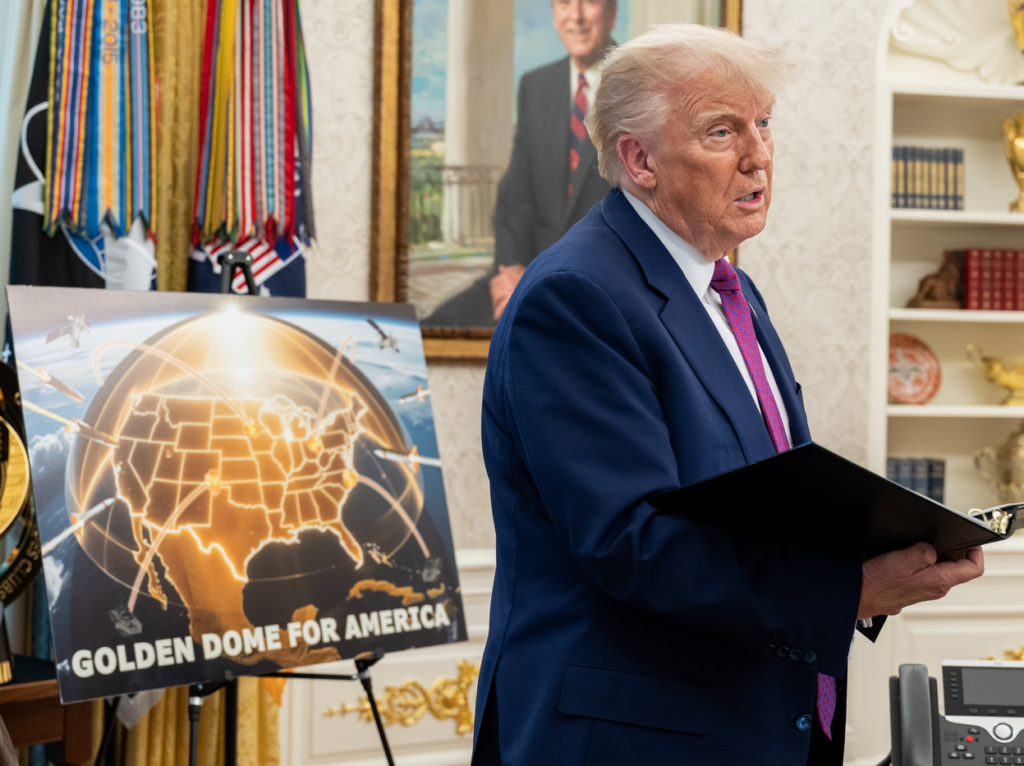
Uh, too bad, Planet Earth. Collective humanity refuses to think at that level. Technology serves only our belief in dominance. Consider Trump’s proposed “Golden Dome” nuclear defense system: thousands of satellites patrolling the planet, on the lookout for enemy nuclear missiles, a deeply flawed reincarnation of the Reagan era Strategic Defense Initiative plan that went nowhere. The cost, though minimized by the Trump administration, could wind up, according to some estimates, amounting to well over $3 trillion.
And, according to Taxpayers for Common Sense:
“Pursuing Golden Dome also poses serious strategic risks, including the potential to accelerate nuclear arms and space arms races and to undermine opportunities to secure verifiable arms control agreements that reduce the nuclear threat. The program has also raised troubling conflict-of-interest concerns involving individuals within the Trump Administration and companies vying for Golden Dome contracts.”
Wars. Sometimes you stop ’em, sometimes you start ’em, but they ain’t going away. The most powerful people on the planet are utterly committed to the limited nature of their thinking. That’s just how it goes. What about that do you not understand, Rep. Kucinich?
Remember U.S. Rep. Dennis Kucinich and his Department of Peace legislation, which he introduced in Congress every year from 2001 to 2011? And it was introduced again in 2013 by Rep. Barbara Lee. It, uh, never passed.
Here’s how it was defined in 2001, as HR2458:
“Establishes a Department of Peace, which shall be headed by a Secretary of Peace appointed by the President, with the advice and consent of the Senate. Sets forth the mission of the Department, including to: (1) hold peace as an organizing principle; (2) endeavor to promote justice and democratic principles to expand human rights; and (3) develop policies that promote national and international conflict prevention, nonviolent intervention, mediation, peaceful resolution of conflict, and structured mediation of conflict.
“Establishes in the Department the Intergovernmental Advisory Council on Peace, which shall provide assistance and make recommendations to the Secretary and the President concerning intergovernmental policies relating to peace and nonviolent conflict resolution.”
Holding peace as an organizing principle? Developing policies that promote peaceful resolution of conflict? Can you imagine this at the core to the American government? With significant funding? As I read these words today, I feel compelled to help keep them alive. I want that level of sanity in my government – that level of commitment to something I believe in, with all my heart.
Instead:
“Taken together, the Trump administration’s rhetoric and actions point to a clear conclusion about its recent request for a whopping $1.5 trillion in military spending: This is not a defense budget. It is a war budget, designed to enable a pattern of aggressive military action and escalating threats that are already imposing a devastating toll on civilians abroad, while the combination of spending cuts and rising costs imposed on Americans is deepening injustice at home.”
This is Scott Paul, writing at The Hill. He goes on: “This budget is certainly not business as usual. It is a dramatic reordering of national priorities. Trump has made this shift explicit, arguing that the U.S. cannot afford childcare, Medicaid or Medicare because, as he put it, ‘we’re fighting wars.’”

Robert Koehler (koehlercw@gmail.com), syndicated by PeaceVoice, is a Chicago award-winning journalist and editor. He is the author of Courage Grows Strong at the Wound, and his album of recorded poetry and artwork, Soul Fragments.