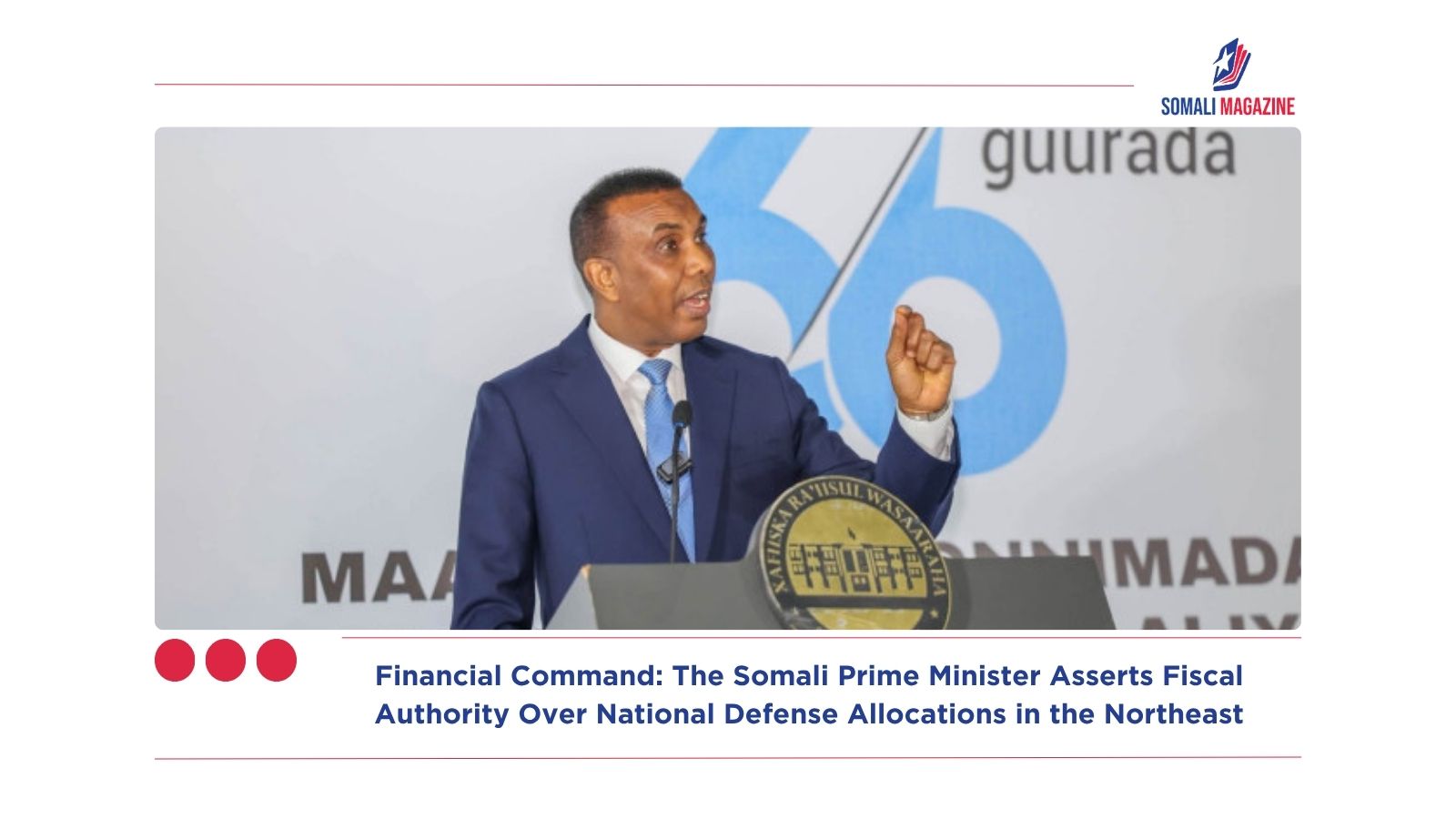
Financial Command: The Somali Prime Minister Asserts Fiscal Authority Over National Defense Allocations in the Northeast
Financial Command: The Somali Prime Minister Asserts Fiscal Authority Over National Defense Allocations in the Northeast
Facebook

Twitter (X)

Instagram

Somali Magazine - People's Magazine
The Somali Prime Minister has vigorously defended the federal government’s ongoing budgetary allocations to national security personnel stationed in the northeast, explicitly positioning the financial outlays as a fundamental state duty rather than a political provocation. Speaking during an official address in Mogadishu, the premier emphasized […]
The post Financial Command: The Somali Prime Minister Asserts Fiscal Authority Over National Defense Allocations in the Northeast first appeared on Somali Magazine.
The Somali Prime Minister has vigorously defended the federal government’s ongoing budgetary allocations to national security personnel stationed in the northeast, explicitly positioning the financial outlays as a fundamental state duty rather than a political provocation. Speaking during an official address in Mogadishu, the premier emphasized that national troops who have sworn an oath to protect the sovereign integrity of the republic are legally entitled to receive their regular salaries and professional promotions directly from the centralized administration. This policy stands firm regardless of the deepening administrative rift between the federal executive and the regional leadership in Garowe, who have vocally opposed these unilateral financial disbursements. The administrative pushback from regional authorities has escalated into a prominent constitutional crisis, as the localized leadership views these direct financial connections as an existential threat to their regional autonomy and an attempt to divide local loyalties.
The current geopolitical friction underscores a broader structural struggle over resource control and military command lines within the fragile federal layout. For several months, federal soldiers stationed in the northeastern territory have operated under highly complex administrative conditions, frequently experiencing severe localized supply challenges and delayed compensations from regional systems. The Somali Prime Minister addressed these structural vulnerabilities directly, challenging the legal logic that would penalize military personnel based on their geographical assignment or deny them livelihood allowances provided by the central state. By formalizing direct biometric banking links for these troops, the centralized government aims to bypass traditional middlemen and ensure institutional transparency across the defense sectors. However, the regional administration continues to assert that the deployment and maintenance of independent national units within their borders without explicit local consent violates long-standing power-sharing frameworks.
As the Somali Prime Minister continues to assert centralized administrative authority, international security partners have urged both sides to prioritize counter-terrorism cooperation over internal fiscal warfare. The persistent breakdown in institutional communication threatens to disrupt ongoing operations against extremist factions, who frequently exploit domestic governance fractures to reclaim rural positions. The federal government has repeatedly reassured external stakeholders that its localized security allocations are designed exclusively to bolster the overall national defense framework rather than to deliberately incite civil unrest. With the legal mandates of the state architecture undergoing extensive scrutiny, the coming months will require structured political compromises to reconcile centralized defense oversight with the preservation of regional legislative rights across the territory.


 Black News