French president says France should have pressed Sahel's “leaders more forcefully”
French President Emmanuel Macron has made a rare, unusually candid admission: France may have stayed too long, acted too slowly, and listened too little in the Sahel region of West Africa, where the country is no longer welcome.
 Black News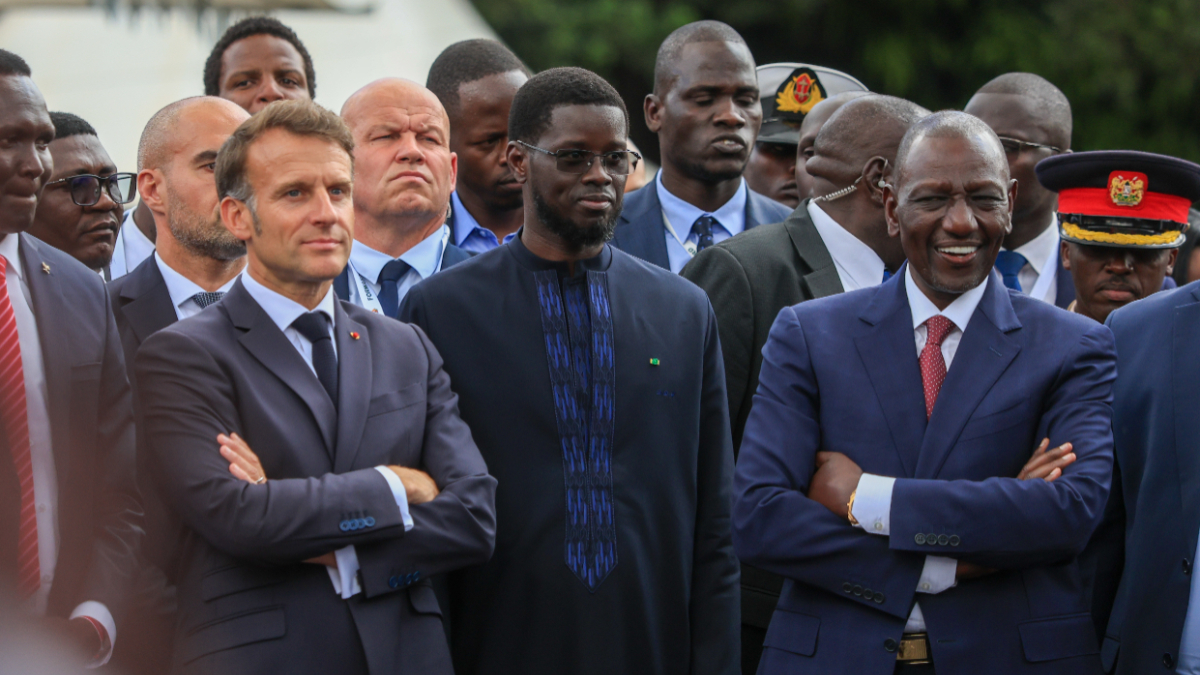
![French President Emmanuel Macron and Kenyan President William Ruto participate in a panel on culture during the Africa Forward Summit in Nairobi, Kenya, on May 11, 2026. [Photo by Lucas Mukasa/Anadolu via Getty Images]](https://ocdn.eu/pulscms/MDA_/73952290ca7b921feb5236fd51889ef1.jpg)
French President Emmanuel Macron has made a rare, unusually candid admission: France may have stayed too long, acted too slowly, and listened too little in the Sahel region of West Africa, where the country is no longer welcome.
- French President Emmanuel Macron admitted France may have stayed too long and acted too slowly in the Sahel region.
- France's involvement through the G-5 Sahel alliance failed to address insecurity, leading to local resentment.
- The G-5 Sahel alliance, formed to combat terrorism, gradually broke down as member states withdrew amid dissatisfaction with French strategies.
- Mali, Burkina Faso, and Niger expelled French troops, ended Western alliances, and disbanded the G-5 Sahel in December 2023.
Speaking recently in an interview with FRANCE 24, RFI, and TV5Monde on France’s troubled role in the region, Macron acknowledged that while its military was present in the countries that now make up the Alliance of the Sahel States, including Burkina Faso, Mali, and Niger, it failed to be more assertive with its policies.
The French leader noted that in 2017, they formed an alliance known as the G-5 Sahel, intended to address security, development, and political challenges in the region.
The G-5 Sahel
The G5 Sahel was established on February 16, 2014, in Nouakchott as a bold regional partnership of Burkina Faso, Chad, Mali, Mauritania, and Niger to combat terrorism and foster development throughout the troubled Sahel.
Its Joint Force, established in 2017, combats extremist groups and cross-border crime.
However, years of insecurity, political turmoil, and internal disputes gradually eroded the bloc.
Countries in the Sahel began to feel slighted by the French, noting that France’s presence within their borders has done nothing to curtail the insecurity plaguing the region.
Soon after these sentiments peaked, the current AES countries began kicking out French troops and expelling all forms of Western influence from their countries.
In addition, these AES countries also started departing from all their Western alliances, including the G-5 Sahel.
After Mali left in 2022, followed by Burkina Faso and Niger in 2023, the alliance was officially disbanded on December 6, 2023, signaling the end of one of Africa's most ambitious regional security experiments.
What Macron said about the alliance
In the recent interview, the French president spoke about the alliance, stating, “In 2017, we launched the G-5 Sahel, an alliance to combine security, development, and politics.”
He also added, “The problem is we weren’t actually tougher or perhaps more assertive on this front. We didn’t press the leaders more forcefully to step in more quickly with administrative measures, development, empowerment projects, and opportunities wherever territory had been recaptured from terrorists.”
In actuality, he contended, it relied too largely on military promises, failing to ensure that freed lands were rapidly established through administration, infrastructure, and economic opportunity.
“Because ultimately, it ended up appearing as though a security guarantee had been provided. And so, I think we should have had that challenging dialogue sooner,” he added.
The political fallout between France and the Sahel countries
Over the last few years, Mali, Burkina Faso, and Niger have all withdrawn French soldiers, decreased military collaboration with Paris, and looked to new partners, most notably Russia.
The three countries have subsequently formed the Alliance of Sahel States, a new regional organization aimed at increasing political and military cooperation among themselves.
Their simultaneous exit from ECOWAS resulted in a significant geopolitical split, undermining both regional diplomacy and France's long-standing power in its old colonial territory.