From dung to flame; how biogas is easing rural life in Kapchorwa
In rural Kapchorwa, a biodigester is fundamentally altering daily life by tackling the most immediate and dangerous tasks which are cooking and collecting firewood. The simple technology has eliminated the need for women to walk up to eight miles to gather wood and by converting cow dung and water into clean biogas, these systems are […] The post From dung to flame; how biogas is easing rural life in Kapchorwa appeared first on The Observer Media Ltd.
 Black News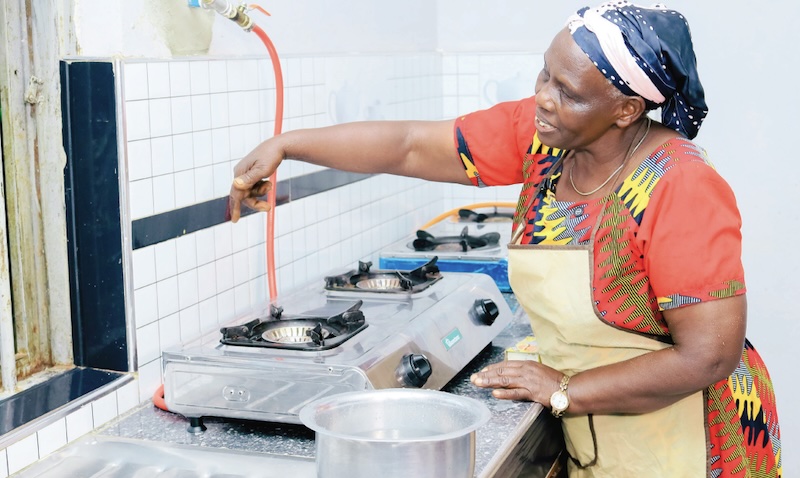

In rural Kapchorwa, a biodigester is fundamentally altering daily life by tackling the most immediate and dangerous tasks which are cooking and collecting firewood.
The simple technology has eliminated the need for women to walk up to eight miles to gather wood and by converting cow dung and water into clean biogas, these systems are now providing a safe, reliable, and smoke-free fuel source that is also highly efficient, writes GEOFREY SERUGO.
In a rural homestead in Kapchorwa district, four cows stand at the centre of a small but powerful energy revolution at Kapchesiy cell. For Sophy Chepkwuru, a farmer, what was once considered waste cow dung has become the backbone of her household energy, cutting costs, saving time, and improving her farm yields.
Chepkwuru is among a growing number of farmers embracing biogas technology, a solution that converts organic waste into clean cooking fuel through a structure known as a biodigester.
Every day begins with a simple routine, using a wheelbarrow, Chepkwuru collects cow dung and pours it into a mixing chamber. Water is added, and the mixture is stirred until it reaches a smooth, porridge-like consistency.
“From these four cows, we get enough dung. That is what feeds the system. We use about two basins of dung every day, mixed with water depending on how hard it is. You must remove any dirt so it does not affect the bacteria,” she said.
This mixture is then fed into the biodigester, a sealed underground chamber where the real transformation happens. According to Dismas Cheptoek, a regenerative agriculture expert at Aidenvironment, the system works much like the human digestive process.
“The feeding chamber is like the mouth, where mixing happens.Inside the digester, microorganisms break down the waste in the absence of oxygen, producing methane gas,” he explains.
The gas rises and is channelled through pipes into the kitchen, where it is used for cooking. Meanwhile, the leftover slurry flows into another chamber before being directed to the farm.
“The more you feed the system, the more gas you produce and the more cooking you can do,” Chepkwuru said.
TURNING WASTE INTO WEALTH
Beyond providing clean energy, the biodigester produces a valuable by- product: organic fertiliser. The slurry, locally referred to as “bioslurry,” is applied to crops such as coffee and bananas. Chepkwuru says this has significantly improved her farm’s productivity.
“Before biogas, our matoke bunches were small. Now they are bigger, and the price has improved from about Shs 15,000 to as much as Shs 30,000,” she recalled.
She carefully applies the slurry around her crops rather than directly onto them, ensuring the roots are not damaged.
“It has helped our coffee too. You can see the improvement,” she adds.
A SHIFT IN HOUSEHOLD LIFE
Inside Chepkwuru’s kitchen, the impact of biogas is immediately visible. The cooking area is clean, with no smoke-blackened walls or soot-covered utensils.
“I now have clean cooking, even my saucepans remain clean, if you are not careful, your tea can even boil over because it cooks so fast, she says.
The gas burns quickly and efficiently, reducing cooking time significantly. The system has also made cooking more accessible within the household.
“Anyone can cook; my husband, my children, even visitors. It is not like firewood, where I had to do everything myself.”
CUTTING COSTS, SAVING TIME
Before installing the biodigester, Chepkwuru relied on firewood and occasionally gas cylinders both costly and unreliable.
“We used to spend about Shs 5,000 a day on firewood, and it was not even enough,” she says.
Refilling a gas cylinder could cost over Shs 120,000 every few months, an expense she can no longer justify.
“Since I got biogas, I have not used the cylinder again.I am now able to save little by little and even renovate my house,” she said.
The savings are now being redirected into other household needs, including home improvements.
BUILDING A BIODIGESTER
Constructing a biodigester requires both technical knowledge and local materials. The system includes a feeding chamber, the main digester, a gas pipe with a control valve, an expansion chamber, and a bioslurry outlet.
Typically, a unit like Chepkwuru’s capable of holding about 4,000 litres of waste costs approximately Shs 2.5 million. However, through a co- financing model supported by development partners, farmers receive subsidies covering up to 40 per cent of the cost, while they contribute the remaining 60 per cent, often in the form of locally available materials.
Chepkwuru says she first learned about biogas through a farmer training programme peddled by Uganda Breweries Limited (UBL), in partnership with Aidenvironment and local stakeholders under the Elgon Pamoja initiative that is transforming farming communities in the Mt. Elgon catchment.
“I attended a training, and they talked about this system. I became interested immediately. That is how I started,” she recalls.
CHALLENGES AND POTENTIAL
Despite its benefits, adoption of biogas remains limited, largely due to the initial investment required and the need for consistent access to animal waste and water.
Water scarcity, particularly during dry seasons, can affect feed preparation, while maintaining the system requires regular input and care. Even so, experts say the long-term benefits outweigh the challenges.
Biogas reduces dependence on firewood, helping to curb deforestation. It also lowers household energy costs, improves indoor air quality, and enhances soil fertility through organic fertiliser.
For farmers like Chepkwuru, the technology represents more than just an energy solution, it is a pathway to resilience.
“This system has saved me. It has reduced my costs, improved my farm, and made life easier,” she said.
As Uganda continues to explore sustainable energy options, small-scale innovations like biogas are quietly transforming rural livelihoods one household at a time.
geofreyserugo1992@ gmail.com
The post From dung to flame; how biogas is easing rural life in Kapchorwa appeared first on The Observer Media Ltd.