Government Resorts to Subsidising Transport Operators after Fuel Price Rise
By MOZTIMES Maputo (MOZTIMES) – The Mozambican government has once again resorted to subsidies to block a possible rise in public transport fares after the recent increase in fuel prices, but the measure has revived longstanding complaints about the alleged exclusion of the informal operators who dominate urban passenger transport. During a joint Friday […]
 Black News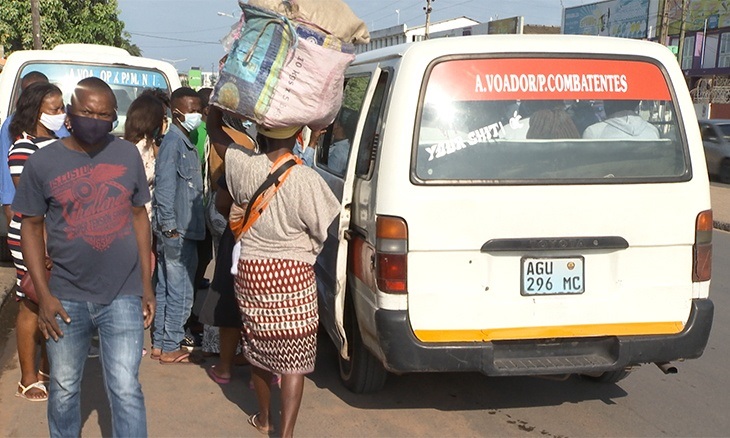
By MOZTIMES
Maputo (MOZTIMES) – The Mozambican government has once again resorted to subsidies to block a possible rise in public transport fares after the recent increase in fuel prices, but the measure has revived longstanding complaints about the alleged exclusion of the informal operators who dominate urban passenger transport.
During a joint Friday press conference in Maputo, the Ministry of Transport and Logistics and the Mozambican Federation of
Road Transport Associations (FEMATRO), Castigo Nhamane, announced a mechanism for temporary compensation intended to mitigate the operational costs of the transport operators.
The government says its goal is to prevent the impact of the fuel price rise from falling directly on the passengers, particularly in the urban and suburban zones where privately owned minibuses remain the main mode of transport for millions of Mozambicans.
“An agreement was reached that the government will subsidise the private sector”, declared FEMATRO President, adding that this measure “seeks to alleviate the cost which could fall on our passengers”. According to the Government, the licensed operators of minibuses (commonly known as “chapas”) could receive 35,407 meticais (about 550 US dollars) a month while articulated buses could benefit from compensation of some 141,000 meticais (about 2,200 USD). These sums were calculated based on the distance journeyed, the fuel consumption, and operational data existing in the official data bases.
But the announcement soon revived an old polemic: who really benefits from public subsidies given to transport operators?
During the conference, journalists and civil society representatives openly questioned the fact that the mechanism remains dependent on lists validated by FEMATRO and on licensing criteria which leave out many of the operators who guarantee everyday passenger transport in Mozambican cities.
“Between 2011 and 2017, FEMATRO received more than a billion meticais, and we have transport operators who have been working for 30 years and never received any compensation”, claimed Américo Tembo, representative of the Network Against Road Accidents (RECAP), during the press conference.
He went further and questioned directly the legitimacy of FEMATRO to handle public subsidies.
“If the law does not oblige anyone to join FEMATRO in order to operate, then why can only transporters linked to FEMATRO benefit?”, he asked, adding that “the history of FEMATRO in distributing and managing subsidies is not clean”.
Such declarations reveal the discomfort around the new package of compensation, in a sector where informal operators dominate.
In practice, a significant number of “chapas” operate without full licensing, often due to red tape, administrative costs and the weaknesses of the state inspection system. Even so, it is these operators who every day ensure the transport of thousands of passengers in the peripheral and suburban neighbourhoods where the number of public buses remains insufficient.
Faced with criticism, the government has insisted that the new model will be more transparent than the previous one, because the money goes directly to the operators.
“The transporters will be compensated directly”, said the Secretary of State for Transport, Chinguane Mabote, representing the Ministry of Transport. He described the mecanism as “an innovation”.
Even so, access to the subsidy will remain conditional on licensing and validation through the recognised associations.
“Those who are unlicensed should go to the licensing bodies to be license. We represent transporters who are duly licensed”, stressed the FEMATRO President.
The Government is now trying to transform the crisis into an opportunity to speed up the formalisation of the sector, which is proving difficult and bureaucratic.
The Ministry of Transport explained that there will be a three month window to allow the informal operators to obtain licences and to join the new, digital compensation system.
The government promises that, during this period, it will implement a technological mechanism that can monitor routes, fuel consumption and the operational activity of the vehicles in real time.
“In the second phase, we shall have a digital process where compensation will be fair and transparent”, declared Mabote.
But the doubts persist.
Journalists wanted to know what specific mechanisms will be used to avoid diversion of funds, manipulation of data, or undue favouritism.
Others question the informal fare increases already reported in some suburban areas, even before the official implementation of the compensation announced by the government.
The FEMATRO President admitted that the agreement reached is far from satisfying all the operators. “No negotiations satisfy everybody 100 per cent”, he said. “We have to find a compromise”. (MT)