How South Africa’s 30 June unfolded:
South Africa’s (SA’s) highly anticipated 30 June anti-illegal immigration protests passed largely without the widespread violence many had feared, as thousands marched in cities across the country under a heavy security presence. While the day remained mostly peaceful, there were isolated incidents of unrest. Two people were wounded in a shooting in Hillbrow, the South […] The post How South Africa’s 30 June unfolded: appeared first on The Namibian.
 Black News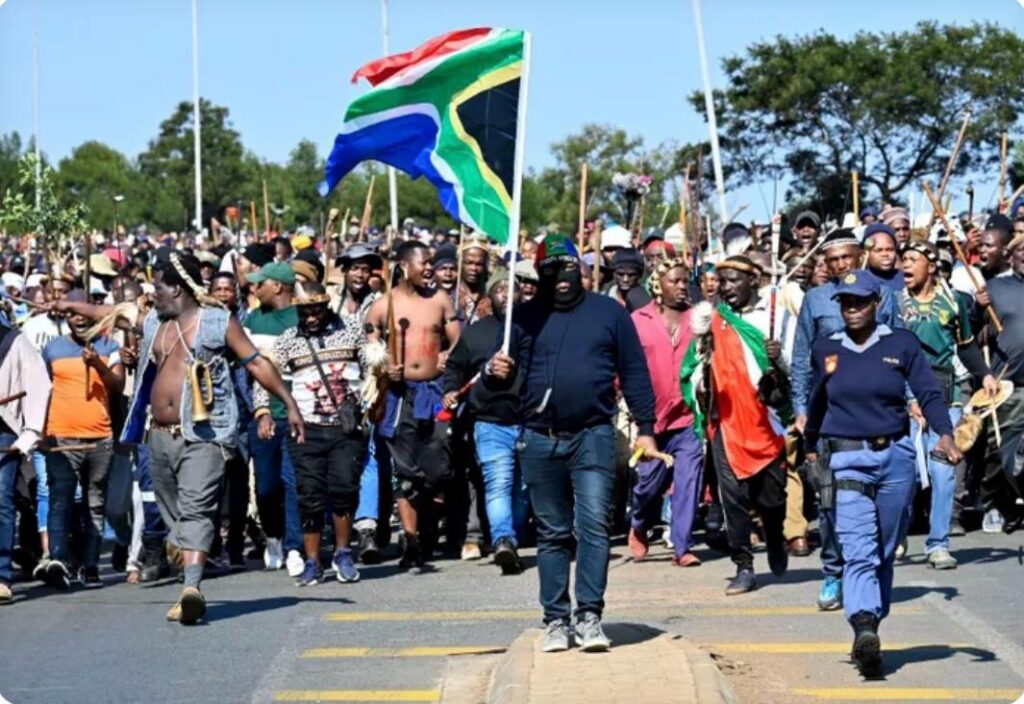
South Africa’s (SA’s) highly anticipated 30 June anti-illegal immigration protests passed largely without the widespread violence many had feared, as thousands marched in cities across the country under a heavy security presence.
While the day remained mostly peaceful, there were isolated incidents of unrest.
Two people were wounded in a shooting in Hillbrow, the South African National Defence Force was deployed to parts of Johannesburg, and police made several arrests linked to looting in Cape Town, Durban and elsewhere.
The demonstrations were sparked by a 30 June deadline set by anti-illegal immigration groups, which had demanded that undocumented foreign nationals leave the country. The call drew large crowds to the streets of Durban, Johannesburg, Pretoria and Cape Town, with smaller marches taking place in several other towns.
Smaller marches also took place in towns including Hermanus, Gqeberha, Kroonstad, Tzaneen, Thohoyandou and Kimberley.
The deadline had been set by anti-immigration citizen groups, chief among them the March and March movement, led by former broadcaster Jacinta Ngobese-Zuma, alongside movements such as Operation Dudula and the Amabutho.
And as the marches wound down, Ngobese-Zuma told supporters in Durban the campaign was only beginning, vowing protests every Thursday until undocumented immigrants were gone.
“For as long as they haven’t left, we are marching every Thursday,” Ngobese-Zuma said.
Acting police minister Firoz Cachalia says officers moved quickly to stamp out looting wherever it broke out.
“Members deployed across the country have been instructed to act swiftly and decisively against anyone who engages in criminal activities, including looting and attempted looting,” Cachalia spokesperson Kamogelo Mogotsi says.
In Johannesburg, the country’s financial hub, most businesses closed during a march of several thousand people, with many workers staying home and public transport limited.
Men and women in blue in bulletproof vests and helmets stood watch as marchers hoisted placards demanding SA pull out of the United Nations refugee convention.
They warned of a threat to “the future of our kids”, and claimed the vast majority of children born in Limpopo are born to foreign nationals.
The march moved through Hillbrow and Yeoville, areas of the city known to house many immigrants, with some smaller groups breaking off to throw stones at windows as police and private security looked on.
Protesters lit fires in the city centre as the march wound through the streets.
Gauteng police spokesperson colonel Dimakatso Nevhuhulwi says three suspects had been arrested after two people, including a 17-year-old, were shot and wounded during the protest.
The men had allegedly opened fire on protesters passing through the street, and the marchers had then set fire to the suspects’ vehicle.
The SA National Defence Force was deployed to Hillbrow as tensions rose.
Gauteng deputy police commissioner major general Fred Kekana says the march was peaceful and under control.
“The people are marching, and of course, it is their right to march,” Kekana says.
“Even after tomorrow, we are not going to stop operating and ensuring that the community is safe.”
Gauteng provincial commissioner lieutenant general Tommy Mthombeni had warned that anyone inciting violence or breaking the law would be tracked and arrested, with police deploying helicopters, drones and more than 33 000 CCTV cameras.
In Durban, more than 15 000 people gathered in the city centre, in what became the largest march of the day.
Made up mostly of young people bused in from townships around the city, the crowd carried traditional weapons, cowhide shields and knobkieries.
The march began at King Dinuzulu Park, moved through the Durban central business district and ended at the Point police station, where organisers handed over a memorandum.
The crowd refused to be addressed by eThekwini mayor Cyril Xaba and deputy police minister Cassel Mathale.
ActionSA KwaZulu-Natal leader Zwakele Mncwango has accused the government of failing to secure the country’s borders.
“We have been very consistent on the issue of illegal immigration,” Mncwango says.
“Our country has been invaded, but one must also clarify this point: there’s nothing wrong if people come from other countries legally.”
Mncwango dismissed intelligence reports that had warned of violence and looting, and criticised the money spent on policing the marches.
Addressing the crowd at the Point, Ngobese-Zuma said South Africans of all backgrounds had united behind the campaign.
“Thousands of our people have gathered across the length and breadth of our country, united in their diversity,” she said.
“White, Black, Indian, Coloured, Xhosa, Tsonga, Tswana, Swati, Zulu and all the indigenous people of our country are longing for a safe and prosperous SA.”
She rejected accusations that the movement was xenophobic.
“This is not xenophobia and it is not ethnic mobilisation,” Ngobese-Zuma said. “It is a fight for the social well-being of South Africa in particular and Africa in general.”
She argued that employers were hiring foreign nationals at the expense of South Africans.
“We hope the government has a budget for another R600 million,” she said, referring to the amount Cachalia confirmed had been set aside for Tuesday’s security operation.
Not everyone in Durban shared the peaceful intent, and an angry regiment leader says the marchers had come to fight.
But anti-illegal immigration activist Nkosikhona Ndabandaba says the day had proved the doubters wrong.
“We were united and defeated the narrative peddled by doomsayers who had wished that our protest would descend into chaos,” Ndabandaba says.
KwaZulu-Natal transport executive council member Siboniso Duma says the province had remained largely peaceful, with teams monitoring the N2, N3 and other corridors from before dawn.
“Some of us have been up since 04h00,” Duma says.
“We are proud to mention that in all our districts, things were smooth in the majority of the areas; however, we have to highlight that in Mariannhill and Clermont there were some incidents that were contained and managed instantly,” he says.
“We are glad and delighted that in the province of KwaZulu-Natal it was peaceful,” he says.
There was, however, sporadic looting in the province, including a break-in at a tuck shop in Hammarsdale and an attempt to break into a foreign-owned tuck shop in Briardene.
In Sydenham, the police arrested a woman for assaulting officers who had intervened to stop an attack on a foreign national, and in Pietermaritzburg four people were arrested for looting foreign-owned tuck shops at the Madiba informal settlement.
The Durban police also opened an inquest after a foreign national died on Margaret Mncadi Avenue on Monday night.
Police spokesperson colonel Robert Netshiunda says three foreign nationals had allegedly broken into a storage facility and stayed there for three days.
“They reportedly heard noises and concluded that they were being targeted,” Netshiunda says.
“One of them jumped from the eighth floor and sustained broken limbs,” he says.
He says the man had been declared dead at the scene, and that the immigration status of the deceased and the others was being verified.
In Cape Town, the shutdown was largely contained.
“The 30 June shutdown has been largely contained in Cape Town,” safety and security political head JP Smith says.
“Two marches that took place in the CBD and Kraaifontein concluded, for the most part, without incident,” Smith says.
“We have experienced what appear to be opportunistic looting attempts in some areas, most notably Delft, Wesbank and Hanover Park.
“Services were on scene quickly and managed to shut down these acts – at last count, a dozen suspects have been arrested by police and metro agencies, on charges including public violence, theft and malicious damage to property.
“The enforcement staff will remain on high alert overnight to monitor for and respond to any additional attempts at criminality directed at foreign nationals or businesses,” he says.
Earlier, two groups of marchers had converged on the Kraaifontein police station to hand over a memorandum, and a stun grenade was fired to restore order after a section of the crowd turned riotous.
Authorities say claims on social media of xenophobic violence in Gugulethu were false, and related to a cash-in-transit robbery.
In the Overberg, Overstrand mayor Archie Klaas says two protests had taken place, one in Hermanus and one in Stanford, with about 200 people joining the two marches.
In the town of Gansbaai, police mounted foot patrols, but the streets were quiet after foreign nationals had been driven out of the township in earlier unrest.
Along the Garden Route, Mossel Bay mayor Dirk Kotze says the situation was calm and normal, while George saw only small protests and Thembalethu sporadic demonstrations that did not get out of hand.
In the Eastern Cape, the provincial government says the day had passed off calmly, with marchers singing and dancing before handing over memorandums.
“The Eastern Cape provincial government continues to monitor march activities across the province through the Provincial Joint Operations and Intelligence Centre, with the overall situation remaining calm and stable,” provincial spokesperson Khuselwa Rantjie says.
“While marches continue in hotspot areas across various municipalities, no major incidents of unrest or violence have been reported thus far.”
In Buffalo City metro, a march commenced in KwaGompo township, while several businesses remained closed as a precautionary measure.
In Nelson Mandela Bay, the joint operations centre has similarly confirmed that no incidents of public unrest or protest action have been reported, with monitoring continuing throughout the metro.
Community safety executive council member Xolile Nqatha commends residents for keeping the peace.
“We are encouraged that the situation has remained calm and stable, despite expectations that marches will continue in some identified areas,” Nqatha says.
“We commend communities for acting responsibly and urge all those participating in marches to do so peacefully and within the confines of the law.”
Also in Nelson Mandela Bay, disaster management head Sindisiwe Nyide says the metro had remained calm and stable, with only isolated march activity and no incidents of violence or damage to infrastructure.
The police say 76 undocumented foreign nationals, including seven children, had been arrested during a joint operation in central Gqeberha on Monday.
In the Free State, anti-immigration protesters took to the streets in Mangaung, claiming their communities had been blighted by drugs allegedly sold by foreign nationals.
In Bloemfontein, the Nigerian husband of a senior Free State politician was arrested after about 28 undocumented foreign nationals were found hiding at his guesthouse.
Premier MaQueen Letsoha-Mathae says the occupants had been staying at the property for about a week without leaving.
“It’s a guesthouse where we had about 28 to 29 people that were arrested because they were hiding in this place,” Letsoha-Mathae says.
“What we have observed or what the police have found is that most of them don’t have documents,” she says. “They are illegal immigrants from different countries.”
She says officers had also found a Nigerian passport together with the death certificate and identity document of a deceased SA woman.
In Limpopo, police spokesperson Brigadier Mashaba says no violent incidents had been reported, and that a video of a shop being looted in Steelpoort was old footage and disinformation.
He says the police had arrested a farm owner (48) and 15 undocumented workers at a farm in Trichardsdal, near Tzaneen, for contravening the Immigration Act.
In Mpumalanga, police spokesperson lieutenant colonel Jabu Ndubane says there had been no major incidents linked to the protests.
In the Northern Cape, about half the businesses in Kimberley’s central business district traded as usual, with smaller shops shuttered, as marchers walked from the Kemo Hotel to the premier’s office.
The police say they had arrested 15 384 people nationwide in operations between 22 and 28 June, including 2 884 foreign nationals for immigration offences.
The National Joint Operational and Intelligence Structure says more than 25 000 foreign nationals had been repatriated, and that it had recorded at least 103 cases of anti-immigrant violence and made 195 arrests since 1 March.
Business groups have reported that the marches had been broadly peaceful, with major shopping centres trading as usual, though smaller informal traders and foreign-owned shops were targeted.
Delivery and e-hailing services were also disrupted as foreign drivers stayed home.
President Cyril Ramaphosa had called for calm and condemned attacks on foreign nationals, and said only the state could enforce immigration law.
Ngobese-Zuma said she was unaware of a reported meeting between Ramaphosa and leaders allied to the campaign, after the president met two anti-immigration leaders, Ndabandaba and Ngizwe Mchunu, on Monday to urge a peaceful protest.
– IOL
The post How South Africa’s 30 June unfolded: appeared first on The Namibian.