Kampala has enough water. Why are taps still dry?
Millions of litres of treated water leave Kampala’s treatment plants every day, yet households and businesses across the city and its surrounding districts continue to struggle with dry taps, low pressure and unpredictable supply. The problem, according to the National Water and Sewerage Corporation (NWSC), is not that Greater Kampala lacks enough water. Much of […] The post Kampala has enough water. Why are taps still dry? appeared first on The Observer Media Ltd.
 Black News

Millions of litres of treated water leave Kampala’s treatment plants every day, yet households and businesses across the city and its surrounding districts continue to struggle with dry taps, low pressure and unpredictable supply.
The problem, according to the National Water and Sewerage Corporation (NWSC), is not that Greater Kampala lacks enough water. Much of the difficulty lies in getting it from treatment plants to the people who need it.
NWSC has now launched a Shs 6 billion project, dubbed K-Flows, to address the ageing and overstretched distribution network responsible for persistent shortages. The project targets Kampala and surrounding areas, including Mukono, Entebbe, Wakiso, Matugga, Bombo and parts of Mpigi.
It will involve constructing new pipelines, expanding existing infrastructure, installing water reservoirs and boosting pressure in areas where supply has remained unreliable.
The initiative was launched on November 5 at the International Resource Centre in Bugolobi, where NWSC branch managers and engineers met to plan its implementation.
Kampala Water general manager Mahmood Lutaaya said the interventions would address supply interruptions affecting more than five million customers across Greater Kampala. In some neighbourhoods, residents endure water rationing lasting up to six hours. Elsewhere, low pressure prevents water from reaching homes and businesses consistently.
The situation is worsened when water pipes are damaged during road construction, industrial development and other infrastructure works.
“There’s enough water to meet the demand in Kampala but there are bottlenecks in the supply system. For example, when our pipes are cut or damaged, relocating or repairing them causes interruptions in the water supply and, in the process, we’re forced to ration some areas to give water to other parts,” Lutaaya explained.
ENOUGH WATER, BUT LIMITED DISTRIBUTION
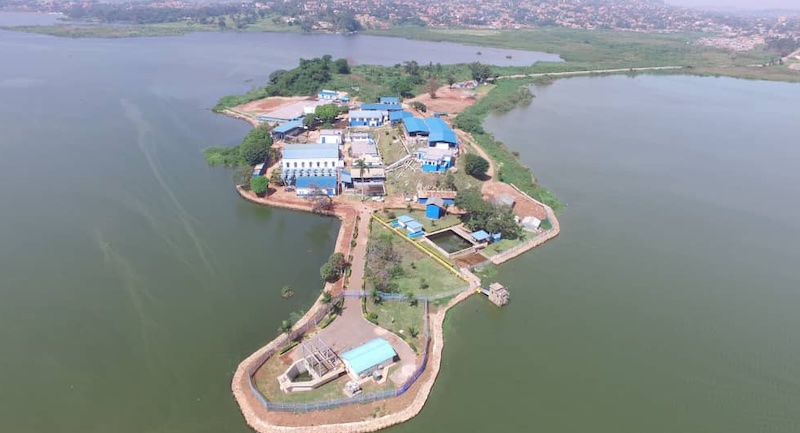
Figures from NWSC illustrate the contradiction. Greater Kampala receives water from two major treatment facilities: the Ggaba Water Treatment Complex on Lake Victoria, which supplies 240 million litres daily, and the Katosi Water Treatment Plant in Buikwe, with a capacity of 160 million litres.
Together, the facilities have a reported daily production capacity of 400 million litres, compared with estimated demand of 330 million litres. That represents a potential surplus of 70 million litres a day.
However, production capacity does not necessarily mean all that water can reach consumers. NWSC director of public relations and corporate communications Samuel Apedel said the corporation has sufficient treatment capacity but lacks the infrastructure needed to distribute the available water efficiently.
“We have a lot of water in the supply system but we are constrained in moving it to our customers, and that is what we are going to solve through this K-Flows project,” Apedel assured.
He revealed that NWSC currently uses only 60% of the water available from Katosi, highlighting the need to strengthen transmission and distribution infrastructure rather than simply increase production.
WHICH AREAS WILL BENEFIT?
K-Flows will include a 71-kilometre pipeline, new reservoirs and booster facilities in Kkungu, Kanyanya, Kabulengwa and Mutungo. Booster facilities increase pressure in water pipes, helping water reach neighbourhoods where the existing network cannot deliver it reliably.
Kampala Water chief manager for water supply, Eng Francis Kateeba, said a new supply line and reservoirs at Kanyanya would improve delivery to Matugga, Wakiso, Nansana, Mpererwe and Lutete.
NWSC also plans to drill boreholes in Kasenge, Maya, Nabbingo, Nalumunye and Nankulabye to strengthen local supplies. Lutaaya said customers in some of the affected neighbourhoods should begin noticing improvements by December 2026.
The corporation has indicated that the full works will be completed around June or July 2027, although the different completion dates require clarification.
The investment comes as rapid urbanization, industrial expansion and population growth increase pressure on Greater Kampala’s water network. NWSC managing director Dr Silver Mugisha urged managers and engineers to implement the project efficiently and avoid unnecessary expenditure.
“We shall come and do a value-for-money audit of the entire project, so be careful,” Mugisha cautioned.
The post Kampala has enough water. Why are taps still dry? appeared first on The Observer Media Ltd.