Minister Farrakhan’s guidance is a benefit to the African diaspora
In 2012, I wrote an article in the New York Amsterdam News titled “Farrakhan’s cry may be our last chance at responding to the inevitable.” In my commentary, I wrote about Jamaican columnist Betty Ann Blaine, who, in an article she wrote at the time, focused on the challenges of Caribbean politics that troubled the […] The post Minister Farrakhan’s guidance is a benefit to the African diaspora appeared first on Final Call News.
 Black News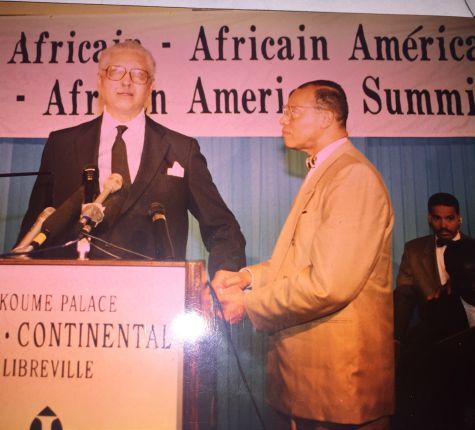


In 2012, I wrote an article in the New York Amsterdam News titled “Farrakhan’s cry may be our last chance at responding to the inevitable.”
In my commentary, I wrote about Jamaican columnist Betty Ann Blaine, who, in an article she wrote at the time, focused on the challenges of Caribbean politics that troubled the social, economic, and political conditions of both the West Indies and the African continent. The lack of willingness, including neocolonial impediments, prevented the building of coalitions that could have expanded Blaine’s critique to include Africa and the entire North American African diaspora. In her 2012 treatise, Blaine, a columnist for the Jamaican Observer, expressed particular concern for religious leaders and their roles.

Quoting Rev. Dr. Martin Luther King Jr. and his critique of the Black church, she wrote, “In spite of the noble affirmations of Christianity, the church has often lagged in its concern for social justice and too often has been content to mouth pious irrelevances and sanctimonious trivialities.”
She continued, writing, “Any religion that professes to be concerned with the souls of men and is not concerned with the economic and social conditions that strangle them and the social conditions that cripple them is the kind the Marxist describes as ‘an opiate of the people.’”
As I wrote in my 2012 article, Blaine’s ruminations were a direct response to Minister Farrakhan’s first leg of his Caribbean tour and his past tours of Africa, including his highly anticipated address to African heads of state and delegates at the Second African/ African-American Summit in Libreville, Gabon, in May 1993.
During his 1993 message, Minister Farrakhan highlighted the need for unity between Africans in the diaspora. His weighty words focused on bridging the gap between Africa and Black Americans, fostering a “strong united hand,” and making Africa into a 21st-century superpower.
Minister Farrakhan, whose parents hailed from the West Indies, delivered a similar message in the Caribbean, calling for regional unity as the only way for Caribbean peoples to withstand the onslaught of Western economic and cultural imperialism. His message, especially geared toward the entire Black world, is to galvanize economic and political resources and synthesize ideological bents as the only way to survive.
However, Minister Farrakhan has also explained the importance of not being beholden to outside influences, something that our people in America, Africa and the Caribbean should take heed to.
The continuing “absence of moral capital” and the manifested “poverty of ideas,” as declared by Blaine in her description of the Caribbean region’s ruling class, which is being replicated in Africa, can be summed up in Minister Farrakhan’s July 10, 2010, open letter to Black leaders.
In it, he describes the inability of the wealthy and influential to effect positive changes among the masses if they are beholden to outside forces.
“However, have you ever noticed that no matter how rich and powerful some of us have become, we have never been shown how to network with the wealthy and learned of our people, pooling our resources that we may produce for our people that which would grow us from a begging position as little children to become masters of our own destiny?”
The absence of original or good ideas geared toward self-actualization and self-reliance is evident in the neoliberal directives from which some government leaders derive their marching orders. And at times, as the popularity of many Black government officials or heads of state increases, their connection to their constituents’ needs can decrease. Likewise, as their relationships with those in the past, they were critical of increases—including multinational interest groups—addressing the needs of their community, becomes co-opted. It becomes compromised by approaches that take into account the newfound support they receive from those with whom they were once in opposition.
During his address at the summit in Gabon, Minister Farrakhan referenced both the Bible and the Holy Qur’an to encourage the Black American and African leaders to seek a higher power than the neocolonialism that continues to deny Africa its ability to unify and realize its full potential.
“We are here at a summit because each one of us is losing power, authority, wealth, self-esteem, and the dignity of our own humanity because we’re in a new form of slavery called debt. Surely, man is in loss. Why, because we are not aware of the time,” Minister Farrakhan said.
“It is not the time by our watch, but the time by Allah’s (God’s) measurement of time. What time is it? We are at the time of the end of White supremacy. We are at the time of the end of White domination of the darker peoples of the world. We are at the time of the end of racism, sexism and materialism,” he said.
Today, in 2026, for the African continent, watching from afar, the destabilization of the Western world’s economic system is not enough. Africa and Africans and Blacks in the diaspora must prepare for the possibility of a prolonged war in the Middle East and its impact. For Africa, unity would have global implications that, in turn, would impact the world.
As economist Jeffrey Sachs noted in the April 16 edition of the International Affairs Forum, on their own, 55 individual African nations are too small to achieve the kind of global role and competitiveness the continent needs.
“However, if Africa truly creates a political, economic, financial, and eventually monetary union, then it will be able to emulate the great successes of China and India. With a single market, a unified financial system, and increasing monetary integration, Africa will be well positioned to create a truly unified economic space, also deeply interconnected by transboundary infrastructure (for power, fiber, roads, rail, shipping, and ecosystem management). Moreover, with a strong union, Africa will be positioned to play a global diplomatic role as well, helping to lead global decision-making in key international forums.”
This unity also applies to the Caribbean nations and Black America, all of which should heed Minister Farrakhan’s guidance, benefiting the entire diaspora.
Follow Jehron Muhammad @africawatchfcn on X
The post Minister Farrakhan’s guidance is a benefit to the African diaspora appeared first on Final Call News.