Nigeria targets $74bn livestock boom to tackle food crisis and inflation
Nigeria’s federal government has set out plans to expand the country’s livestock industry to $74bn over the next decade, positioning the sector as a key lever to address food insecurity, curb inflation, and support economic stability.
 Black News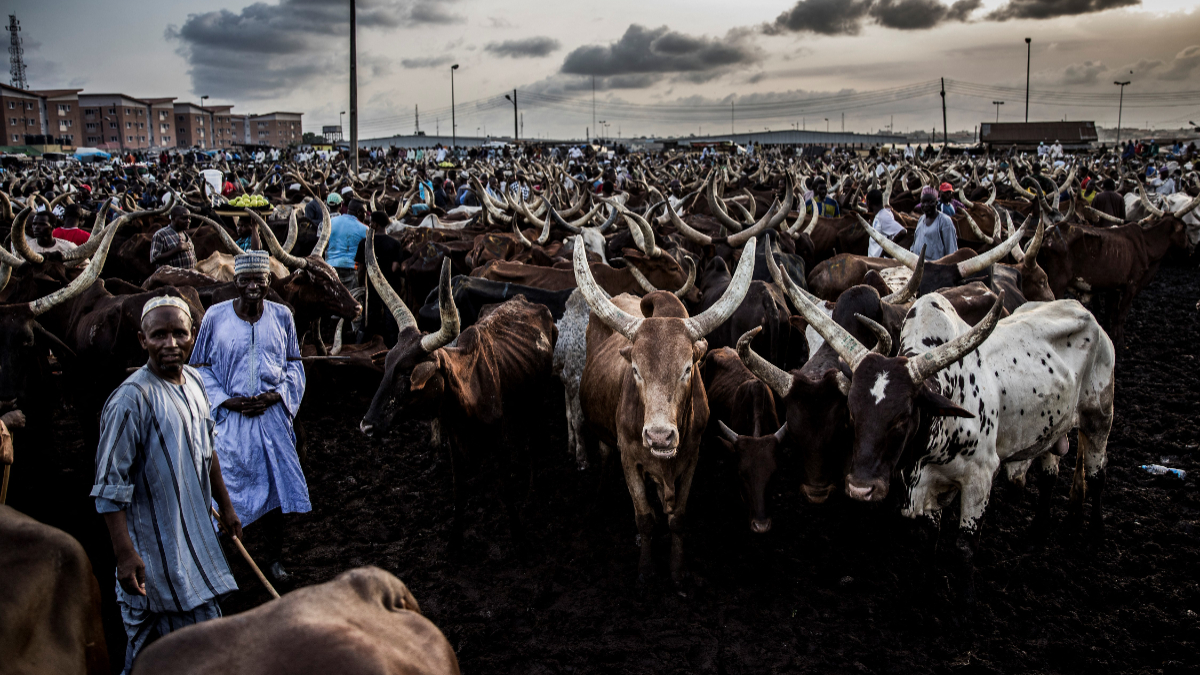


![Herdsmen along with their cows wait for buyers at Kara Cattle Market in Lagos, Nigeria. Kara cattle market in Agege, Lagos is one of the largest of West Africa receiving thousands of cows weekly due to the massive consumption of meat in Lagos area. [Photo by LUIS TATO/AFP via Getty Images]](https://ocdn.eu/pulscms/MDA_/41da371cb2c7cbb44b967bd5ba2ecc92.jpg)
Nigeria’s federal government has set out plans to expand the country’s livestock industry to $74bn over the next decade, positioning the sector as a key lever to address food insecurity, curb inflation, and support economic stability.
- Nigeria plans to expand its livestock industry from $32bn to $74bn over the next decade.
- The move is part of wider efforts to address food insecurity and stabilise the economy.
- More than 25 million Nigerians face acute hunger amid persistent food inflation above 30 per cent.
- Officials say cheaper financing, improved infrastructure, and better security are key to unlocking growth.
The proposal, outlined at the ninth Vanguard Economic Discourse in Lagos, forms part of a broader strategy to revitalise agriculture, which contributes roughly a quarter of Nigeria’s gross domestic product and employs up to 40 per cent of its workforce.
Speaking on behalf of the Minister of Livestock Development, Idi Maiha, adviser Eustace Iyayi said the government aims to grow the sector from its current estimated value of $32bn to $74bn by 2035 through a 10-pillar transformation plan.
“Agriculture remains central to Nigeria’s economy… yet the country continues to grapple with persistent food insecurity,” Iyayi said.
The urgency of the reforms reflects mounting strain on Nigeria’s food systems. More than 25 million people are at risk of acute food insecurity, according to figures cited at the event, while food inflation has stayed above 30 per cent in recent periods, eroding household incomes.
Although the livestock sector accounts for between five and eight per cent of GDP and about one-third of agricultural output, officials say it remains underperforming. Average daily animal protein intake stands at 7 to 10 grams per person, well below the recommended minimum of 20 grams.
![Hausa-Fulani pastoralists and cattle buyers wait for cattle transactions while sitting on a metallic fence at Kara Cattle Market in Lagos, Nigeria. [LUIS TATO/AFP via Getty Images]](https://ocdn.eu/pulscms/MDA_/e83f373f68e2d138e2cc8ea161ca6576.jpg)
Nigeria has one of Africa’s largest livestock populations, including tens of millions of cattle, sheep, and goats, as well as nearly 700 million poultry birds. However, productivity has been constrained by limited access to quality feed, weak animal health systems, poor genetics, and inadequate infrastructure.
The government’s reform agenda focuses on improving feed and fodder systems, expanding veterinary services, increasing access to finance, and strengthening market infrastructure. Iyayi highlighted high borrowing costs as a major obstacle, warning that current interest rates of 23 to 25 per cent are unsustainable for agricultural investment.
“There is no viable agricultural business with interest rates at 23 to 25 per cent,” he said, calling for single-digit lending rates.
Officials also identified insecurity in farming regions and post-harvest losses, estimated at up to 40 per cent for perishable goods, as critical challenges to be addressed.
Participants at the forum, including international development agencies and local stakeholders, stressed that food security is increasingly tied to broader economic and national stability.
“Food security is no longer just an agricultural issue. It is a pillar of national security and economic resilience,” Iyayi said.