Nigeria’s exports hit nearly $1 billion as non-oil trade gains traction in 2026
Nigeria’s export sector expanded sharply in the first quarter of 2026, signalling renewed momentum in non-oil trade as volumes, revenues and port activity all recorded strong gains, according to new data released by the Nigeria Customs Service.
 Black News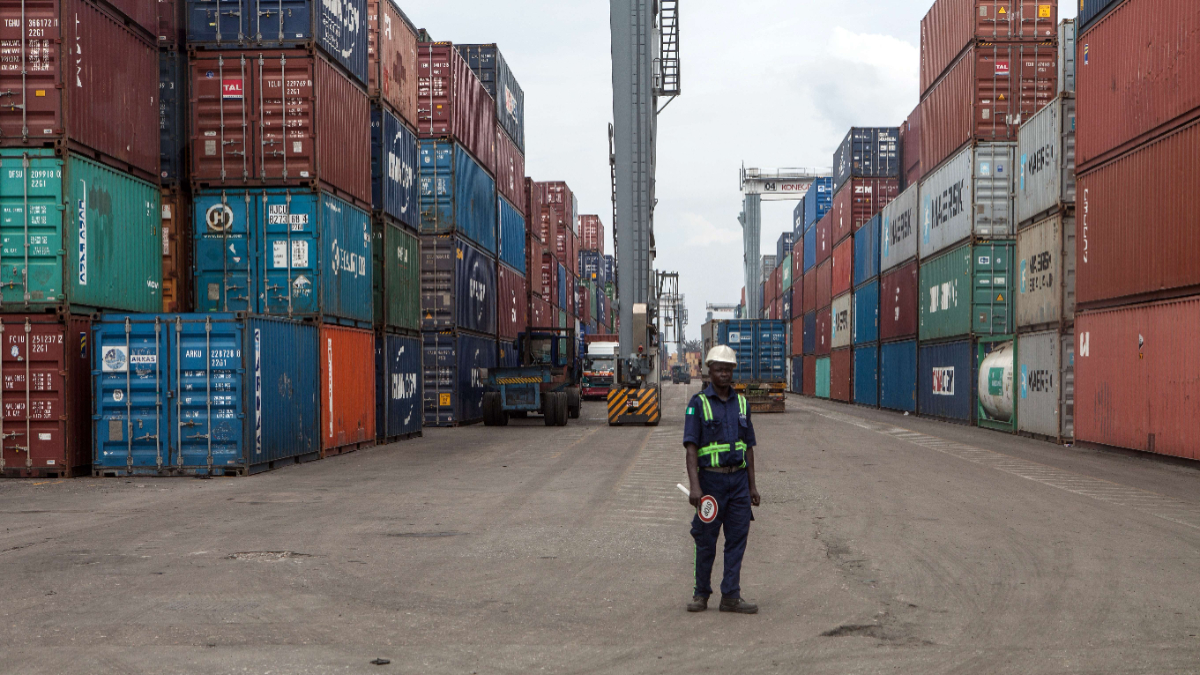
![A member of the security stands among containers at the Lagos Tin-Can Island container terminal in Apapa, on October 7, 2015. Tin Can Island Port is Nigerias second largest seaport about seven kilometers due west of the city centre of Lagos across Lagos harbor. [Photo by FLORIAN PLAUCHEUR/AFP via Getty Images]](https://ocdn.eu/pulscms/MDA_/9bd8ae30b05ab2d44078069870461172.jpg)
Nigeria’s export sector expanded sharply in the first quarter of 2026, signalling renewed momentum in non-oil trade as volumes, revenues and port activity all recorded strong gains, according to new data released by the Nigeria Customs Service.
- Nigeria’s exports rose by 38.68% in Q1 2026, signalling renewed strength in non-oil trade.
- Container traffic nearly doubled, reflecting improved port operations and logistics capacity.
- March drove the surge, recording a 135.83% year-on-year jump in export value.
- Rising export-linked revenues suggest diversification efforts may be gaining traction.
Total exports rose by 38.68% year on year to $925.84 million, underscoring what officials describe as a rebound in trade outside the country’s dominant oil sector. At the same time, export container traffic nearly doubled, climbing from 9,722 units in the first quarter of 2025 to 19,014 in the same period this year, a 95.58% increase.
In its report, the agency said, “exports processed in Q1 2026 stood at $925.84m, representing a 38.68% increase compared to Q1 2025, while total containers handled rose to 19,014 from 9,722, indicating a 95.58% growth.”
The rise points to improving logistics capacity and more efficient port operations, factors widely seen as critical to Nigeria’s long-running efforts to diversify its economy.
Monthly data show a mixed start to the year, followed by a strong finish. Exports dipped slightly in January, falling by 1.12% to $267.66 million from $270.70 million a year earlier, before recovering in February with a 12.43% increase to $253.12 million. The most significant acceleration came in March, when exports surged by 135.83% to $425.48 million, up from $171.76m in March 2025.
“March 2026 recorded the highest export performance within the quarter at $425.48 million, reflecting a 135.83% increase year-on-year and driving the overall quarterly growth,” the report noted.
Revenue linked to export activity also increased. Export surcharge collections rose from N163.66 million, about $109,000, in Q1 2025 to N199.36 million, roughly $133,000, in Q1 2026, a 21.81% increase. Similarly, collections under the Nigerian Export Supervision Scheme rose from N5.01 billion (approximately $3.34 million) to N6.03 billion (approximately $4.02 million), representing a 20.15% increase.
The growth in these revenue streams reflects higher export volumes and suggests that non-oil sectors such as agriculture, manufacturing and solid minerals may be gaining ground.
The data comes amid ongoing policy efforts to improve trade facilitation, reduce port bottlenecks, and boost export competitiveness. Increased container throughput, in particular, indicates stronger utilisation of port infrastructure and a more active trade environment.
Nigeria Customs, which plays a central role in trade facilitation and revenue generation, has in recent years recorded steadily rising collections. In 2025, the agency generated N7.281 trillion, approximately $4.85 billion, exceeding its target of N6.5 trillion, about $4.33 billion, by N697 billion, or roughly $465 million. The figure also marked a year-on-year increase from N6.1 trillion, about $4.07 billion, recorded in 2024.
The Service has set a revenue target of around N9 trillion, equivalent to about $6 billion, for 2026.
While the latest figures suggest that reforms may be beginning to yield results, analysts say sustaining growth will depend on consistent policy implementation, stable exchange rates and continued investment in infrastructure. March’s sharp uptick provides momentum, but maintaining that pace for the rest of the year will be a key test for Nigeria’s trade outlook.