Putin pushes for AI sovereignty as Russia, Kazakhstan deepen technology ties
Russian President Vladimir Putin has called for greater domestic control over artificial intelligence, warning that dependence on foreign technology could expose countries to external interference and undermine national sovereignty. Putin said global technological leadership would increasingly depend on how countries combine human capabilities with autonomous systems, arguing that Russia must develop its own artificial […] The post Putin pushes for AI sovereignty as Russia, Kazakhstan deepen technology ties appeared first on Daily Star.
 Black News
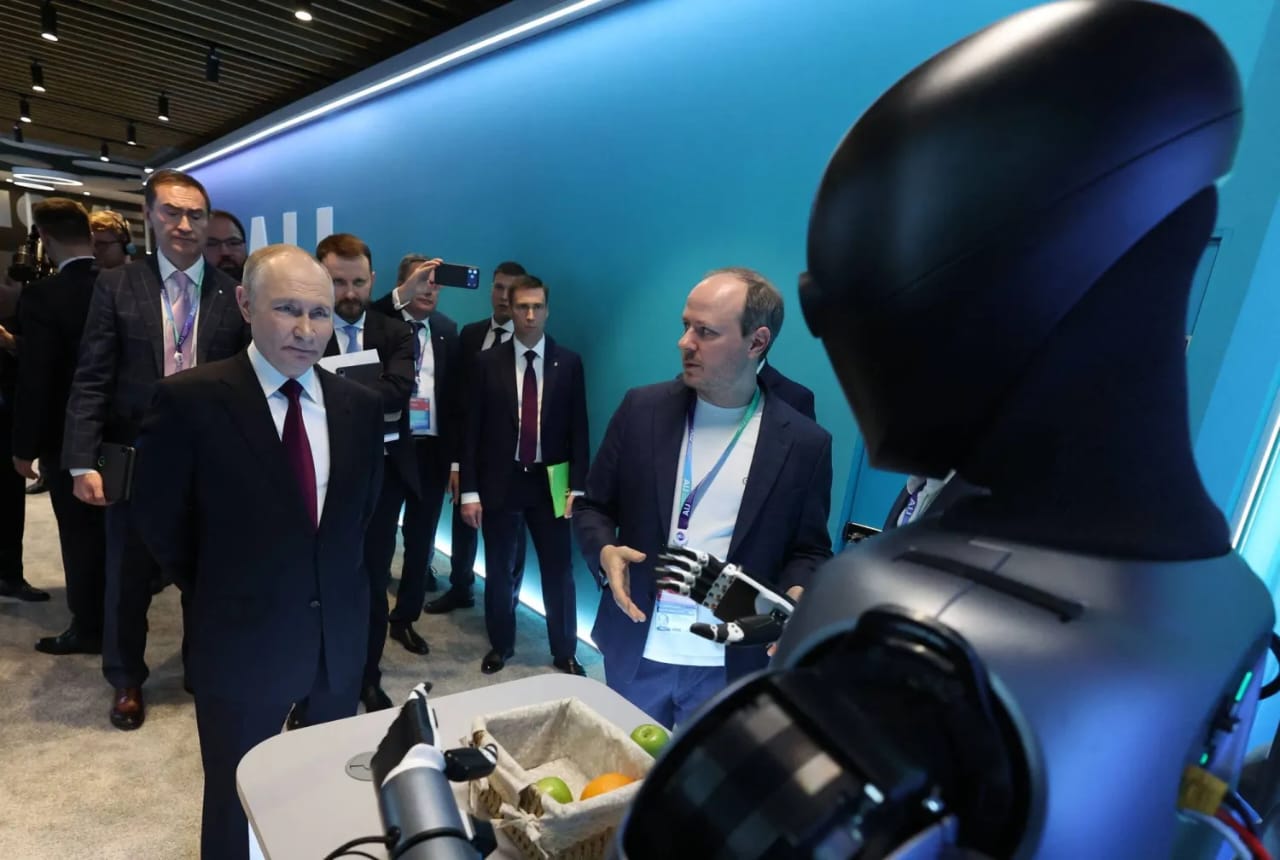
Russian President Vladimir Putin has called for greater domestic control over artificial intelligence, warning that dependence on foreign technology could expose countries to external interference and undermine national sovereignty.
Putin said global technological leadership would increasingly depend on how countries combine human capabilities with autonomous systems, arguing that Russia must develop its own artificial intelligence technologies to protect its strategic interests and strengthen its scientific and economic competitiveness.
“To rule the world and take leadership positions now … one needs to ensure the most harmonious cooperation of man and autonomous system,” he said.
While describing artificial intelligence as a powerful tool for innovation and human advancement, Putin warned that the technology could also become dangerous if developed or deployed without adequate safeguards.
“AI can be a powerful tool in human hands: for both creating, and doing harm,” he said, cautioning that it could turn into a “malevolent agent”.
He argued that Russia’s priority should be to ensure artificial intelligence serves people by improving livelihoods, supporting human development and strengthening national capabilities.
Central to this ambition, Putin said, is the development of domestic AI systems built on Russian technology, data and values rather than excessive dependence on foreign platforms.
He warned that AI models trained on foreign data and cultural values could gradually influence the thinking of millions of people, making technological independence an important component of national security and sovereignty.
Russia, he said, must avoid a situation in which foreign powers could use artificial intelligence against it or remotely disable critical systems.
To reduce such vulnerabilities, Putin proposed digitising national archives and other information resources to provide locally developed AI models with data reflecting Russian history, culture and values.
He also called for mobile operating systems sold in Russia to give users a choice of artificial intelligence applications, including locally developed alternatives.
Putin further proposed public-private partnerships to accelerate investment in data centres and called for an update of Russia’s national AI strategy, with a planning horizon extending to 2036.
His proposals also addressed the risks artificial intelligence poses to workplaces, education and scientific research. He warned that employees secretly using foreign AI platforms could expose personal information and commercial secrets, calling for clear limits on the activities autonomous AI agents can undertake without human supervision.
Putin also sees artificial intelligence as a possible response to Russia’s demographic and labour challenges, arguing that automation could improve productivity and support scientific research.
The push for technological independence comes as Russia and Kazakhstan seek to deepen cooperation in advanced technologies, with Kazakh President Kassym-Jomart Tokayev visiting Moscow in late November.
Tokayev met Putin at the Kremlin and attended the AI Journey 2026 conference, where he described technological development as an increasingly important pillar of the two countries’ strategic partnership.
He said the two countries’ shared history, longstanding friendship, economic relations and humanitarian ties provided a strong foundation for expanding cooperation in emerging technologies.
“We are witnessing the emergence of a fundamentally new geotechnological map of the world, in which access to advanced developments, computing power, and skilled personnel has become a defining factor for the competitiveness and security of nations,” Tokayev said.
He called for stronger international scientific cooperation, warning against concentrating critical technologies in the hands of a small number of countries and institutions.
The Kazakh leader also highlighted the importance of energy and transport infrastructure, noting that the expansion of artificial intelligence would increase demand for computing capacity and reliable electricity supplies.
He said Kazakhstan and Russia could explore establishing a digital transport corridor to improve connectivity and strengthen logistics between the two countries.
Tokayev also congratulated Putin on the outcome of a summit in China and the adoption of a declaration by three major powers.
He praised Russian engineering achievements as an important contribution to humanity’s intellectual heritage, describing them as evidence of Moscow’s determination to remain at the forefront of scientific and technological progress.
The latest engagements build on Putin’s state visit to Kazakhstan on May 27, 2026, when Tokayev hosted him in Astana. The two leaders discussed bilateral trade, energy, transport infrastructure and regional economic cooperation.
Russia and Kazakhstan have also continued strengthening their economic relationship, including expanding the use of national currencies in bilateral trade settlements.
The growing focus on artificial intelligence reflects a broader effort by Moscow and Astana to strengthen domestic technological capabilities, reduce external dependence and protect strategic interests as emerging technologies increasingly shape global economic and political power.
The post Putin pushes for AI sovereignty as Russia, Kazakhstan deepen technology ties appeared first on Daily Star.