Russia, China tip Africa as next global trade powerhouse as BRICS surpasses $1 trillion
The global economic centre of gravity is shifting, and Africa is increasingly being positioned as one of its biggest beneficiaries.
 Black News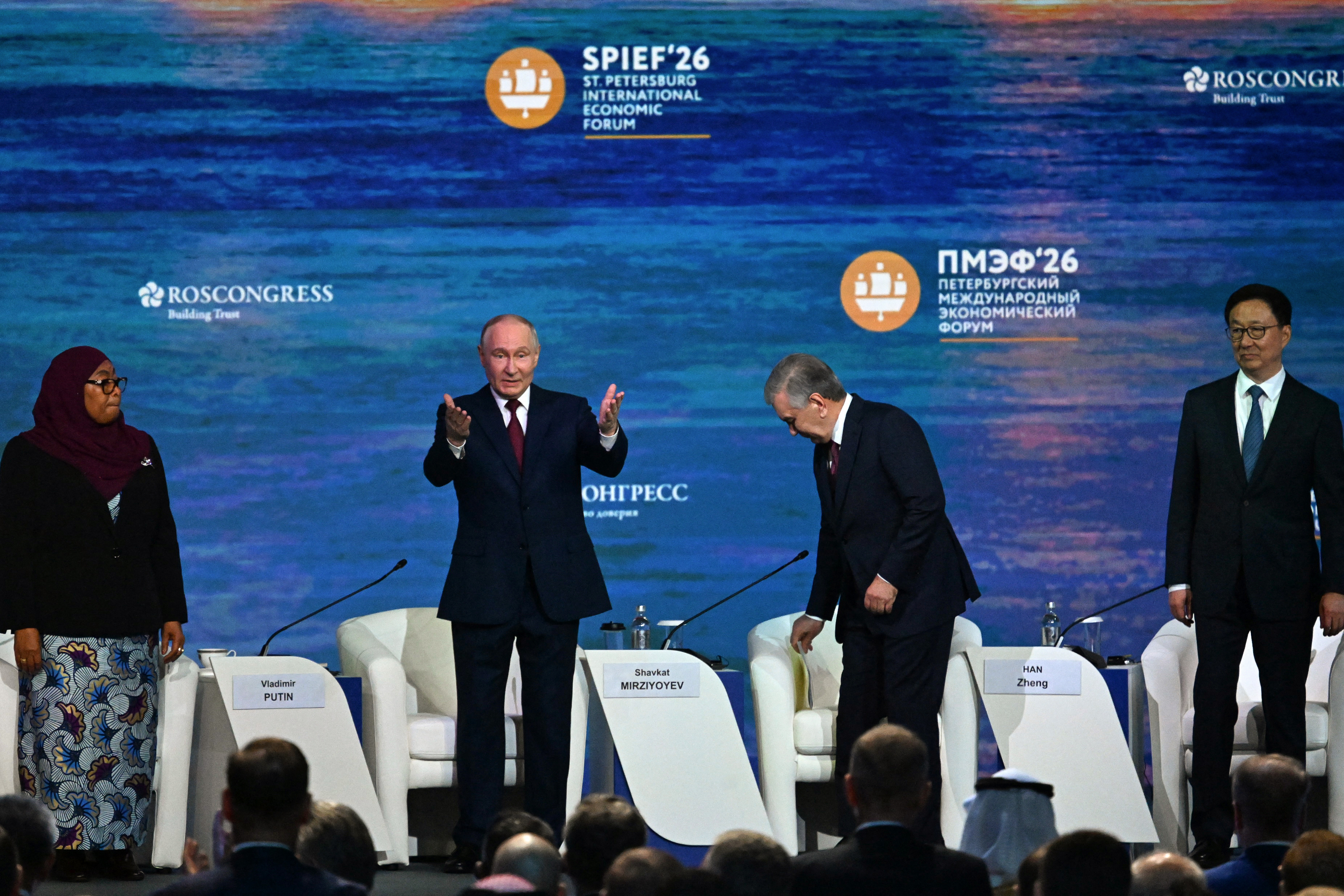
![Tanzania's President Samia Suluhu Hassan, Russian President Vladimir Putin, Uzbek President Shavkat Mirziyoyev and Vice President of the People's Republic of China Han Zheng arrive for the plenary session of the St. Petersburg International Economic Forum (SPIEF) in Saint Petersburg on June 5, 2026. [Photo by OLGA MALTSEVA / AFP via Getty Images]](https://ocdn.eu/pulscms/MDA_/638911e8df7b94677caa13091b57c53f.jpg)
The global economic centre of gravity is shifting, and Africa is increasingly being positioned as one of its biggest beneficiaries.
- BRICS countries now account for nearly 40% of global GDP and generated 49% of global economic growth over the past five years, according to Russian President Vladimir Putin.
- The bloc's share of global trade and high-tech exports has expanded significantly, highlighting a shift in economic and technological influence toward emerging markets.
- Tanzanian President Samia Suluhu Hassan said Africa's growing population, expanding middle class, and AfCFTA position the continent as a future engine of global growth.
- Leaders at the St. Petersburg International Economic Forum argued that emerging economies are increasingly shaping global trade, investment, technology, and development agendas.
Speaking at the plenary session of the 29th St. Petersburg International Economic Forum (SPIEF), Russian President Vladimir Putin said BRICS nations now account for nearly half of global economic growth and are rapidly expanding their influence in trade, technology, and investment.
Putin said the bloc, which includes Brazil, Russia, India, China, South Africa, and newer members, currently represents about 40% of global GDP measured by purchasing power parity. Over the past five years, BRICS countries generated 49% of annual global GDP growth, underscoring what he described as a growing shift toward emerging economies.
"The focus of global trade, and with it the financial system, will also shift. In fact, it is already shifting," Putin told delegates, which included Tanzanian President Samia Suluhu Hassan, Uzbek President Shavkat Mirziyoyev, and Chinese Vice President Han Zheng.
![Russian President Vladimir Putin delivers a speech during the plenary session of the St. Petersburg International Economic Forum (SPIEF) in Saint Petersburg on June 5, 2026. [Photo by OLGA MALTSEVA / AFP via Getty Images]](https://ocdn.eu/pulscms/MDA_/7e17e306488566e05ea2fa34b5f236c8.jpg)
According to Putin, BRICS countries have more than doubled their share of global merchandise trade since the bloc's creation and now account for almost a quarter of world exports. Trade among BRICS members has also surpassed $1 trillion.
One of the clearest signs of the bloc's growing influence, he said, is its expanding role in high-tech industries. BRICS nations now account for more than one-third of global high-tech exports, reflecting a broader redistribution of technological capabilities beyond traditional Western economies.
Putin highlighted China's leadership in artificial intelligence patents, India's strong position in the global software industry, and Russia's advances in digital services, online platforms, and nuclear energy technology.
But while discussions around BRICS often focus on Asia, African leaders at the forum argued that the continent's future economic role may be equally significant.
President Samia Suluhu Hassan said Africa's demographic and economic trajectory positions it as one of the world's most important growth regions in the coming decades.
"By 2050, one in every four people on this planet will be African. Nine of the world's twenty fastest-growing economies will be located on the African continent," Hassan said.
![In this pool photograph distributed by the Russian state agency Sputnik, Tanzania's President Samia Suluhu Hassan attends the St. Petersburg International Economic Forum (SPIEF) in Saint Petersburg on June 5, 2026. [Photo by Alexander KAZAKOV / POOL / AFP via Getty Images]](https://ocdn.eu/pulscms/MDA_/fd061ccfd513ab67d00ef4e37944b819.jpg)
She noted that Africa's middle class is expected to exceed one billion people, while the African Continental Free Trade Area (AfCFTA) is developing into the world's largest market by population.
Hassan said Africa is no longer merely a destination for investment but is increasingly defining its own development path through frameworks such as the African Union's Agenda 2063.
The Tanzanian leader also highlighted her country's recent investment gains, revealing that Tanzania attracted $12 billion in foreign direct investment in 2025. Reforms, including a one-stop investment centre and 24-hour online company registration, have helped position the country as one of Africa's fastest-growing investment destinations.
The forum also highlighted the growing strategic relationships emerging across the Global South. On the sidelines of SPIEF, Putin and Uzbek President Mirziyoyev launched construction of a nuclear power plant in Uzbekistan, which became a BRICS partner state in 2025.
Mirziyoyev said joint projects between Uzbekistan and Russia now exceed $50 billion, spanning energy, manufacturing, agriculture, logistics, and technology.
As geopolitical and economic power becomes more dispersed, discussions at SPIEF reflected a broader theme: emerging economies are increasingly seeking to shape their own growth models, trade networks, and technological futures.
For Africa, leaders argue, the coming decades could offer an unprecedented opportunity to move from the margins of the global economy to one of its key engines of growth.