The death of KOKO Networks: a post-mortem of a biofuel startup and the rise of carbon economies in Africa
What does the much-publicised rise and sudden death of a firm that boasted friends in Silicon Valley and Washington DC tell us about the climate crisis, structural underdevelopment in Africa and the frugal innovations designed to mitigate it? The closure of Koko Networks at the beginning of February elicited an interesting range of reactions in the country. Some cast suspicion on the Kenyan government, claiming that the company was denied the letter of authorisation (LoA) because it refused to pay rent to the political class. Others took on a more sympathetic view of the government, remarking that Koko’s closure should […] The post The death of KOKO Networks: a post-mortem of a biofuel startup and the rise of carbon economies in Africa appeared first on African Arguments.
 Black News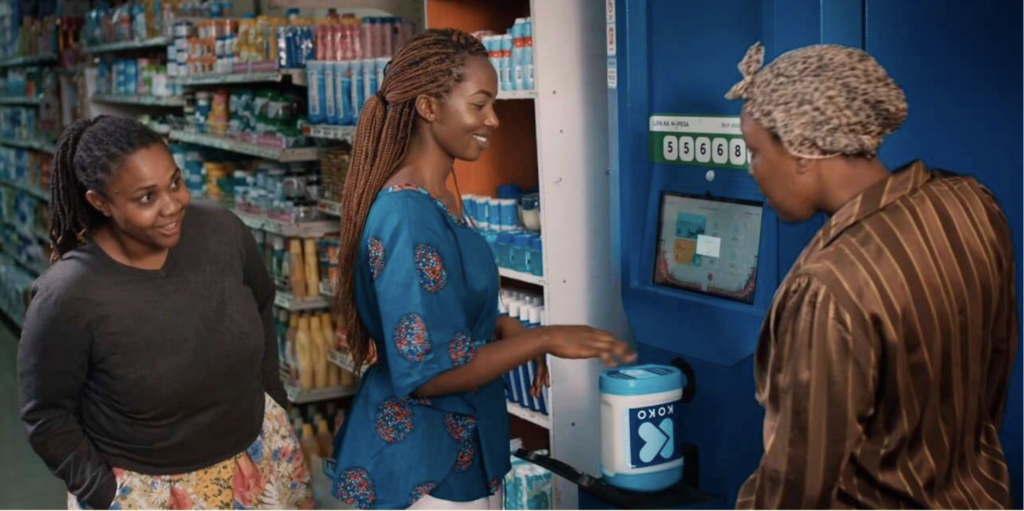
What does the much-publicised rise and sudden death of a firm that boasted friends in Silicon Valley and Washington DC tell us about the climate crisis, structural underdevelopment in Africa and the frugal innovations designed to mitigate it?
Customers at a KOKO Networks fuel ATM (Courtesy: KOKO Networks on Facebook)
The closure of Koko Networks at the beginning of February elicited an interesting range of reactions in the country. Some cast suspicion on the Kenyan government, claiming that the company was denied the letter of authorisation (LoA) because it refused to pay rent to the political class. Others took on a more sympathetic view of the government, remarking that Koko’s closure should indicate to climate investors that the country is “high integrity not high yield” and that national interest precedes developer profit.
Koko Networks, which was founded in 2013 and launched its first network of bioethanol fuel ATMs in 2019, folded its operations on 31st January 2026, announcing the move through a brief message sent to customers. On 3rd February 2026, Trade CS Lee Kinyanjui stated that Koko was denied the LoA because it sought to claim Kenya’s entire carbon credit allocation in the compliance carbon markets. Two days later, Tom Price, founder and former president of EcoSafi — a clean-cooking company that operates in Kenya and Uganda — wrote a LinkedIn post claiming that Koko’s carbon credits were flawed but that ultimately, the company’s closure was “a silver lining for carbon integrity”, and that GoK was simply doing its job in trying to ensure that its carbon credits were of as high quality as their other exports including tea and coffee. Indeed, Kenya has positioned itself as a hub for carbon finance. At COP 27 in Sharm El Sheikh, Egypt, President Ruto referred to carbon offsets as the country’s “next significant export.” At the same conference, Kenya became one of the seven pioneer countries to sign on to the Africa Carbon Markets Initiative which seeks to scale carbon credit production via voluntary carbon market activation plans.
Carbon offsets fund projects that either sequester CO2 (that is, remove carbon dioxide from the atmosphere and store it), or lower carbon emissions. Such projects typically include renewable energy initiatives, energy efficiency projects such as clean cookstoves, reforestation, waste and landfill management, and carbon storing agricultural practices. The origins of carbon offset projects date back to the 1980s. In 1989, amid a severe drought in the United States that pushed global warming to the front pages for the first time, American utility and power generation company Applied Energy Services devised the idea that to reduce the emissions generated by its coal powered plant in Connecticut, it could plant trees around the plant to absorb the carbon it emitted. There was just one problem. It would be impossible to plant 52 million trees in the densely populated area of Connecticut that the plant was located in – the number of trees calculated as necessary to absorb the carbon emitted by the plant. But since the atmosphere was a global common, AES executive Sherly Sturges proposed that the trees could simply be planted elsewhere. Thus, AES initiated the first land-based carbon project where they would support an agroforestry project in Guatemala, planting 52 million trees over the course of 10 years with an expected 16 million tons of carbon sequestered.
Sturges’ idea caught the world’s attention. In October 1988, a Times Magazine headline referred to the AES’ carbon offset project as an “Antidote for a Smokestack”, and in the article, the planting of 52 million trees in Guatemala vs the coal-powered plant in Connecticut was said to form a “healthy environmental equation”. Over the next few decades, the practice of carbon offsetting came to be enshrined in international climate treaties such as the 2005 Kyoto Protocol, which introduced the Clean Development Mechanism (CDM) that allowed “developed” countries to meet emission reduction targets by investing in emissions reduction projects in “developing” nations. Demand from compliance markets subsequently reduced, leaving leftover supply in the CDM’s carbon offset schemes. From this leftover supply, a market for voluntary carbon trading emerged. Alongside the UN’s carbon system, other sources of accreditation such as the Gold Standard (2003), American Carbon Registry (2007), and Verra (2007), were established.
The effectiveness of carbon projects however, has largely been unquestioned. It is extremely difficult to measure the amount of atmospheric carbon reduced by most carbon projects. Developers often inflate their project’s impact. The AES carbon project, for example, only offset about 10% of its targeted emissions. Food shortages arose from the enormous quantities of land set aside for forestry provoking arguments between farmers, some who simply began refusing to plant trees. Cookstove projects in particular have been found to have an average offset achievement ratio of 10.8%.
Projects must prove ‘additionality’, meaning that they must have a project baseline that is an estimate of how much carbon would have been emitted had the project not existed — a counterfactual, the journalist Heidi Blake notes, that is nearly impossible to prove. In cookstove carbon projects, emissions reductions are calculated by assessing adoption, usage, and stacking rates — where adoption refers to the percentage of efficient stoves in use, usage to the number of meals cooked on the stove, and stacking to the percentage of meals cooked on the project stove relative to baseline stoves. These calculations also rely on the fraction of non-renewable biomass (fNRB) — the proportion of woody biomass used as fuel that exceeds a landscape’s natural regeneration rate —as well as estimates of baseline fuel consumption.
In the case of Koko Networks, as Price points out, the company allegedly overstated the fraction of non-renewable biomass (using 98 percent instead of 38 percent), relied on a distorted fuel baseline that assumed users previously cooked primarily with charcoal (despite 67.2 percent of households in Nairobi – where Koko was expanding most rapidly – using LPG), and reported inflated usage figures.
Ultimately, most of those who support the government’s decision to deny Koko the LoA attribute the issue to the “integrity” of carbon credits that Koko Networks used. Others, as previously noted, criticise the government’s callousness and lack of consideration for the 1.3-1.5 million households (a likely inflated figure) and the 700 jobs that were lost. These customers and employees may be the latest victims of carbon offset projects, which often mobilise the realities of Global South residents – such as the urgent need for clean cooking solutions in Kenya – to justify financial flows that ultimately enrich corporations and their intermediaries. Communities whose land is managed by the Northern Rangelands Trust under the Northern Kenya Grasslands Carbon Project (NKCP) for instance, received $234,000 from the sale of carbon credits that are estimated to have sold for somewhere between $21 million and $45 million.
Carbon projects function as socio-ecological fixes – interventions that “directly engage with and resolve, mitigate, or postpone a structural impediment – including environmental ones – to sustained capital accumulation.” This concept draws from Marxist geographers such as David Harvey, who argue that capital, in its pursuit of infinite expansion, is shaped by internal and structural contradictions that constantly have it looking for fixes. These contradictions then become inscribed in the material world, which offers temporary “fixes” for capital to continue its expansion. For example, Africa’s re-incorporation after the trans-Atlantic Slave Trade into the Western capitalist economy occurred through colonialism, which alleviated the crises of overproduction and underconsumption by opening new markets and providing access to cheaper raw materials. These new geographies also functioned as what Harvey calls a “spatial fix”, as the construction of infrastructure enabled the absorption of excess capital.
While the contradictions mentioned above are built around the social relations of capital, a second set emerges around the ecological contradictions of capitalism. Capitalism, as geographer James Moore has argued, is an ecological regime whose expansion is dependent on natures it cannot reproduce. Limits arise in the capacity of the planetary ecosystem as a source of material inputs and a sink for unwanted by-products such as carbon emissions. Production under such conditions creates an imbalance between production and the natures that sustain it, generating a “metabolic rift”. In its quest for infinite expansion, capitalism dematerialises the economy, abstracting it into exchange values while obscuring the material ecological foundations upon which it depends. The result is an underproduction of the ecological conditions necessary for continued accumulation. Yet the recognition of the use-value of ecosystem “services,” such as carbon sequestration or of technologies of decarbonisation has not curtailed this logic. Instead, it has expanded the terrain on which capitalist actors can assign exchange value to include decarbonisation services; presenting these services as “fixes” that permit continued extractive production while also opening up new frontiers for accumulation.
Such ecological fixes can be regarded as capital simply looking to take advantage of crises/socio-natures of its own making to enhance profitability. In Kenya and other Global South contexts, these crises are rooted in their colonial formations. As Frantz Fanon observed, colonial economies were not integrated into a unified national economy; development occurred primarily in zones of extraction and white settlement, while other regions were left structurally underdeveloped. After independence, the Kenyan government sought to address the human and physical capital deficits inherited from colonial rule. Colonial investment had been highly selective, concentrated primarily in agricultural zones occupied by Europeans. Because of the exclusion of Africans from the colonial economy, the depletion of public coffers due to World War 2 shocks, and the costs of the Emergency period, Kenya could not rely on significant domestic savings. Like many other Global South states, it turned to debt financing. The government took on ambitious development plans, promoting import substitution industrialisation. As a result, Kenya’s industrial sector averaged an annual growth rate of 9.5 percent in the years between independence and 1979, and expanded its output by three and a half times. Simultaneously, the state pursued an aggressive rural development program aimed at ensuring that “people as a whole can participate in the development process”. This growth trajectory was disrupted by the sharp rise in global interest rates triggered by the collapse of the Bretton Woods system, the oil shocks of the 1970s, the inflation in the Global North that followed, the Volcker Shock of October 1979 that attempted to correct it, and the ensuing Third World debt crisis.
Under the Bretton Woods system, the US had premised monetary stability pegged on the dollar, which was in turn backed by gold. Underlying this arrangement was the assumption that the US would maintain sufficient gold reserves to back up world trade in dollars. In the period following the independence of the Global South however, demand for dollars skyrocketed as newly independent countries sought foreign investment for their industries and infrastructure. This investment mostly came dressed as foreign aid, mostly denominated in dollars. Additionally, the financing of wars such as the Vietnam war triggered a flood of US dollars into the global economy. Thus, dollar demand was higher than the amount of gold required to back it, creating an increasing consensus that the dollar was overvalued, causing periodic runs on the dollar “undermining the nation’s foreign trading position”. To fix this, Richard M. Nixon applied what famously came to be known as the “Nixon Shock” in August 1971, suspending dollar convertibility into gold and effectively devaluing the dollar.
Since the price of oil was quoted in dollar terms, the depreciation of the dollar resulted in reduced revenues for oil-producing countries, to which they responded by building a 2.5 percent annual inflation factor into the dollar price of oil in the Tehran Agreement of 1971. It is important to note that the Organisation of Petroleum Exporting Countries (OPEC) had been created in 1960 by Venezuela, Iran, Iraq, Kuwait, and Saudi Arabia as an expression of nationalism, and that the proximate trigger of its creation was the reduction of the price of Arabian crude oil by Esso Petroleum. In January 1972, OPEC called for a further 8.49 percent increase in the dollar price of oil to match a corresponding percentage increase in the price of gold relative to the US dollar. Then came the Yom Kippur War, during which the OPEC embargo on the United States raised the price of oil from $4.31 to $10.11. While the embargo was lifted by March 1974, oil prices remained high. These prices —and for many foodstuffs and other primary commodities — were passed through to final product prices with average annual increases of domestic prices in the Global North in the range of 7–8 percent in the 1970s. “Stagflation” became the descriptor of the prevailing economic environment.
In the 1970s, increased oil revenues for OPEC countries were deposited into Western banks such as Chase and Citibank. Unable to figure out where to invest the money, these banks dispatched agents around the world convincing the leaders of newly independent countries who were taking on ambitious development plans to take out dollar-denominated loans to finance their plans. While the interest rates for these loans were favourable for that period, they were to increase dramatically following the Volcker Shock of 1979. Frustrated by the persistent inflation of the 1970s, U.S. Federal Reserve chairman Paul Volcker increased U.S. short-term interest rates (on which most external debt contracts were based) from 9.5 percent to 16 percent. Global South states found themselves in three problems: the cost of servicing their dollar-denominated debts increased by an estimated 7-8% of export earnings, the cost of importing oil went even further up (in the first oil shock of 1974, the oil import bill of non-oil producing African countries had gone up from $516 million in 1972 to $2,063 million in 1974) while their ability to earn from exports was weakened by the recession in the Global North markets. IMF structural adjustment programs subsequently reversed many of the developmental strategies that had been pursued under proposals such as the New International Economic Order, approved at the 1974 UN General Assembly. Domestic industries collapsed, and state investment in human capital declined. The rollback of the state and the contraction of formal industry pushed millions into the informal economy as a means of survival.
It is such populations in which clean cooking projects like Koko intervene.
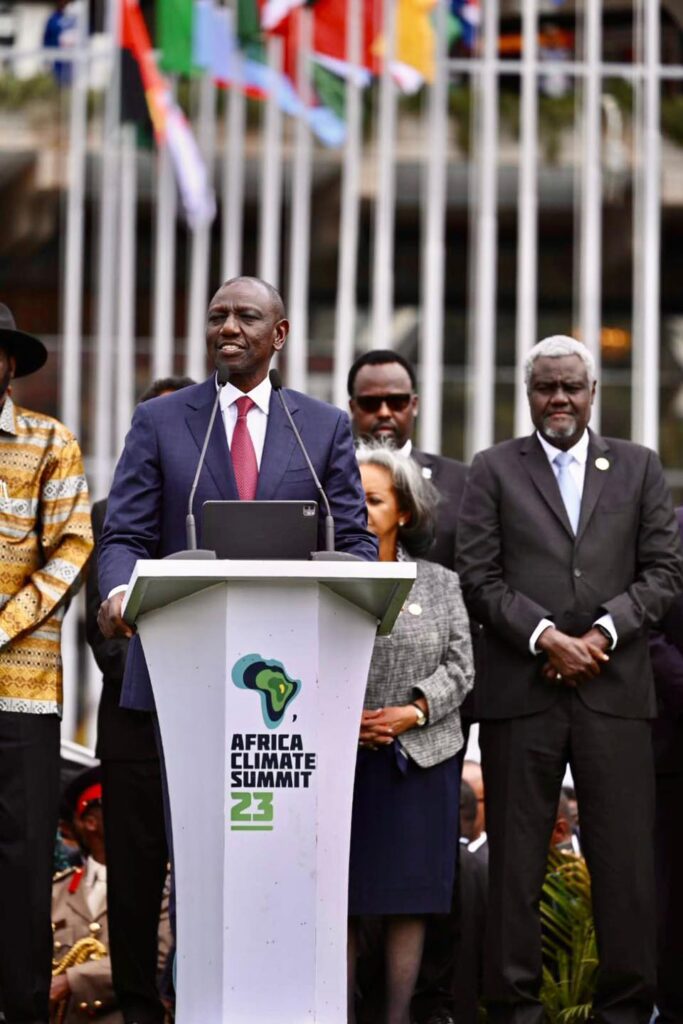
Kenya’s president, William Ruto at the Nairobi Climate Summit in 2023: He proclaimed that carbon exports would be the country’s “next significant export” (Photo: State House, Nairobi).
As socio-ecological fixes, solutions promoted by actors such as Koko function as frugal innovations that “emphasise the ‘co-creation’ of affordable, accessible and aspirational products through active collaboration between formal and informal actors”. The informal economy — in the post-SAP austerity era, it supports approximately 85 percent of employment in sub-Saharan Africa – has evolved into a space of both survival and accumulation. As Julia Elyachar argues, “informality has become too central … to be relegated to the sphere of negative phenomena – the not-formal.”
Driven by the desire to penetrate new markets in “emerging economies”, corporations have in the past two decades grown increasingly interested in African informal spaces. Innovations such as M-PESA have subsequently been borne of corporations integrating informal economy practices such as Kenyans sending airtime via mobile phone as a means of transferring money. Carbon finance, newly directed towards the continent, follows the same trajectory at the level of “frugal innovations”. Initiatives such as Koko Networks work with retail traders to set up fuel ATMs at sites with already established footfall, promising “disruption” and “inclusion”. In doing so, Koko worked with “found institutions”, and harnessed their networks to construct low-cost, workable economic arrangements that disproportionately benefit the company over the communities it claims to serve. Koko Networks, for instance, claimed to subsidise their cooking stoves from $115 to $12.Yet, as Richard Mbindyo has pointed out, these were simple, mass-produced units from Indian factories whose base price was artificially inflated to shape carbon pricing calculations.
Carbon pricing typically reflects an interplay of market forces (supply and demand), estimates of avoided damage (in this case, Koko’s claims about reducing non-renewable biomass use), and the developer’s reported costs – creating incentives to inflate baseline prices. Koko’s supposed subsidy isn’t an act of philanthropy meant to help users who would have otherwise incurred health damage from burning charcoal, but a way for Koko to capture carbon revenues from the international market by exaggerating the cost of avoided emissions, while purportedly capturing domestic fuel markets. Moreover, Koko fuel reportedly cost users between KSh 80 and KSh 100 per day, amounting to over KSh 2,000 per month – more expensive than a monthly refill of a 6kg LPG cylinder, which averages around KSh 1,200. Rather than addressing informality as a condition of structural vulnerability, companies such as Koko treat it as a reservoir of labour, networks, and institutional resources to be harnessed. Where communities experience an unaffordable cost of living that forces them to purchase daily necessities piecemeal and at inflated prices, market actors perceive “predictable and repeated demand” within “embedded trust networks”.
There is, undeniably, an urgent need for solutions to dirty cooking and other developmental challenges in Kenya and across the continent. This need, however, is not going to be met through fixes by private capital simply looking for its next frontier of accumulation, or trying to evade a crisis of legitimacy by portraying itself not as the driver of climate change (or other problems caused by the extractive economy), but the way out of it, while shifting blame onto a depoliticised materiality of CO2, and to individualised citizen-consumers who, as evidenced by the case of Koko networks, are remade into subjects to be “helped” but whose deeply political realities are simply instrumentalized for carbon revenue. Dirty cooking is not an isolated technical problem; it is a product of the structural underdevelopment produced by the current global economic order. Any meaningful attempt to resolve it must begin from that recognition.
The place of the Global South’s debt crisis in creating the conditions of poverty that the Brundlandt report was quick to recognise as a cause of environmental degradation and emissions must be recognised. Consequently, debt cancellation must form part of any serious climate solution, freeing public revenues in heavily indebted countries to address developmental and ecological challenges on their own terms. As many have argued, climate justice is inseparable from debt justice. Funding meant to combat climate change must also not be issued in the form of debt (90 percent of climate financing issued by multilateral development banks such as the World Bank is in the form of loans), which risks worsening the debt crisis and pushing states into even further economic entrapment. Nor should climate funds be used to derisk private accumulation, as in the case of Koko, which stands to benefit from a $179 million guarantee from MIGA.
Instead, climate finance should be delivered as grants and directed toward strengthening public sector capacity. To encourage clean cooking in Kenya for instance, this would mean funding and implementing the National Clean Cooking Transition Strategy outside the narrow imperatives of market profitability. Left to the market, solutions will inevitably prioritise investor returns over public goods. In a 2021 article on the redemptive logic of most socially oriented start-ups in Africa, Joshua Polinksy argues that the “good purpose” of these (commercial) ventures cannot be disentangled from the power structures and ideologies that define what impact is necessary or even possible. One might recall the establishment of the Congo Free State in 1885 by King Leopold II, and his creation of the International African Association (IAA), an organisation with ostensibly charitable goals, but which was in fact a cover for ruthless exploitation. The IAA, later renamed to the International Congo Association (ICA), collected donations from the European elite, promising to use them to promote “the civilization and commerce of Africa, and for other human and benevolent purposes.” In practice, King Leopold embarked on a mission to monopolise free trade in Congo, engaging the services of explorers such as Henry Morton Stanley to negotiate with tribal leaders for the sale of land, effectively establishing a brutal private colony from which he amassed a fortune from ivory and rubber – extractive activity which was directly responsible for the scramble and partition of Africa that followed a decade later.
Koko Networks and other “socially-oriented” start-ups and non-profits in Africa today exist as a rearticulation of this redemptive logic. As part of his philanthropic mission, Leopold set out to establish orphanages in the Congo. However, given the strength of kinship structures in African societies, there were few orphans in the way he had imagined. In response, his forces raided villages to produce them. A similar dynamic is recorded in Charis Enns and Brock Bersaglio’s Settler Ecologies: The Enduring Nature of Settler Colonialism in Kenya, where they unpack how settlers, despite their portrayal today as custodians of wildlife that might otherwise be exterminated by “natives”, were actually responsible for bringing the species they attempt to conserve today to the brink of extermination as they a) promoted wildlife hunting for sport in the earlier days of colonialism; and b) eliminated native species that they deemed undesirable and rewilded places with species deemed more desirable. When the winds of decolonisation started blowing, however, settlers resorted to rescuing species at risk of extinction to shore up moral support for their claim to the land. Today, as the influx of conservation and climate finance in the aftermath of the Kyoto Protocol demands scaling of these settler ecologies, land outside private ownership is increasingly incorporated into carbon and biodiversity credit schemes through the establishment of nominal “community conservancies”, often reproducing older logics of control and extraction under the guise of environmental stewardship.
Most of these redemptive missions are clearly just well-disguised commercial ventures. Not that there is anything inherently wrong with commerce. As Jean Baudrillard noted, human relations have always been structured around a sense of lack; it is this lack that drives systems of exchange, and from which ideas of debt and credit emerge. “To be is to be in debt” is a maxim that Michael Allen Gillespie argues would have gone largely undisputed for most of human history. In modernity, however, this proposition has become less self-evident, with attempts to eliminate indebtedness in its traditional sense emerging as a defining feature of Western modernity. Yet paying off one’s debt does not necessarily abolish indebtedness, as illustrated in Christian theology, where salvation through Jesus renders believers perpetually indebted to him. This “ruse of God” is also the ruse of capital: capital “continually plunges the world into greater debt while simultaneously redeeming it.”
Understanding this ruse in the context of the trajectory of most Global South states requires starting with their incorporation into the global economic order under imperial and unequal terms of exchange. These conditions not only produced debt and underdevelopment but also compelled these states to redeem themselves from this state—either through the accumulation of sovereign debt or through the forms of “salvation” offered by Western capital seeking new frontiers for accumulation such as we witness in the case of Koko. Breaking free from this cycle of unending indebtedness requires confronting unequal exchange itself: the Global North is estimated to drain approximately $2.2 trillion annually from the Global South. This drain occurs primarily through illicit financial flows, including trade misinvoicing, tax evasion, and corruption. Trade misinvoicing—the deliberate under- or-overstatement of import and export values—accounts for an estimated $30–$52 billion in annual financial flow gaps in Africa alone, representing more than half of such outflows. In recent years, double taxation agreements (DTAs) have also emerged as key mechanisms facilitating tax avoidance. While ostensibly designed to prevent the double taxation of cross-border business activity, corporations frequently exploit these agreements to minimise or evade tax obligations. Under DTAs, countries may waive or reduce taxes on corporate earnings, deferring taxation to the other signatory state. Although intended to attract foreign direct investment, such arrangements often enable corporations to reroute profits to “treaty havens,” where tax liabilities are minimal. In the case of Africa, UAE and Mauritius have been reported to be the “most corrosive” treaty havens undermining tax collection on the continent. Kenya maintains DTAs with both countries. Notably, in the Multilateral Investment Guarantee Agency’s profile of Koko Networks, Mauritius is listed as the “investor” country.
The post The death of KOKO Networks: a post-mortem of a biofuel startup and the rise of carbon economies in Africa appeared first on African Arguments.