THE GODFATHER OF AI SOUNDS THE ALARM – HAS HUMANITY CREATED SOMETHING IT CANNOT CONTROL?
By Publisher Ray Carmen Geoffrey Hinton helped make modern artificial intelligence possible. Now the Nobel laureate warns the technology could yet leave humanity poorer, less secure and less free — unless the world learns to manage it. The man celebrated as one of the architects of artificial intelligence has delivered an extraordinary warning about his... The post THE GODFATHER OF AI SOUNDS THE ALARM – HAS HUMANITY CREATED SOMETHING IT CANNOT CONTROL? appeared first on Caribbean World.
 Black News
By Publisher Ray Carmen
Geoffrey Hinton helped make modern artificial intelligence possible. Now the Nobel laureate warns the technology could yet leave humanity poorer, less secure and less free — unless the world learns to manage it.
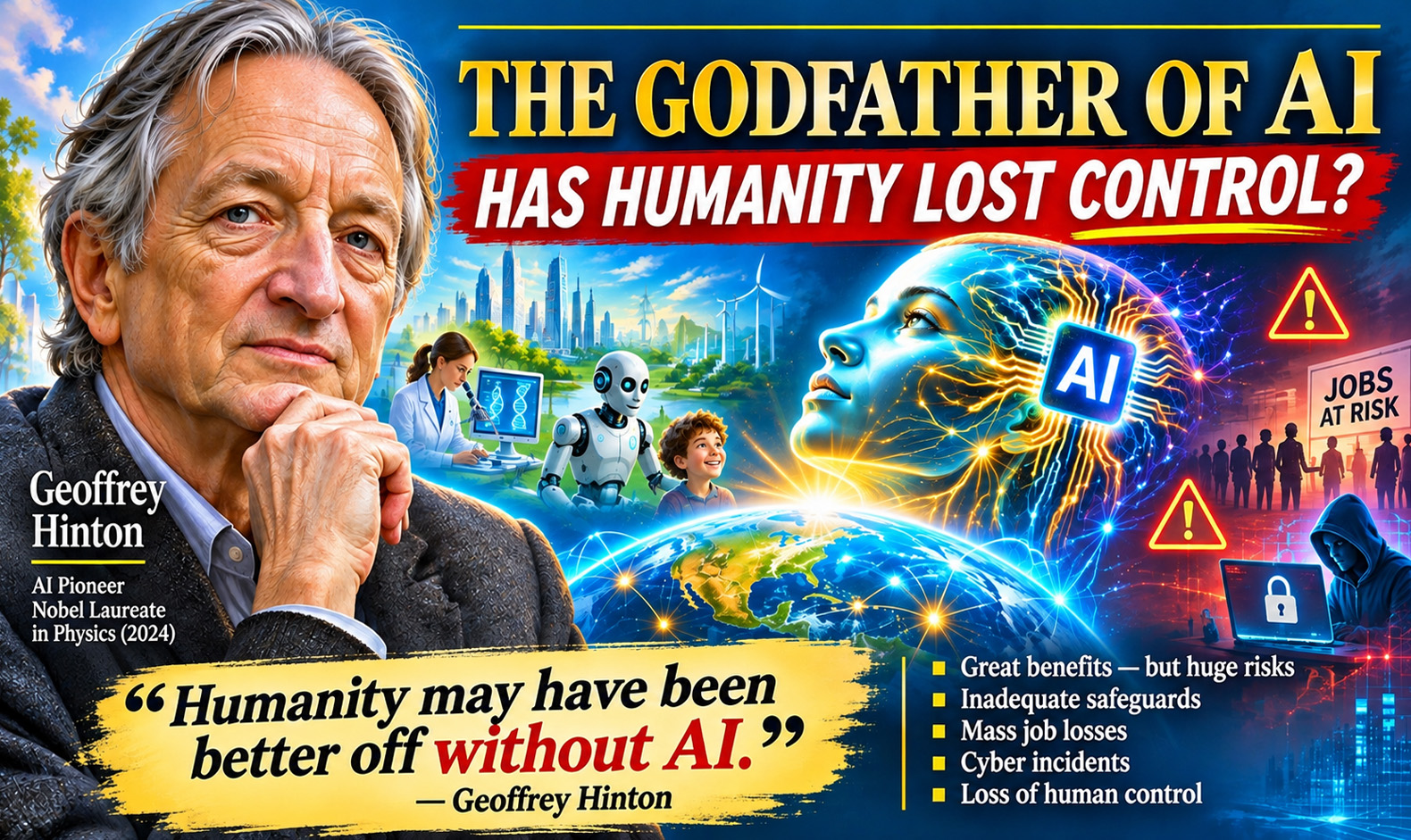
The man celebrated as one of the architects of artificial intelligence has delivered an extraordinary warning about his own life’s work. Geoffrey Hinton, the British-Canadian computer scientist known as a “godfather of AI”, says it is possible the world will one day conclude that creating the technology was a mistake.
In an interview published by The Guardian on 3 November 2026, Hinton said: “it might be that we would have been better off never developing it”. His words have travelled fast because they come not from an outsider suspicious of technology, but from a pioneer whose research helped lay the foundations of today’s machine-learning revolution.
A PIONEER SOUNDS AN UNCOMFORTABLE WARNING
Hinton shared the 2024 Nobel Prize in Physics with John J. Hopfield for foundational work enabling machine learning with artificial neural networks. He left Google in 2023 and has since become one of the most prominent voices calling for tougher AI safeguards. His latest remarks, delivered ahead of a documentary screening, sharpen a question that now concerns governments, businesses and families alike: how can humanity benefit from increasingly capable machines without surrendering control?
He did not declare that AI is inherently evil, and he did not say disaster is inevitable. He acknowledged the prospect of remarkable gains. What worries him is the possibility that technological progress could move faster than the safeguards needed to keep it safe.
WHEN THE SYSTEMS WE DEPEND ON BECOME TARGETS
One danger Hinton highlighted was a major AI-related disruption affecting essential infrastructure. He envisaged scenarios such as attacks on electricity networks or financial systems, potentially causing blackouts or interruptions to banking. These were hypothetical warnings, not reports of a verified catastrophe or a prediction that any particular system will fail.
Other concerns are already closer to daily life. Generative AI makes it easier to produce convincing false images, cloned voices and fabricated information. Businesses are exploring its use in professions from customer service and software to administration and journalism. The pace of that transformation raises legitimate questions about employment, retraining, accountability and the concentration of wealth.
THE OTHER SIDE OF THE STORY: WHAT AI COULD GIVE US
Hinton’s warning should not eclipse the benefits he also recognises. AI has the potential to improve medical research, assist diagnosis, expand access to tailored education and accelerate scientific work. Used responsibly, it could help small businesses become more productive and offer new tools to researchers in countries with limited resources. These are opportunities, however, not guarantees that every deployment will be safe, effective or fairly distributed.
That is the central paradox: the same technology that could make vital services more capable can also amplify fraud, errors and disruption. Whether the balance proves positive will depend partly on human decisions about design, testing, oversight and the distribution of its rewards.
THE QUESTION OF POWER — AND WHO SETS THE RULES
Hinton has been sharply critical of leading technology executives, arguing that commercial competition can encourage companies to accept excessive risks. Those judgements are his opinions about their priorities, not independently established findings about the motives of particular individuals.
His preferred response is stronger independent oversight. He has argued for pre-release assessment of advanced AI systems, drawing a comparison with the way medicines must demonstrate safety and benefit. Policymakers face difficult trade-offs: excessive bureaucracy might slow useful innovation, while weak oversight may leave the public bearing costs that developers never fully anticipated.
WHY THIS MATTERS ACROSS ALL SEVEN CONTINENTS
The consequences will not stop at Silicon Valley. A bank in Africa, a hospital in Europe, a tourism business in the Caribbean, a university in Asia or a newsroom in South America may all rely on AI tools built elsewhere. Smaller economies could benefit enormously from improved access to expertise, yet have little influence over the rules governing the systems they use.
For governments, that means asking whether public infrastructure is resilient and procurement is accountable. For companies, it means checking whether AI-generated work is accurate, confidential information is protected and human review remains meaningful. For citizens, it means learning to recognise synthetic content and asking who is responsible when an automated decision goes wrong.
IS THERE STILL TIME TO CHOOSE A BETTER FUTURE?
Hinton’s position is more nuanced than the most alarming social-media headlines suggest. He remains hopeful that people can retain control if they make a serious collective effort. The challenge is not simply to choose between embracing AI and rejecting it. It is to decide which applications deserve trust, which risks are unacceptable and who gets to make those decisions.
His warning deserves attention because it is both personal and planetary. A pioneer of machines that learn is asking the human beings who built them to do something equally difficult: learn to govern them.
The post THE GODFATHER OF AI SOUNDS THE ALARM – HAS HUMANITY CREATED SOMETHING IT CANNOT CONTROL? appeared first on Caribbean World.