
The Pope has declared holy war on AI
The New Butlerian Jihad — In his first encyclical letter, Pope Leo XIV addressed the increasing pervasiveness of artificial intelligence as a threat to the already fragile structures of society. Newsletter columnist Emma Garland makes sense of it all.
 Black News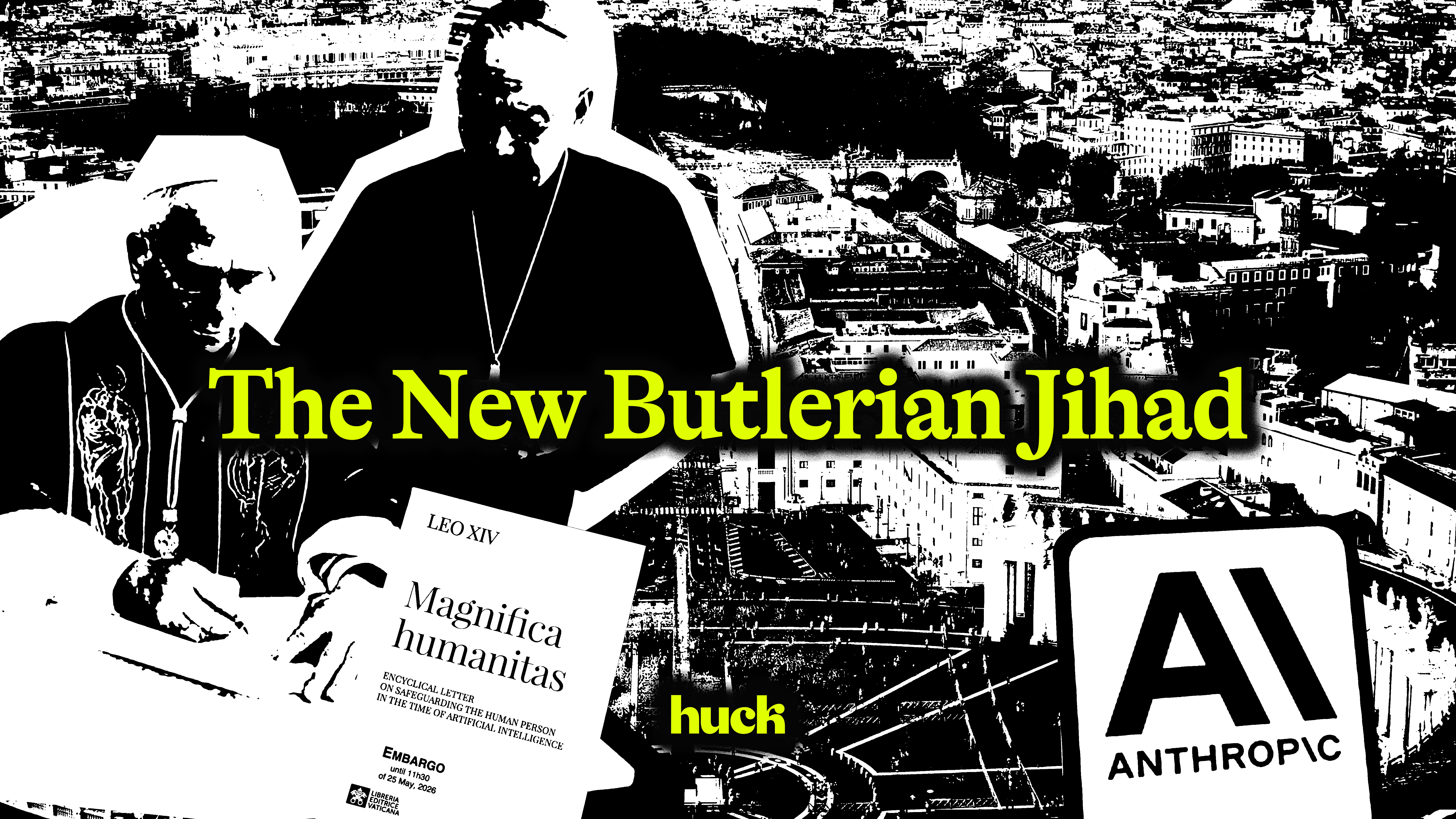
The New Butlerian Jihad — In his first encyclical letter, Pope Leo XIV addressed the increasing pervasiveness of artificial intelligence as a threat to the already fragile structures of society. Newsletter columnist Emma Garland makes sense of it all.
This column first featured in Club Huck’s culture newsletter. Sign up for free here to make sure it lands in your inbox every month.
Three significant things happened on Monday, May 25. The UK recorded its hottest ever day in May, with temperatures in London reaching an historic 34.8C, prompting widespread toplessness and beach scenes resembling Normandy in 1944 but with more sun umbrellas. The Knicks swept the Cavaliers and clinched a spot in the NBA finals for the first time since 1999. Meanwhile, in Vatican City, Pope Leo XIV declared holy war on artificial intelligence.
In his first encyclical letter since his elevation to the papacy last year, the US-born Pope addresses the safeguarding of human dignity in the age of AI. He acknowledges that while technology is not “inherently evil” in and of itself, in practice it takes on “the characteristics of those who devise it, finance it, regulate it and use it.” Following that logic, he warns that AI – when monopolised in the hands of private companies and technocrats – has the power to drive further division, injustice, and dehumanisation by reducing “the mystery of the person into mere performance metrics.”
For several reasons, the encyclical has travelled much further than a letter from a Pope ordinarily would. Firstly, it must be acknowledged, is that his pen was on fire throughout, and it kicks off with a fucking bar and a half: “Humanity, created by God in all its grandeur, is today facing a pivotal choice: either to construct a new Tower of Babel or to build the city in which God and humanity dwell together,” begins the 42,300-word address, which is split into four chapters. Sounding like the start of a new Butlerian Jihad, it’s written with the kind of passion we rarely experience from public figures nowadays (mainly because we live in litigious times and heated words, even in the name of good, often provoke backlash; this time last year, journalist Terry Moran was let go from ABC News after writing on X that Stephen Miller – the architect of Donald Trump’s hardline immigration policies – “eats his hate”). Grounding the church’s perspective in cultural references, the encyclical nods to everything from Picasso’s ‘Guernica’ to Beethoven’s ‘Symphony No. 9’, and Schindler’s List to Lord of the Rings – another reason why it has gained traction in the news. Reportedly, it took Pope Leo a year to write. Think about that next time you boot up ChatGPT to write a thank you card to your own grandmother, I guess.

“Reportedly, [the encyclical letter] took Pope Leo a year to write. Think about that next time you boot up ChatGPT to write a thank you card to your own grandmother, I guess” – Emma Garland
Secondly, the rapid onslaught of AI has taken place without the approval – or baseline enthusiasm – of the majority. It has been foisted upon us from above, like a tactical vest on a reluctant marine, which is one of the biggest points of contention around it. Without justification or explanation or even transparency in most cases, this technology has intruded upon most areas of life, and is now present everywhere from meme slop to healthcare provision, children’s books, and workflows. If you use Gmail, Gemini will likely suggest a reply to this newsletter without you even asking for one. Not everyone finds this as ‘helpful’ as it’s purported to be, and to many the omnipresence of AI feels unwanted at best and malevolent at worst. The Pope, then, is being received as a dissenting voice of reason – a heaven-sent version of the man in Norman Rockwell’s Freedom of Speech. “Pope Leo just condemned the idea that ‘work dignifies man’,” one X user wrote. “We. Are. So. Back!”
It’s worth taking a beat here to appreciate how nuts it is that the brightest guiding light on this issue is the Catholic Church, an institution that has rarely taken a progressive or daring stance on global issues beyond “war = bad” and “gays = alright” – and even that last one really depends on who you ask. Pope Leo himself occupies a less progressive stance on certain LGBTQ issues than his predecessor, Pope Francis aka “Cool Pope,” but he has a growing track record of advocating for thoughtfulness in the face of lunacy. This has proven particularly resonant as the Trump administration increasingly integrates traditional Christian doctrine into federal policy, collapsing the separation of church and state. Recently, he publicly criticised the US’s campaign in Iran, angering the administration and sitting down self-proclaimed evangelicals JD Vance and Peter Hegseth after they tried to argue that the attack was consistent with the Catholic Church’s “just war” theory, which the Pope called “outdated.”
That said, the Pope, who’s been described as a “bridge builder” personality, is also not opposed to fraternising with the enemy. In the interest of widening the conversation on the questions raised by AI, Anthropic co-founder Chris Olah was also invited to speak at the Vatican. His statement was comparatively brief compared to Pope Leo’s – and quite funny, if you’re the sort of person who finds corporate droid-speak amusing, which, as someone who has been regularly besieged with “free pizza!” in a media office kitchen and then herded into a conference room by a 40-year-old man wearing a trucker cap to witness a mass layoff, I do. Olah states immediately that “There is a real possibility that AI will displace human labor at very large scale,” before admitting that there are currently no solutions for this presumably quite enormous problem. He then suggests that AI might be conscious and that those on the inside of the industry don’t know what they’re building, and there are no safeguards for those issues either. No matter. “Let it also be a decisive first step toward a hopeful future for magnificent humanity!” he concludes. I can taste the cold, congealed mozzarella now.
Emma Garland is a culture writer and editor based in London. Follow her on Instagram.
Buy your copy of Huck 83 here.
Enjoyed this article? Follow Huck on Instagram for more from the cutting edge of sport, music and counterculture.
Support stories like this by becoming a member of Club Huck.