US-linked deal gives Rwanda 25% of tungsten venture before new American defence-supply rules take effect
Rwanda will take a 25% stake in a new tungsten venture with Nasdaq-listed Almonty Industries, positioning the African country to supply a metal used in missiles, ammunition and aircraft parts as the United States tightens its defence supply chains.
 Black News
Rwanda will take a 25% stake in a new tungsten venture with Nasdaq-listed Almonty Industries, positioning the African country to supply a metal used in missiles, ammunition and aircraft parts as the United States tightens its defence supply chains.
- Rwanda will own 25% of a new tungsten venture with Nasdaq-listed Almonty Industries.
- The agreement follows an introduction by the US State Department under a bilateral economic framework.
- The venture will initially buy and process material from existing Rwandan miners while exploring a 32-square-kilometre concession.
- It arrives before stricter US defence-sourcing rules take effect in January 2027, but no American military purchase has been announced.
The binding agreement follows an introduction by the US Department of State under the 2025 US-Rwanda Framework for Shared Economic Prosperity, according to an announcement released by Almonty on Monday.
Reuters reported that the partnership forms part of Washington’s attempt to strengthen critical-mineral relationships in Africa and reduce Western dependence on China.
The Rwandan government will receive 25% of Almonty Rwanda, while the Canadian-based mining company will retain the remaining 75%.
Rwanda will not pay cash for its interest. The government is contributing the Shyorongi tungsten exploration concession and a mineral-processing licence in exchange for the shares.
The arrangement gives Rwanda direct ownership of the company that will aggregate, process and potentially export tungsten-bearing material, rather than limiting the government’s benefit to taxes and royalties.
DON'T MISS THIS: Rwanda exports critical mineral tungsten concentrate to the U.S. for the first time
Venture will begin with existing miners
The Shyorongi concession covers approximately 32 square kilometres in Rwanda’s northern Rulindo district. It is a greenfield property, meaning Almonty has not yet established a commercial mineral reserve or built a mine there.
Consequently, the venture does not have to wait for exploration and mine construction before seeking revenue.
Almonty Rwanda may initially buy ore, partly processed material and panning tailings from existing licence holders, including small-scale miners. Higher-grade material could be sold or exported, while lower-grade supplies may be sent to Almonty’s existing facilities for further processing.
Mine tailings are the material left after miners have extracted the more accessible portion of an ore. They can still contain valuable minerals that improved processing technology may recover.
The company also intends to acquire a mobile unit that can process tailings close to existing mining sites. A permanent collection and processing plant is planned for Rwanda later, although Almonty has not disclosed its cost, capacity, location or construction timetable.
The venture’s first material is therefore expected to come from Rwanda’s existing miners—not from a new mine at Shyorongi.
Why the United States is interested in tungsten
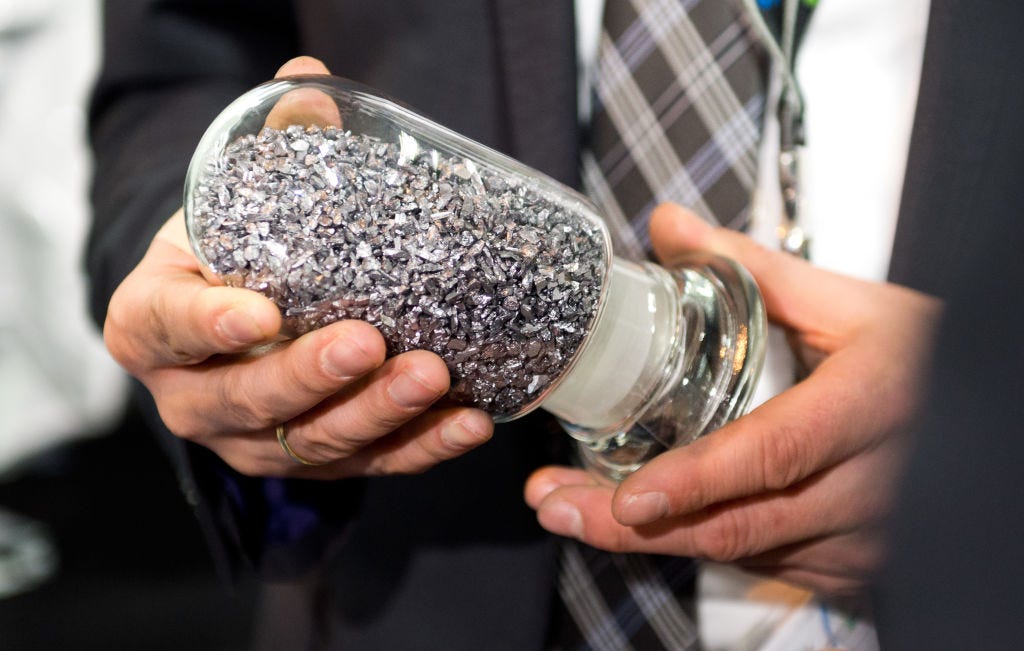
Tungsten has the highest melting point of any pure metal and retains its strength at extremely high temperatures.
Those characteristics make it valuable for industrial cutting tools, semiconductors and electronics, but they also give it significant military uses. Tungsten alloys are used in armour-piercing ammunition, missile components, aircraft parts and other equipment exposed to extreme heat or force.
Rwanda produced approximately 1,300 tonnes of tungsten in 2025, according to figures drawn from the US Geological Survey’s 2026 mineral summary. It was the only African country among the world’s ten largest producers.
DON'T MISS THIS:Congo rebels fuel mineral trade chaos with illegal exports to Rwanda
Its output remains small beside China’s. China produced approximately 67,000 tonnes and dominates global mining, processing and consumption of the metal.
That concentration has become a strategic concern for Washington, particularly after China imposed controls on exports of tungsten and other dual-use minerals. Tungsten prices subsequently climbed to record levels in January.
New US rules create an opening for Rwanda
The timing gives the Rwandan venture an additional advantage.
From January 2027, stricter US defence-procurement restrictions will apply to specified tungsten products entering American military supply chains. Suppliers will need stronger evidence establishing where the material was mined and processed.
The White House has also ordered the US defence authorities to stop issuing certain sourcing waivers from 1 January 2027, increasing pressure on contractors to find compliant alternatives.
A traceable supply originating from licensed Rwandan mines could therefore become more attractive to American defence contractors and other Western manufacturers seeking material outside China.
DON'T MISS THIS:Behind the D.R. Congo-Rwanda peace deal: Why Washington is pushing for a bigger role
However, the US government is not disclosed as an investor in Almonty Rwanda, and neither the Pentagon nor an American defence manufacturer has announced an agreement to buy tungsten from the venture.
The precise description is therefore that the US helped connect the partners and provided the economic framework surrounding the agreement. It has not been established that Washington is financing the project or guaranteeing its output.
Traceability will be the real test
For Rwanda, the partnership offers an opportunity to earn more from mineral processing and strengthen the credibility of its tungsten exports.
That credibility matters because Rwanda’s mineral trade remains politically sensitive. The Democratic Republic of Congo has repeatedly accused the country of benefiting from minerals smuggled out of conflict-affected eastern Congo, claims Kigali denies.
The Financial Times reported that Rwanda has been expanding industrial mines and traceability systems as it attempts to distance its exports from the conflict-mineral label.
Almonty said Rwanda’s government would facilitate introductions to mine operators, landowners and licence holders. The company will still need to demonstrate that every shipment acquired from third parties has a documented origin.
That could determine whether the venture becomes a credible Western alternative to Chinese tungsten or simply another aggregation business operating in a region where mineral provenance is frequently disputed.