War veterans seek direct ConCourt hearing over presidential vote
4 more matters in pipeline to be heard by ConCourt
 Black News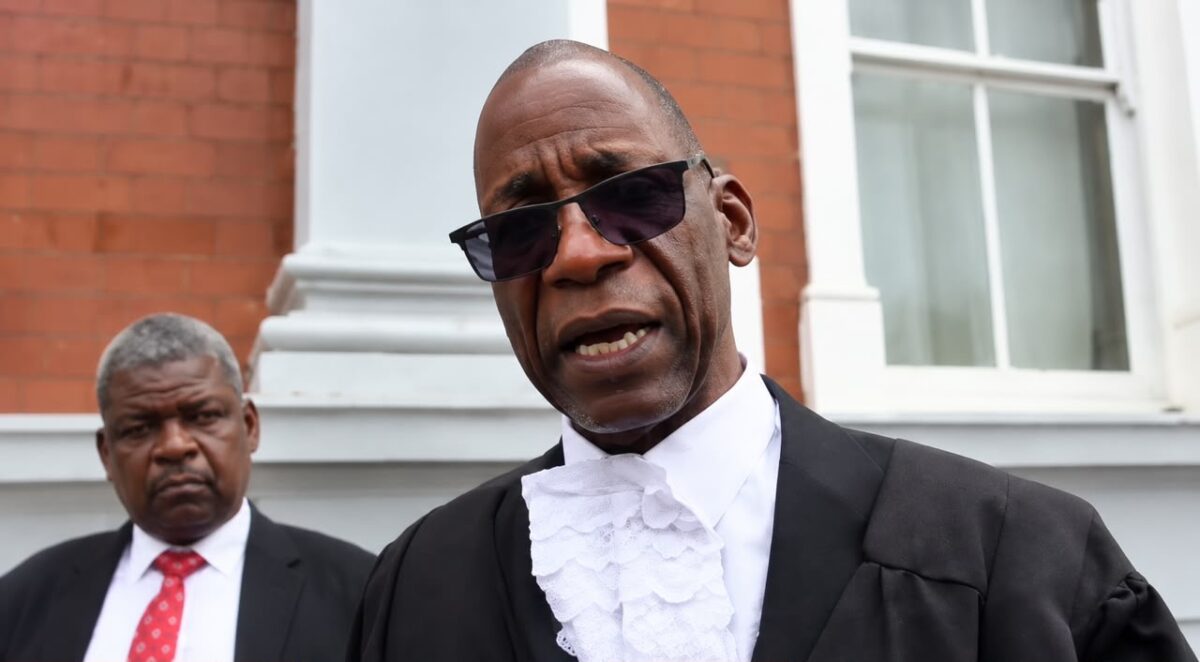
 Professor Lovemore Madhuku speaking outside the Constitutional Court in Harare on September 22, 2026
HARARE – Lawyer Professor Lovemore Madhuku says a ruling allowing a group of war veterans to challenge recent amendments to the constitution directly in the Constitutional Court would be a “very big victory” for opponents of the changes.
Madhuku was speaking after the Constitutional Court on Tuesday reserved judgement on an application for direct access in which the applicants are challenging changes signed into law in July that removed the direct election of the president by voters.
The application was heard by a three-judge panel headed by Deputy Chief Justice Paddington Garwe, sitting with Justices Rita Makarau and Chinembiri Bhunu.
Madhuku said the applicants were asking the Constitutional Court to bypass the High Court because the matter raised issues that ultimately had to be determined by the apex court.
“The application we were having today is called an application for direct access,” Madhuku said.
“It is a procedure which you follow where the High Court has jurisdiction in a matter but you believe that the matter is such that it ought not to be heard by the High Court but must be heard first and last by the Constitutional Court.
“If that is the case, you must seek leave from the Constitutional Court and ask that they must allow you to come direct.”
Madhuku said the central constitutional question was whether lawmakers could remove citizens’ direct right to elect the president without holding a referendum.
“The matter which we had brought which we want to be determined by this court is that you cannot take away the right of ordinary citizens to vote directly for the president without a referendum,” he said.
“So even if you have not changed Chapter 4, which is the Bill of Rights, but you do things outside the Bill of Rights which actually affects things in the Bill of Rights, then in that case you have affected the Bill of Rights and you need a referendum.
“We want that to be determined by the full court.”
Madhuku said the applicants had put forward a persuasive case for direct access.
“We put across what we believe were exceptional circumstances including that the matter is urgent and that it must be determined on that basis and also that it’s a very important matter which cannot just be dealt with by the High Court because it has jurisdiction,” he said.
“We want this court.”
The government opposed the application, arguing that the applicants had failed to meet the requirements for direct access and should first approach the High Court.
Advocate Sylvester Hashiti, representing President Emmerson Mnangagwa, Justice Minister Ziyambi Ziyambi and the attorney-general Virginian Mabhiza, said the applicants had failed both procedurally and substantively.
“Procedurally, the applications did not comply with the rules, the requirements in an application of this nature,” Hashiti said.
“Secondly, the applicants did not set out on what basis they were coming to the court. They did not prove that they were registered voters; they did not prove that they were presidential candidates; they did not prove any interest, even a public interest, on why they were approaching the ConCourt.”
Hashiti said the applicants had also failed to demonstrate why their case was exceptional enough to warrant bypassing the High Court.
“We also referred the court to the issue that the substance of the application itself, there was no case set out why exceptionally the war veterans must come to the ConCourt and not the High Court,” he said.
“They should have gone to the High Court as the court of first instance.”
He also challenged the inclusion of the president as a respondent.
“The last point we also raised was that the citation of the president was simply mischievous,” Hashiti said.
“The president has no interest. There is no justification for involving him in these things because his function was already concluded and no-one has challenged that the president was wrong in assenting to the law.”
Hashiti said the applicants’ case against the president was therefore unnecessary.
“For those reasons we have asked the court to dismiss the application and to dismiss also any intended application for direct access,” he said.
Madhuku said the applicants would proceed to the High Court if the Constitutional Court refused direct access.
“It clearly would be a disappointing result,” he said. “We are saying to the judges this is a matter you ought to hear yourselves. Let’s not waste time going to the High Court because if the High Court rules in our favour, the ruling would not take effect until confirmed by the ConCourt.”
He compared the direct-access application to a football match at halftime.
“If they allow us direct access, it would be a very big victory,” Madhuku said. “If this were a football match we would say it’s halftime and we are ahead, if we get direct access. We would then go and have a hearing.”
The application is one of several constitutional challenges to the amendments, which also changed the term of the president from five to seven years, while also extending Mnangagwa’s second and final term by two years to 2030.
Madhuku said the remaining cases were taking different legal approaches to the proposed amendments and would involve some of the same lawyers.
He said the case brought by Prince Dubeko Sibanda, challenging the amendments on the basis that they benefit incumbents, is scheduled for September 30.
Another challenge by the MDC under Douglas Mwonzora was also due to be heard, although Madhuku said he understood it could be moved to be heard together with the other cases.
He said another application had been filed by National Constitutional Assembly member Vhurande Mahlupeko, who argues that provisions were amended despite not having appeared in the government gazette.
A further challenge has been brought by individuals represented by former finance minister Tendai Biti, with Advocate Lewis Uriri – who assisted Madhuku on Tuesday – also involved.
“So the four remaining matters somewhat will be dealt with by the same legal team,” Madhuku said. “They are all taking different angles.”