When Doctors Cry: Cuba’s Agony Under Siege
By Milton Allimadi [Letter From Havana] Photo Above: (Dr. Daniels, second from right, and delegation meet Cuban doctors.) There are moments in journalism when statistics, speeches, and political arguments suddenly become irrelevant. (With Dr. Hernández Cruz. He had to step away for several minutes to recover, during his response to a question about psychological impact of treating patients in Cuba.) A human being tells the story better than any report ever could. One such moment unfolded recently inside Havana’s Hospital Clínico Quirúrgico when an American psychologist, Dr. Monique Swift Muhammad, posed what seemed like a straightforward question to a group of Cuban physicians. How, she asked, do doctors cope emotionally with treating patients amid severe shortages of medicines, equipment, and supplies? The question landed like a blow..For several seconds, Dr. Calixto Hernández Cruz, one of seven physicians seated across from an international emergency fact-finding delegation, remained silent. He was the only doctor at the table who spoke English and had eagerly volunteered to answer. Then his eyes filled with tears. The physician seated beside him began crying as well. Soon the questioner herself was wiping away tears. Several others in the room followed. Without uttering a word, the doctor had delivered the most powerful answer possible. The crisis facing Cuba is no abstraction. It is measured in human suffering. As a progressive journalist, I support the Cuban Revolution. I believe that without six-and-a-half decades of American economic warfare, Cuba—with one of the highest literacy rates in the world, a highly educated population, and a remarkable culture of resilience and public service—would today be among the most prosperous nations in the Caribbean. And it should be remembered that education and healthcare became free after the Revolution. It would be a society where human beings, not capital, occupy the center of national life. Yet support for the Revolution does not require blindness to Cuba’s present reality. Nor does it require pretending that mistakes were not made by Cuban leaders over the decades. But there is also no honest way to assess Cuba’s condition without acknowledging the enormous role played by the United States embargo and the ever-tightening sanctions regime that has strangled the island’s economy for 65 years. The impact is everywhere. Doctors described shortages of critical medicines, including components needed to treat pediatric cancer patients. Hospital officials reported that survival rates for some childhood cancers have fallen from 85 percent to 65 percent because of difficulties obtaining essential drugs. A healthcare system that once performed approximately 1.2 million surgeries annually completed only about 700,000 last year because of shortages of medicines, surgical equipment, spare parts, and fuel. More than 100,000 patients are currently waiting for surgery, including approximately 11,000 children. There are 3,000 dialysis patients who face transportation difficulties because fuel shortages have crippled public transit. Out of 930 nursing positions at the hospital, only about 130 are filled. The shortages extend even to antibiotics needed by infants and pregnant women suffering infections. The Cuban officials who briefed the delegation described a healthcare system struggling heroically against conditions few hospitals elsewhere in the hemisphere would consider manageable. Outside hospital walls, the crisis is equally visible. Cuba is experiencing severe fuel shortages that have produced recurring electrical blackouts lasting anywhere from 20 to 36 hours. People walk miles to work and school carrying backpacks. Others rely on bicycles, bicycle taxis, overcrowded buses, or paid hitchhiking arrangements. President Miguel Díaz-Canel recently disclosed to the delegation one of the most heartbreaking examples of the crisis: ships carrying approximately 15,000 tons of rice—one of Cuba’s staple foods—were sitting in Havana’s ports, yet fuel shortages prevented the government from distributing the grain throughout the country. Hunger has become increasingly visible. Young people, middle-aged adults, and the elderly can often be seen approaching tourists to sell small items, offer services, or communicate a simple message through gestures universally understood: they need food. (The Cigar Lady. What will this 96-year-old and other vulnerable Cubans do if the US invades?) The hardship is undeniable. Several Cubans interviewed on Havana’s streets spoke nostalgically about the Obama era, when normalization efforts led to increased tourism and greater economic activity. One taxi driver and freelance guide told me that during that period he earned nearly three times what he earns today. “We need Obama,” he said. Others expressed even more startling sentiments. “We need Batista,” one
 Black News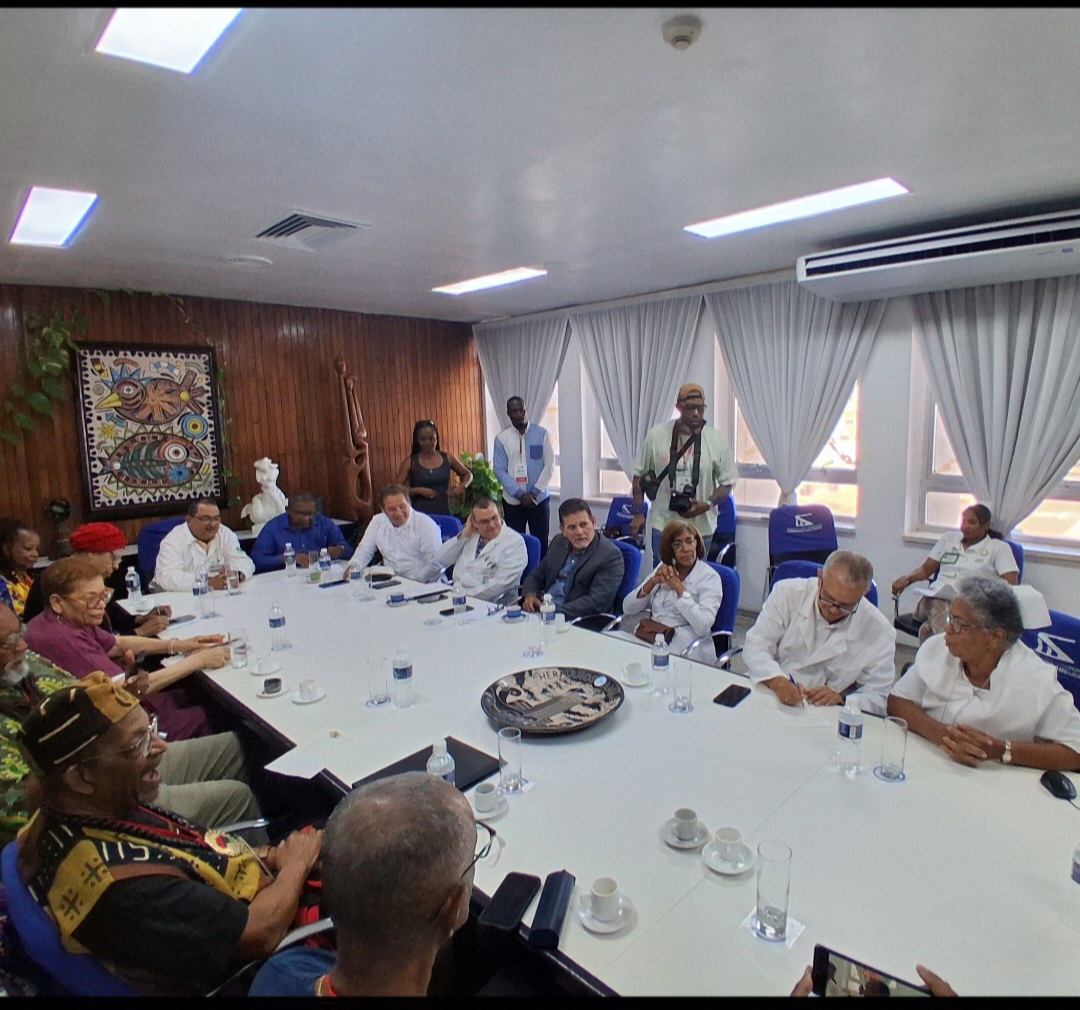
By Milton Allimadi
[Letter From Havana]
Photo Above: (Dr. Daniels, second from right, and delegation meet Cuban doctors.)
There are moments in journalism when statistics, speeches, and political arguments suddenly become irrelevant.

(With Dr. Hernández Cruz. He had to step away for several minutes to recover, during his response to a question about psychological impact of treating patients in Cuba.)
A human being tells the story better than any report ever could. One such moment unfolded recently inside Havana’s Hospital Clínico Quirúrgico when an American psychologist, Dr. Monique Swift Muhammad, posed what seemed like a straightforward question to a group of Cuban physicians.
How, she asked, do doctors cope emotionally with treating patients amid severe shortages of medicines, equipment, and supplies?
The question landed like a blow..For several seconds, Dr. Calixto Hernández Cruz, one of seven physicians seated across from an international emergency fact-finding delegation, remained silent. He was the only doctor at the table who spoke English and had eagerly volunteered to answer.
Then his eyes filled with tears. The physician seated beside him began crying as well. Soon the questioner herself was wiping away tears. Several others in the room followed.
Without uttering a word, the doctor had delivered the most powerful answer possible.
The crisis facing Cuba is no abstraction. It is measured in human suffering.
As a progressive journalist, I support the Cuban Revolution. I believe that without six-and-a-half decades of American economic warfare, Cuba—with one of the highest literacy rates in the world, a highly educated population, and a remarkable culture of resilience and public service—would today be among the most prosperous nations in the Caribbean. And it should be remembered that education and healthcare became free after the Revolution.
It would be a society where human beings, not capital, occupy the center of national life. Yet support for the Revolution does not require blindness to Cuba’s present reality.
Nor does it require pretending that mistakes were not made by Cuban leaders over the decades. But there is also no honest way to assess Cuba’s condition without acknowledging the enormous role played by the United States embargo and the ever-tightening sanctions regime that has strangled the island’s economy for 65 years.
The impact is everywhere. Doctors described shortages of critical medicines, including components needed to treat pediatric cancer patients. Hospital officials reported that survival rates for some childhood cancers have fallen from 85 percent to 65 percent because of difficulties obtaining essential drugs.
A healthcare system that once performed approximately 1.2 million surgeries annually completed only about 700,000 last year because of shortages of medicines, surgical equipment, spare parts, and fuel.
More than 100,000 patients are currently waiting for surgery, including approximately 11,000 children.
There are 3,000 dialysis patients who face transportation difficulties because fuel shortages have crippled public transit. Out of 930 nursing positions at the hospital, only about 130 are filled.
The shortages extend even to antibiotics needed by infants and pregnant women suffering infections.
The Cuban officials who briefed the delegation described a healthcare system struggling heroically against conditions few hospitals elsewhere in the hemisphere would consider manageable.
Outside hospital walls, the crisis is equally visible.
Cuba is experiencing severe fuel shortages that have produced recurring electrical blackouts lasting anywhere from 20 to 36 hours.
People walk miles to work and school carrying backpacks. Others rely on bicycles, bicycle taxis, overcrowded buses, or paid hitchhiking arrangements.
President Miguel Díaz-Canel recently disclosed to the delegation one of the most heartbreaking examples of the crisis: ships carrying approximately 15,000 tons of rice—one of Cuba’s staple foods—were sitting in Havana’s ports, yet fuel shortages prevented the government from distributing the grain throughout the country.
Hunger has become increasingly visible.
Young people, middle-aged adults, and the elderly can often be seen approaching tourists to sell small items, offer services, or communicate a simple message through gestures universally understood: they need food.

(The Cigar Lady. What will this 96-year-old and other vulnerable Cubans do if the US invades?)
The hardship is undeniable. Several Cubans interviewed on Havana’s streets spoke nostalgically about the Obama era, when normalization efforts led to increased tourism and greater economic activity.
One taxi driver and freelance guide told me that during that period he earned nearly three times what he earns today. “We need Obama,” he said.
Others expressed even more startling sentiments.
“We need Batista,” one man remarked, referring to the dictator overthrown by Fidel Castro’s revolutionaries in 1959. He said the exchange rate between the Cuban peso to the dollar is 500 to one today; under the kleptocrat Batista it was on par.
Such statements would have been almost unthinkable during earlier periods of the Revolution. Desperate times produce desperate nostalgia.
People forget that under Fulgencio Batista, Havana was effectively a playground for organized crime, gambling syndicates, and foreign exploitation. They forget the staggering inequalities that fueled the Revolution itself.
What they remember is that the shelves were stocked.
What they feel now is hunger, which has a way of reshaping political memory.
Even though this reporter is an unabashedly biased progressive who supports the Cuban Revolution, there is no denying that American pressure has exacted tremendous pain and suffering on ordinary Cubans.
Nor should anyone be surprised that some Cubans, exhausted by shortages and blackouts, are willing to believe that President Donald Trump and Secretary of State Marco Rubio might somehow come to their rescue. Economic despair often creates fertile ground for political illusions.
The Trump administration’s renewed sanctions and restrictions have intensified conditions that many Cubans describe as a “blockade.” Cuban officials including the Speaker of the National Assembly Esteban Hernandez estimate that sanctions have cost the country roughly $60 billion over their lifetime.
Whether one accepts that figure in full or not, there is little dispute that the cumulative economic damage has been immense.
The objective of U.S. policy has long been clear: create sufficient hardship to trigger either mass unrest or political collapse. Military invasion seems on the horizon. “Dialogue is possible,” President Diaz-Canal, said. “But you cannot talk under pressure.”
He added, “We are convinced Cuba and the US can settle their differences through dialogue.”
The Cubans are taking tbe threats of war seriously. “If we are invaded there will be fighting,” President Diaz-Canal said. “We will defend the Revolution to the last consequences.”
Yet despite the deprivation, Cuba has not descended into chaos. The social fabric is fragile. The resilience of ordinary Cubans is perhaps the most extraordinary aspect of the current crisis.
One evening, during a lengthy blackout in Havana, I watched a musical performance at Cesar Jazz Club delayed because the bass guitarist could not power his instrument. For nearly ninety minutes, electricity remained unavailable.
The audience stayed. The musicians stayed. A flutist improvised and carried the performance until power returned.
The show went on.
That phrase may best summarize contemporary Cuba.
The show goes on. It goes on in hospitals where doctors struggle to save children without adequate medicines.
It goes on in homes illuminated by battery-powered lamps and candles.
It goes on in classrooms reached by students hungry for knowledge who walk miles because buses lack fuel.
It goes on in neighborhoods where great grandmothers, like Havana’s celebrated 96-year-old “Cigar Lady,” continue greeting visitors from windows lined with paintings depicting their younger selves.
And it goes on despite the expectation in some quarters of Washington that enough suffering will eventually force Cubans to abandon the Revolution.
Perhaps it will. Perhaps it won’t.
History offers no guarantees.
But after witnessing doctors cry over the fate of their patients, one conclusion seems unavoidable.
Whatever one’s opinion of Cuba’s political system, the people of this island have already endured far more punishment than any nation should be asked to bear.
The tears in that hospital conference room were not political.
They were human.
And they spoke volumes.

Editor’s Note: The fact-finding delegation was organized by the Institute of the Black World 21st Century’s Pan-African Unity Dialogue and led by IBW21’s President Dr. Ron Daniels. A Cuban noted that Secretary Rubio has never been to the country. For more please visit www.ibw21.org