Almost three years after putting out an EP entitled, “Public Enemy n a Krip-Hop Remix” in 2023 kripping Public Enemy’s 1990 classic album, Fear Of A Black Planet and receiving no write ups, nothing so I wrote my own review below.
My EP, “Public Enemy n a Krip-Hop Remix” can be understood as a radical intervention into both Hip-Hop politics and disability culture. The project does not simply remix the sound of Public Enemy; it remixes the political function of Hip-Hop itself through the lens of Krip-Hop Nation, Black disability consciousness, and Afro-Krip critique.
At the center of the EP is a dialogue with the militant sonic tradition established by Public Enemy and especially Chuck D. Public Enemy’s music historically exposed state violence, white supremacy, media propaganda, mass incarceration, and anti-Black racism. I try to extend that framework by arguing that disability is not outside of these structures but produced through them. Police violence, poverty, environmental racism, war, incarceration, medical neglect, and urban abandonment all create debility in Black communities. Thus, Krip-Hop remixes Public Enemy politically, not just musically.
The title itself, Public Enemy n a Krip-Hop Remix, suggests several layers:
- Public Enemy becomes reinterpreted through disabled Black experience.
- Krip-Hop inserts disability into revolutionary Hip-Hop discourse.
- The “remix” symbolizes rewriting history from the margins.
- Disability is transformed from stigma into political identity and cultural production.
The EP likely functions as what Krip-Hop Nation calls “kripping Hip-Hop,” exposing how mainstream Hip-Hop often reproduces ableism while simultaneously emerging from conditions of social disablement. My work confronts this contradiction directly. Many traditional Hip-Hop narratives celebrate physical dominance, invulnerability, hypermasculinity, and bodily control. Krip-Hop disrupts these norms by centering disabled embodiment, pain, survival, and interdependence without abandoning militancy or resistance.
Sonically and politically, the project can also be read as building on the noise aesthetics of Public Enemy’s Bomb Squad production style. Public Enemy’s dense layering of sirens, speeches, scratches, and chaos mirrored urban crisis and state surveillance. In a Krip-Hop context, fragmentation, interruption, stuttering rhythms, or altered vocal textures can symbolize disabled temporality and embodiment. The remix becomes an aesthetic challenge to normalized listening practices.
Another important dimension is language. Krip-Hop reclaims terms historically used against disabled people in ways similar to how Hip-Hop Nation Language reclaimed and transformed marginalized Black urban speech. My remix tradition parallels how Hip-Hop flipped dominant language into cultural resistance. Here, disability terminology becomes political vocabulary rather than pathology.
The EP also expands Black radical tradition. Public Enemy framed Black communities as under siege by systemic racism; Krip-Hop argues disabled Black people experience layered forms of abandonment within both white institutions and Black cultural spaces. Therefore, the remix critiques:
- Black ableism
- capitalist productivity norms
- exclusionary forms of Black nationalism.
Importantly, I do not reject Hip-Hop. Instead, the EP insists that disabled Black people have always been part of Hip-Hop history, even when erased. The remix becomes archival recovery and political correction.
Through Afro-Krip theory, the project can be interpreted as arguing:
- disability is central to Black modernity
- debility is produced by racial capitalism
- disabled Black bodies generate culture and theory
- liberation movements must include disability justice.
In this sense, Public Enemy n a Krip-Hop Remix is not nostalgia. It is a reconstruction of revolutionary Hip-Hop for a new political era where disability, race, incarceration, policing, colonialism, and survival are understood as interconnected struggles.
Link to the EP

 Black News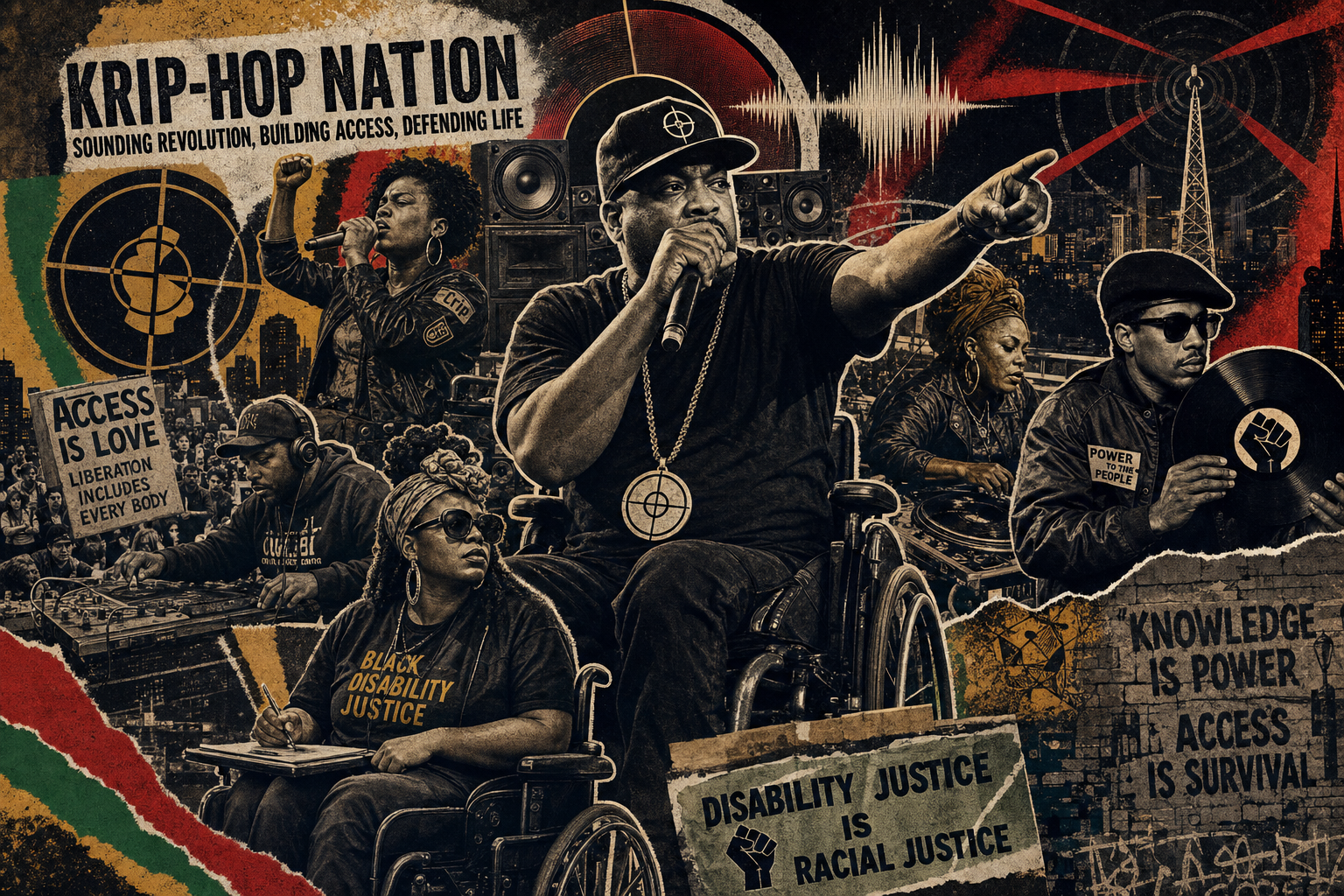

![SPOTLIGHT: Vincent Neil Emerson - "Blue Stars" [VIDEO]](https://storage.ghost.io/c/18/d0/18d08e58-3b1b-4720-ae25-a31b44e69d4b/content/images/2026/04/Spotlight-Template.png?#)