A century of Kruger
Kruger National Park’s 100-year milestone reflects both South Africa’s conservation history and SANParks’ efforts to shift from exclusionary “fortress conservation” to community partnerships and local economic development
 Black News
As SANParks prepares to mark 100 years since the establishment of the Kruger National Park, the people who lived in and interacted with the landscape for tens of thousands of years are long gone.
Among them were the San, whose presence during the Stone Age survives in the park’s rich collection of rock art and artefacts, a legacy that continues to offer insight into South Africa’s deep human history.
Reflecting on Kruger’s early years, renowned environmental historian Jane Carruthers recalled a vastly different park experience from the tightly regulated reserve visitors know today.
Carruthers, author of the influential book The Kruger National Park: A Social and Political History, said tourists visiting around 1927 often arrived with little understanding of wilderness conservation.
“When tourists came to Kruger, they wanted to touch the wild animals — even lions, if they could,” she told the Mail & Guardian. “There were no roads and no infrastructure. The instruction from the central government, which had taken over Kruger from the Transvaal administration, was simply that it should operate as a tourist destination.”
At the time, the southern enclave near Pretoriuskop Rest Camp was the only section open during winter.
“There were no rules and regulations,” Carruthers said. “People got out of their cars and camped wherever they wanted. There was nobody to watch them — no opening or closing times.”
For Carruthers, Kruger’s centenary is significant not only as a conservation milestone but as a reflection of South Africa’s political and social evolution.
“It tells us about the history of South Africa over the last 100 years, because Kruger has fitted into that history and South Africans have always adapted,” she said.
“In all the changes of government we’ve had, the fact that Kruger still survives is remarkable. It could have gone in a completely different direction. Each succeeding generation has taken the best of it and carried it forward.”
Spanning nearly two million hectares across Limpopo and Mpumalanga, with its eastern boundary running along the Lebombo Mountains bordering Mozambique, Kruger remains one of the world’s largest protected areas.
Often compared by European tourists to the size of Wales, the park is home to an estimated three to five million animals, according to SANParks chief executive Hapiloe Sello.
“Statistics are never entirely accurate around the borders,” Sello noted.
But while Kruger’s wildlife attracts millions of visitors, communities living alongside the park continue to face many of the same challenges affecting the rest of the country: unemployment, poverty and limited economic opportunities.
Sello said SANParks has increasingly shifted away from the exclusionary conservation model that historically separated parks from neighbouring communities. Through its Vision 2040 strategy, the organisation is trying to integrate biodiversity protection with local economic development.
“When running conservation areas, we have to avoid creating islands of privilege that only serve holidaymakers,” she said.
“In the last 30 years, particularly post-1994, one of our guiding principles has been bringing communities closer to national parks and identifying areas of mutual benefit.”
Central to that effort is SANParks’ enterprise and supplier development programme, which supports small businesses through training, market access and financing.
Among the flagship initiatives is the Sanlam-SANParks SMME Fund, which provides non-interest-bearing loans of up to R1 million to small businesses that secure SANParks contracts but lack working capital.
“These are people who ordinarily would not have access to a R1 million loan from a bank,” said Sello. “Without working capital, they wouldn’t be able to fulfil the order.”
SANParks effectively acts as guarantor for participating businesses, with a purchase order serving as security. About 150 SMMEs have benefited from the programme so far.
“We’re looking for more social-impact partnerships,” Sello said. “We cannot do this alone without collaboration with the private sector.”
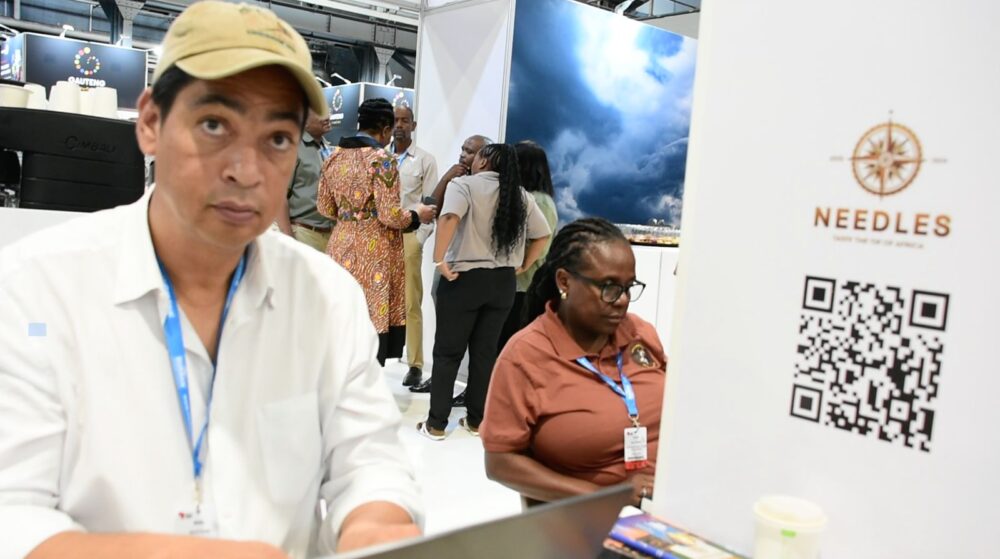
One such partnership is unfolding at Agulhas National Park in the Western Cape, where Needles Kitchen — a 60-seater restaurant near the southern tip of Africa — recently opened as part of a public-private partnership with SANParks.
The restaurant focuses on locally sourced seafood, meat and fynbos-inspired dishes alongside Cape wines and regional craft spirits.
Co-founder Noël Bastiaan said partnering with SANParks had opened significant opportunities for the family-owned business.
“As concessionaires, we’ve been welcomed by SANParks and learned a lot about the organisation’s culture,” Bastiaan said.
The company secured the tender after a lengthy compliance and regulatory process following SANParks’ 2024 call for investors in the new tourism precinct.
“This is the southernmost restaurant on the African continent,” Bastiaan said.
But beyond the location, he said the emphasis is on locality and community development.
“Our objective is to source locally — from fishermen, vegetable producers and local suppliers,” he said.
“We also want to upskill staff from the area so that international guests receive world-class service.”
The business, he added, is equally conscious of operating within a protected conservation area. “We have to think about waste management, sustainability and how we conduct ourselves in the park environment,” Bastiaan said.
Further north, tourism entrepreneur Pindile Sopouza Chaga is using tourism to create economic opportunities in remote villages.
Chaga, co-owner of Chaga Tours and Adventures, said the company works with rural communities to build tourism awareness and develop local infrastructure, including accommodation, catering and village clean-up initiatives.
“We go into villages where people don’t even realise tourism can create jobs and income,” she said.
The business operates across several villages in the region, where attractions include mountains, waterfalls and agricultural tourism.
But with tourist numbers fluctuating, the company has also diversified into cultivating herbs and medicinal plants such as rosemary, thyme, lavender and calendula. Villagers grow and harvest the plants, which Chaga Tours then buys and sells through its networks.
“We realised we were preaching tourism to struggling communities,” she said. “So we had to help them heal as well.”
The project has since expanded into supplying products to businesses in Johannesburg and Limpopo connected to SANParks-supported SMME programmes.
Working with communities, women, youth and traditional leaders
Inclusive conservation — working alongside communities, traditional leaders and local knowledge holders — remains central to the work of the Natural Heritage Alliance (NHA), a civil society coalition advocating for conservation reform in South Africa.
The alliance this year marked five years since South Africa adopted the recommendations of the High-Level Panel’s report to review policies, legislation and practices on matters related to the management, breeding, hunting, trade and handling of elephants, lions, leopards and black and white rhino, a process that reshaped debate around wildlife conservation, animal welfare and community inclusion.
Established in 2022, the NHA brings together communities, women leaders, youth organisations, traditional healers and conservation groups. It says conservation should not focus only on protecting wildlife but also on justice, equity and livelihoods.
The coalition said progress had been made since the release of the report in 2021, including policy reforms aligned with the White Paper on Conservation and Sustainable Use of South Africa’s Biodiversity.
But the organisation warned that momentum appears to be slowing. The NHA expressed concern over what it described as declining consultation with traditional leaders, healers and community groups following changes in leadership at the department of forestry, fisheries and the environment last year.
It said inconsistent signals from the government risk undermining trust and delaying conservation reform. “Our commemoration is more than a celebration — it is a call to action,” the alliance said.
“Civil society reaffirms its commitment to work alongside the government to confront the triple crisis of biodiversity loss, climate pressures and inequality.”
“The success of this partnership will determine whether lions, elephants, rhinos and leopards become symbols of hope in landscapes where people and nature can thrive together.”
The High-Level Panel was established in 2019 by former environment minister Barbara Creecy, following mounting criticism of controversial wildlife practices, particularly the captive lion industry and calls from parliament for legislative reform.
The panel’s report, released in 2021, contained recommendations aimed at aligning conservation policy with both biodiversity protection and socio-economic priorities.
Among ongoing concerns raised by civil society groups is the government’s position on reviewing lion bone export quotas, with fears that earlier reforms could be weakened.