Bamako under Siege: How Coordinated Attacks Exposed the Mali Government’s Fragility—and Tested the AES
The coordinated attacks that shook Mali on 25–27 April 2026 are not an anomaly. They are the culmination of a long, deteriorating security trajectory—one that has steadily eroded state authority, exposed strategic miscalculations, and now threatens to overwhelm national and regional security architectures. At the centre of this crisis lies a troubling reality: Mali is no longer facing a fragmented insurgency. It is confronting an adaptive, coordinated, and increasingly convergent threat ecosystem—one that is evolving faster than the institutions designed to counter it. The Crisis Was Long in the Making A critical insight from recent analysis is that the April […] The post Bamako under Siege: How Coordinated Attacks Exposed the Mali Government’s Fragility—and Tested the AES appeared first on African Arguments.
 Black News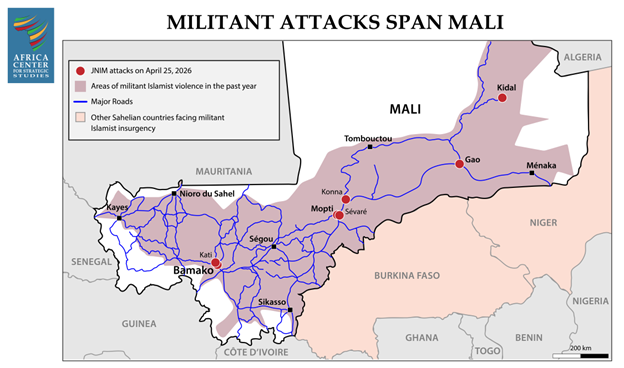

The coordinated attacks that shook Mali on 25–27 April 2026 are not an anomaly. They are the culmination of a long, deteriorating security trajectory—one that has steadily eroded state authority, exposed strategic miscalculations, and now threatens to overwhelm national and regional security architectures. At the centre of this crisis lies a troubling reality: Mali is no longer facing a fragmented insurgency. It is confronting an adaptive, coordinated, and increasingly convergent threat ecosystem—one that is evolving faster than the institutions designed to counter it.
The Crisis Was Long in the Making
A critical insight from recent analysis is that the April attacks should not be interpreted as a sudden deterioration but as the latest manifestation of a sustained downward trajectory. As the Africa Centre for Strategic Studies emphasises, militant Islamist groups—particularly Jamaʿat Nuṣrat al-Islām wa-l Muslimīn (JNIM)—have ‘expanded their reach, increased operational coordination, and intensified pressure on key military, political, and economic centres’ over several years.
A sharp rise in violence has accompanied this trend. Fatalities linked to militant Islamist groups have reportedly tripled under the junta, reflecting both a growing insurgent capacity and a declining state effectiveness. The April offensive, therefore, is not a deviation but an intensification of an already accelerating pattern.
Equally important is the geographic evolution of the threat. JNIM has moved beyond its traditional strongholds in northern and central Mali, expanding into southern and western regions closer to Bamako, thereby collapsing previously distinct conflict zones into a unified operational theatre. This shift has brought the war to the doorstep of political power, fundamentally altering the strategic calculus.
Mohamed Elmaouloud Ramadane, the Azawad Liberation Front (FLA) spokesman, told the BBC, ‘We had been working on this operation for a long time, in a well-planned manner, and, in fact, in alliance with [JNIM].’
A nation in shock
The April attacks demonstrated a level of coordination rarely seen in Mali’s conflict. Armed groups launched near-simultaneous assaults across vast distances—spanning roughly 1,500 kilometres from Bamako to Kidal—targeting military bases, airports, and strategic infrastructure.
This aligns with the earlier intelligence assessment that the operation was intended to impose ‘simultaneous security stress across geographically distant nodes’, thereby straining the state’s response capacity and exposing gaps in rapid reaction and force deployment.
The logic was clear and layered:
- Bamako and Kati: Strike the political and military core
- Sévaré and Mopti: Disrupt logistical arteries linking north and south
- Gao and Kidal: Sustain pressure in contested northern zones
- Aviation infrastructure: Signal vulnerability in mobility and external support
This was not a campaign for immediate territorial control. Rather, it was a demonstration of reach, resilience, and systemic disruption—a model of warfare that prioritises cumulative pressure rather than decisive victory.
Fall of Kidal and the Collapse of Strategic Narratives
Few developments capture the symbolic weight of the crisis more than the reported fall of Kidal. Long a stronghold of Tuareg resistance and a focal point of Mali’s territorial contestation, Kidal represents both a strategic and psychological centre of gravity.
Its recapture by FLA forces signals a profound setback for the junta’s claim of consolidating territorial authority. As the Africa Centre report notes, the loss of Kidal would ‘represent a major setback to the junta’s narrative’.
Compounding this blow are reports that Defence Minister Sadio Camara was killed in the attacks. Whether fully verified or not, these reports reinforce a powerful perception: the state’s elite is no longer insulated from the violence it seeks to contain.
Together, these developments puncture the central narrative of the junta—that sovereignty has been restored and security stabilised. Instead, they reveal a widening gap between official claims and operational realities.
The JNIM–FLA Convergence: From Fragmentation to Hybrid Threat
The most strategically consequential aspect of the attacks is the convergence between JNIM and the FLA. Historically divided by ideology—jihadi versus separatist—these actors have shown capacity for pragmatic, tactical alignment.
This convergence reflects a shared short-term objective: to weaken the Malian state and its external partners. It also creates a division of labour:
- JNIM provides asymmetric warfare capabilities and operational depth
- FLA contributes local intelligence, mobility corridors, and territorial access
This alignment links local territorial disputes to broader insurgent campaigns, creating a more complex and resilient threat environment.
The implications are profound. Traditional counterinsurgency approaches rely on isolating threats—separating jihadists from local grievances. The JNIM–FLA convergence undermines this logic, creating a hybrid insurgency that is harder to fragment and defeat.
On April 28, JNIM announced a total siege of Mali’s capital, Bamako and warned civilians to stay out of their way. This could be the beginning of the end of General Assimi Goita’s junta.
Structural Fragility: The Junta’s Strategic Miscalculations
The April attacks expose not only operational vulnerabilities but also deeper structural weaknesses in Mali’s security strategy.
- Overstretch and Strategic Overreach
The junta’s decision to open a second front against Tuareg separatists—while still confronting a growing jihadist threat—has overstretched already limited resources. Supply lines have been strained, and operational focus has been diluted.
- Reliance on External Security (Russia)
The shift from multilateral partnerships to reliance on Russian paramilitary forces has created a narrow and fragile security model. With only an estimated 1,000–2,500 personnel, these forces cannot compensate for the loss of roughly 20,000 international troops previously deployed in Mali.
- Governance Deficits and Civilian Alienation
Heavy-handed military tactics have contributed to civilian harm, fueling recruitment into militant groups. In some areas, rural populations are reportedly fleeing state forces and turning to insurgents for protection.
- Shrinking Political Space
The junta’s repression of civilian political actors has reduced avenues for addressing grievances and mobilising national cohesion. This has left the military managing security, political, and economic crises simultaneously, with limited legitimacy.
Taken together, these factors reveal a state that is not merely under attack—but structurally weakened from within.
Russia’s Africa Corps: A Diminishing Shield
The role of Russian forces further complicates the picture. Initially presented as a decisive alternative to Western support, Russia’s Africa Corps is now increasingly exposed to scrutiny.
The April attacks—and reports of withdrawal from Kidal—highlight a critical vulnerability: Russian forces are dependent on Malian units for perimeter security and intelligence, creating exploitable gaps.
Moreover, insurgent messaging has explicitly targeted Russia’s involvement, seeking to impose costs and undermine its credibility. What was once a stabilising partnership is now a contested and potentially destabilising factor.
AES – Regional Security Model under Stress?
If Mali is the epicentre of the crisis, the Alliance of Sahel States (AES) is its strategic test case.
Formed as a break from ECOWAS and a declaration of regional autonomy, the AES was intended to provide a collective security framework for Mali, Burkina Faso, and Niger. Yet the April attacks expose its limitations.
Despite the scale of the crisis, there was no immediate, coordinated military response from AES partners. This absence raises critical questions:
- Is the AES operationally capable of collective defence?
- Does it possess the intelligence-sharing and rapid-response mechanisms required for such threats?
- Or is it primarily a political construct lacking functional depth?
The AES’s characterisation of the attacks as a ‘monstrous plot’ by external enemies underscores a narrative approach—but narrative cannot substitute for capability.
In effect, the AES faces a defining moment. Without demonstrable operational coherence, it risks being seen not as a security solution but as part of the problem.
Cognitive Warfare: The Battle Beyond the Battlefield
A defining feature of the April attacks is their integration with a sophisticated information campaign. As earlier analysis noted, the operation was paired with an ‘immediate cognitive-exploitation phase’.
The narrative is simple yet powerful:
- The state cannot protect its core
- Insurgents can strike nationwide
- External partners are ineffective
These messages are reinforced by the visible realities of the attacks, creating a feedback loop that erodes public confidence and strengthens the insurgents’ legitimacy.
At the same time, competing narratives—particularly those amplified by Russian information operations—are increasingly disconnected from conditions on the ground. As the Africa Center report notes, the attacks ‘puncture the myths’ surrounding stabilization claims.
This is not merely a battle of arms; it is a battle of legitimacy.
A Regional and Global Inflexion Point
The implications of Mali’s crisis extend far beyond its borders.
- Sahel-wide instability: The JNIM–FLA model could be replicated in Burkina Faso and Niger
- Cross-border spillover: Threats are spreading towards coastal West Africa
- Global security risks: A weakened Mali risks becoming a sanctuary for transnational terrorist networks
Perhaps most critically, the crisis underscores a central reality: the Malian military cannot manage this threat by itself.
This creates space—and a necessity—for renewed engagement by regional and international actors, including ECOWAS, the AU, and partners such as the United States. The African Union, the United Nations, the Secretary-General of the Organisation of Islamic Cooperation, and the US Bureau of African Affairs have condemned the attacks across Mali. Mahmoud Ali Youssouf, the African Union Commission Chairperson, expressed deep concern and ‘strongly condemns these acts which risk exposing civilian populations to significant harm’. The UN chief, Antonio Guterres, also condemned the ‘acts of violence‘ and expressed his ‘solidarity with the Malian people’. He called for coordinated international support to address the evolving threat of violent extremism and terrorism in the Sahel and to meet urgent humanitarian needs. On its part, the US State Department’s Africa bureau stated that ‘We extend our deepest condolences to the victims, their families, and all those affected, and we stand with the Malian people and government in the face of this violence.’
Conclusion: The Illusion of Control Has Collapsed
The April 2026 attacks mark a turning point. They expose a state under systemic pressure, an insurgency that has grown more sophisticated, and a regional alliance struggling to assert its relevance.
For Mali, the challenge is existential: to move beyond a narrow, militarised approach and rebuild a broader coalition—domestic, regional, and international.
For the AES, the moment is equally defining. It must demonstrate that it is more than a political statement—that it can deliver credible, coordinated security outcomes.
For the wider international community, the lesson is clear: disengagement has not reduced the threat—it has allowed it to metastasise.
In the end, the question is not simply how the mighty are falling. It is whether they can still rise before the trajectory becomes irreversible.
The post Bamako under Siege: How Coordinated Attacks Exposed the Mali Government’s Fragility—and Tested the AES appeared first on African Arguments.