Georgia Law Targeting Black Women Electeds Awaits Governor’s Veto
Fixated on punishing local elected officials in democratic strongholds under the guise of election reform, Republicans ignore real issues facing the state’s elections.
 Black News


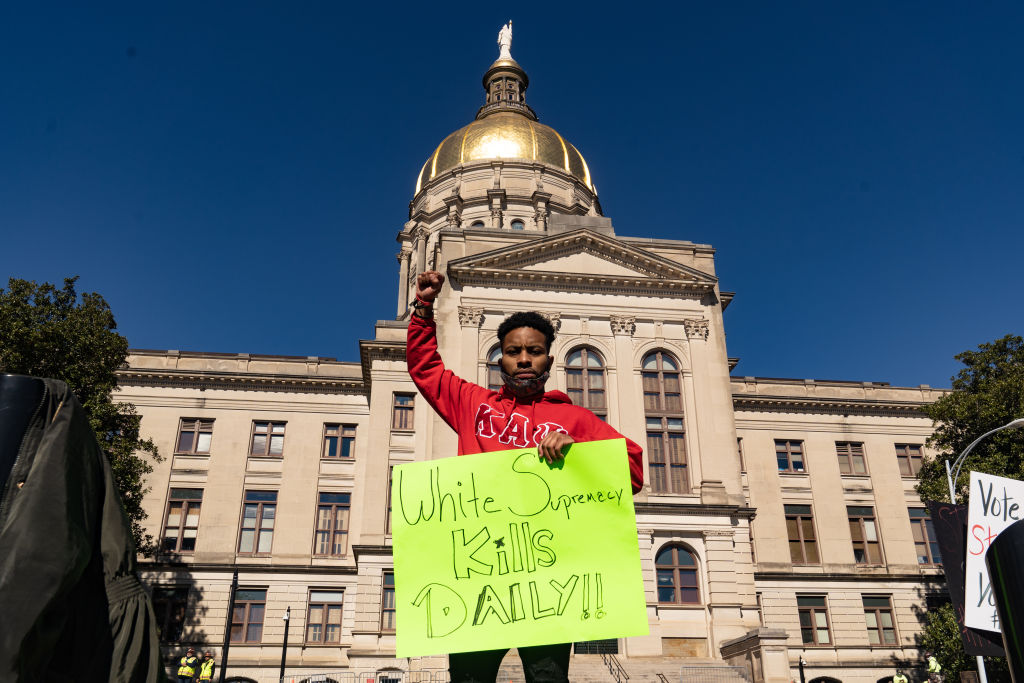
A new law targeting Black women’s leadership in metro-Atlanta.awaits Georgia Gov. Brian Kemp’s signature. But instead of fixing a potentially dire situation concerning a ballot law deadline, Republicans couldn’t pass up the chance to give metro-Atlanta the finger.
HB 369 would require the state’s five most diverse counties to hold nonpartisan elections for certain local races. Georgia has 159 counties, but the new law would only impact Fulton, DeKalb, Cobb, Gwinnett, and Clayton counties.
All have Black women prosecutors. If allowed to take effect, the law could shake up the 2028 election. HB 369 is another example of how Republicans are willing to cripple our elections in their pursuit of petty politics.
If they were really concerned about elections, we wouldn’t be in limbo about a ban on the QR codes used to count votes. QR codes that were put on the ballots 7 years ago, after Republicans played stupid games with the state’s voting machines.
Several groups have called on the governor to convene a special session to fix the problems before SB 189 goes into effect in July.
But instead of getting right, Georgia Republicans have been stuck on going after their political opposition. While some may have their issues with metro-Atlanta prosecutors, they have attempted to make some shifts in criminal justice policies that have angered off Republicans.
Despite Republican claims that it’s merely about “law enforcement,” county sheriffs will still be elected in partisan elections. The Center for Civic Innovation explained that the bill was originally a food truck safety bill but was hijacked into its final form.
Georgia Republicans struggle to make inroads in the capital city region and would like to punish Black women who defy them in the process. Advocates, elected officials, and even some Republicans have called on Gov. Brian Kemp to veto the bill.
“This takes away accountability from the voters,” Stephen Aaron, chairman of the 9th Congressional District Republican Party, told WABE. “It takes away voters’ ability to identify basic philosophy of who’s run when someone’s running for a certain office, and realistically, it’s just bad policy.”
DeKalb County District Attorney Sherry Boston, who was first elected in 2016, has indicated she will fight the new law if the governor does not veto it.
Former Fulton County Commissioner Mo Ivory released a video breaking down the bill and explaining why the targeting of metro-Atlanta-area prosecutors was a problem.
“When our communities organize, vote, and win, some try to change the rules instead of respecting the results,” read the caption on her video. “If it were fair, it would apply everywhere. It doesn’t. This is about power. And I will always fight to protect yours.”
Ivory, who stepped down to run for Fulton County Commission Chair, has been a vocal advocate about Republican efforts to undermine political power in the region. She stepped up after the Trump administration attacked the Fulton County Board of Elections.
Nichola Hines, president of the League of Women Voters of Georgia, released a statement outlining the bill’s threat to democracy under the guise of “reform.”
“It doesn’t just change how people vote, it changes when they vote,” she said. “This bill shifts these races away from the November general election and into a May election calendar when turnout is consistently lower, and few voters are paying attention.”
Hines said the move was about shrinking the electorate.
In 2023, Kemp signed another politically motivated law allegedly aimed at disciplining and removing “wayward prosecutors. Basically, Republicans were mad about the wave of more progressive reformers taking office. The tough-on-crime party has wanted to punish those who would attempt to fix even some of the issues in a corrupt system.
In a perfect world, non-partisan elections could be a decent way to ensure the best ideas and people prevail. Party over people and politics have caused a lot of issues in this country.
But the world’s not perfect, and we know that wolves in sheep’s clothing try to trick us each cycle to grab power. Party labels alone don’t guarantee a candidate will respect the people who elected them.
One only has to look at the charade happening in Georgia’s democratic primary for governor to see that anyone can talk the talk. It’s what they do once they are elected that matters.
Party labels shouldn’t be shorthand for doing the work. But the labels can be helpful when candidates lack the money and resources to engage voters.
Similar to the branding of any major product, it’s often a certification of a candidate’s values and commitment.
Another bill that is equally problematic for Black political power in Georgia, but has received much less attention, is HB1567. The bill would dissolve the city charter for Quitman, GA, and fold it into the surrounding county.
HB 1567 outlines guidelines for how the city should handle its debt and would provide for an election for Brooks County, not just the people of Quitman.
If signed into law, it wouldn’t be Kemp’s first time inflicting political pain on the city, which is a part of a longer arc of his attacks on Black political power around the state. Over 15 years ago, in the early days of Kemp’s voter suppression reign as secretary of state, a group of Black people organized and won seats on the local board of education.
Mad at the outcome, the group more commonly known as Quitman’s 10+2 was targeted for alleged voter fraud and aggressively prosecuted. While those targeted were ultimately acquitted, it was after former Gov. Nathan Deal removed the three Black women who were elected from the county board of education.
SEE ALSO:
Trump Admin’s Attack On Civil Rights Groups Is A Call To Action
Georgia Abortion Prosecution Highlights Damage Caused By Extreme Ban
Lessons From North Carolina: A Canary In The Democracy Coal Mine