Houston Black women leaders reshape beauty culture and media
Three Houston Black women under 40 are boldly reshaping beauty, sound, and media culture.
 Black News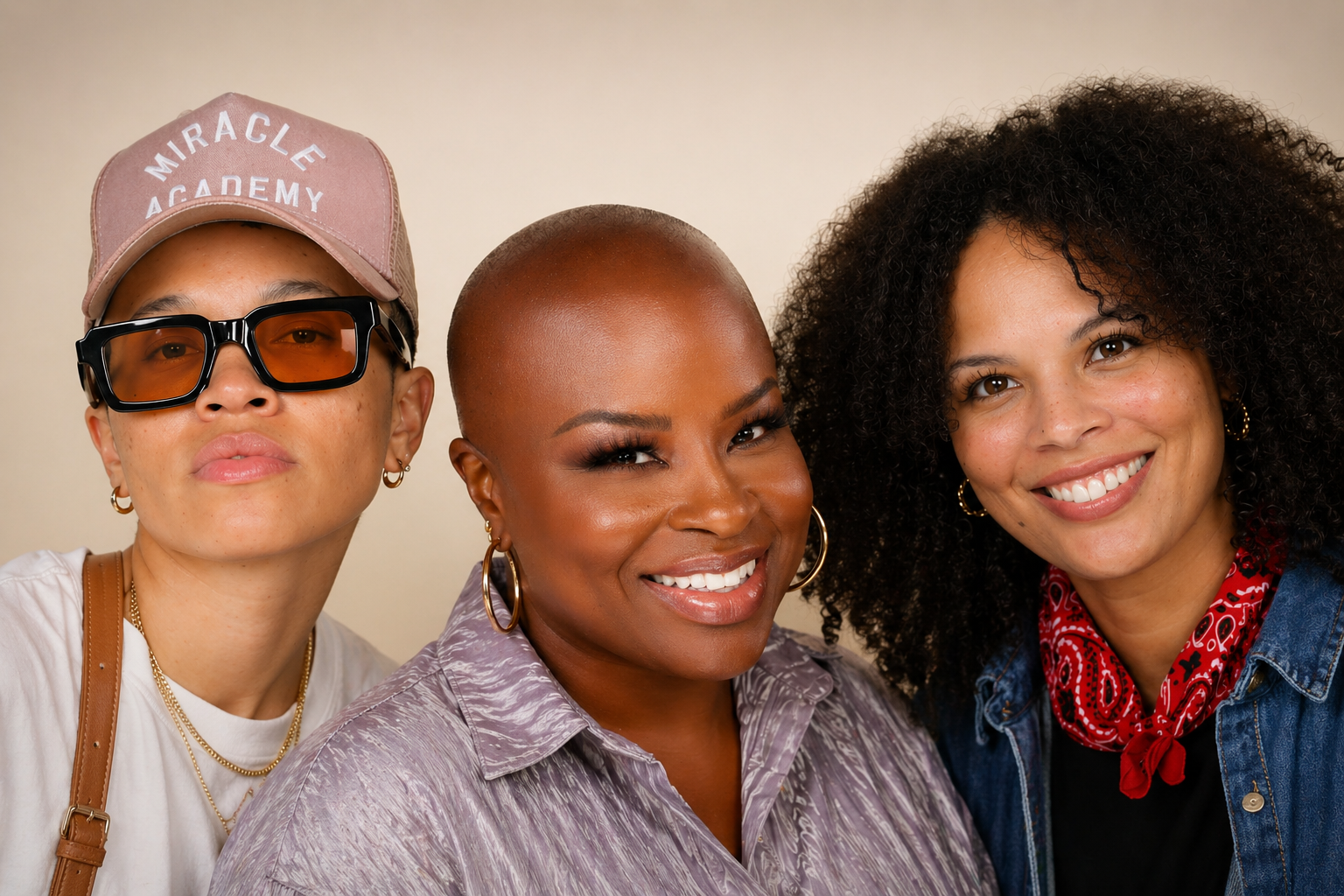

You already know her.
She is the one in your group chat who started a business while everybody else was still talking about it.
The one who took a job at an institution that was never built for her and quietly started rearranging the furniture. The one who showed up to rooms where she was the only one, and instead of shrinking, started building her own.
In Houston, a generation of Black women under 40 is doing something that does not make the evening news but reshapes everything around it. They are deciding, on their own terms, what beauty means, what culture sounds like, and whose stories get told.
They are building archives so Black women are never erased again. They are leading magazines and founding festivals because the ones that existed were not built with them in mind. They are launching beauty brands out of love, grief, and the unshakeable belief that every Black woman deserves to feel like herself.
KIM ROXIE
Founder/CEO: LAMIK Beauty

Kim Roxie did not arrive in beauty with a plan. She arrived with a part-time job and a mother who handed her $500.
At 21, she opened a makeup shop at Houston’s Sharpstown Mall, walking the food court to hunt clients, figuring out technique in real time. She had been hired at a cosmetics counter weeks earlier without ever having touched anyone’s face. Her manager pulled her aside to ask what she was saying to customers. She was outselling everyone on staff.
“I have fallen in love with making women feel good about themselves,” she said. “I feel like a healer. I feel like a doctor.”
Growing up dark-skinned in Houston at a time when “you’re pretty for a dark-skinned girl” passed for a compliment, Roxie understood early that what she was doing at that counter was not about the product. It was about the word that landed and stayed, and about healing the girl inside herself who had not felt seen by the industry she was now leading.

In March 2020, Roxie launched LAMIK Beauty as a national clean beauty brand on Facebook Live, broadcasting from her four-year-old daughter’s bedroom. Every product carries the brand’s affirmation inside, “Beauty is revealed, not applied.”
Roxie has alopecia. For years, she spent entire mornings hiding bald spots, arriving late and diminished. The shift came when she finally saw a dermatologist who looked like her and immediately understood her scalp. She found a community called BaldyCon shortly after, and LAMIK Beauty has now sponsored it for five years running.
“Instead of being in a struggle, I decided to surrender to who I was becoming,” she said. “You’ve got to have a conviction about who you are.”
The road to retail shelves cost her, by her count, at least seven losses for every visible win. A failed partnership with a major department store consumed a year of money, staff, and time. She showed up to find the shelves empty. Most founders would have quit. She chose to keep going.
“By the world’s means, it was impossible for a Black girl from the south side of Houston with no industry connections,” she said. “But the impossible turns into I’m possible. I’m the possibility.”
When that partner dissolved, other brands walked. LAMIK kept knocking. Two years of trunk shows, the first beauty brand that retailer ever hosted in that format, led to a March 2025 launch in JCPenney locations across Texas, Louisiana, Arkansas, and Oklahoma. Products sold out immediately.
Roxie lost both her mother and her sister to breast cancer. She had been doing health equity work in that space before it touched her own family. She has since raised more than $500,000 for The Rose, a Houston nonprofit providing mammograms and follow-up screenings to uninsured women.
“LAMIK is the love that I have in my heart for my mother and my sister,” she said. “I don’t do this from a place of recognition. I do this from a place of love. Real love.”
BRITTANY BRITTO GARLEY
Editor-in-Chief, Houstonia Magazine
Co-Founder, BIPOC Book Fest

Brittany Britto Garley has wanted to be a magazine editor since she was a little girl. She will tell you that plainly, without apology or qualification. In June 2024, that dream became her reality when she was named editor-in-chief of Houstonia Magazine, Houston’s flagship culture publication, stepping into the role alongside a round of staff layoffs.
“It’s been a little bit challenging,” she said. “But I’ve been working on establishing my voice and direction as editor-in-chief and making sure we’re covering the most important and interesting aspects of Houston life.”
Garley arrived at that chair by a route most editors cannot claim. She started at the Baltimore Sun as a general assignment features reporter and blogger, moved to the Houston Chronicle covering education, breaking news, and food, then to Eater Houston, where a company transition pushed her into the role of regional editor of Texas. Each stop built the editorial instincts she draws on now.
“You can think you’re ready, but you’re never really ready,” she said. “You learn so much when you’re in the position. Suddenly, all of what other editors have poured into you, and you tap into that. It starts making sense.”
When she needs guidance, she still picks up the phone, including calls to former editor Karen Denny. Because she has been the underpaid reporter and the freelancer grinding without a safety net, she leads with a rare clarity about people’s humanity at her level.
“Leadership is not about being able to move as if you are not human. I am still just a daughter and a sister missing her loved ones. And I want women to know they can be themselves too.”
Kim Roxie, CEO/Founder, LAMIK Beauty
“You can’t forget what it was like when you were there,” she said. “Just because I’m the editor and kind of the person calling the shots, that doesn’t mean I forget.”
As a Cape Verdean-American woman who has lived in Morocco and Hong Kong, she brings a genuinely global lens to a city that demands one, moving through Houston’s Vietnamese, Nigerian, and Latin communities with the ease of someone who understands that where you come from shapes what you cover.
That same instinct led her, in 2021, to co-found BIPOC Book Fest alongside Chronicle colleagues Brooke Lewis and Jaundrea Clay. Houston had no literary festival centered on authors of color. Born from pandemic conversations and that undeniable gap, the fest is now in its fifth year and thrives without her in a day-to-day role, which she said is exactly the point.
“A lot of us didn’t grow up seeing books in that way, where you could read about your culture or so many subcultures of your culture,” she said. “And if you’re curious about other cultures, that was the opportunity to explore in a welcoming atmosphere.”
It is the same standard she holds herself to at Houstonia.
“Leadership is about making things easier for the people you’re leading,” she said. “I want my writers, my staff, my freelancers to thrive and ultimately be better than when they first started with me. You’re supposed to be passing the baton in little ways every single day.”
MO NIKOLE
Founder, Blkwomanmusiq/ Blkpplchrch

Mo Nikole is a Southern Black lesbian Sonic Memory Worker, essayist, and Houston native. She is the founder of blkpplchrch, a fellowship honoring the Southern Black aesthetic through sound and communal gathering, and blkwomanmusiq, a living archive dedicated to listening to and remembering Black women in music through physical media. Her practice centers on memory, care, and the sacred labor of listening.
Born on Houston’s southwest side and raised largely in Sunnyside, Nikole came up in a family where education and literacy were not guaranteed; her grandfather couldn’t read or write, and her older sister was the first in the family to go to college. What they did have was the Black church, Creole roots from Opelousas and Lafayette, Louisiana, and a father who leaned on music to raise his children.

“They leaned on the church to teach us. They leaned on music to shape us,” she said. “All of those things are attributed to my sense of belonging.”
She grew up Black Catholic, shaped by Kirk Franklin and the Clark Sisters. And then she grew up queer, and the church that had given her everything told her it could not keep her.
“My creativity now is just a reclamation of everything that shaped me and all of the things that harmed me,” she said. “I am able to turn that trauma into something that feels like a homecoming.”
That homecoming became blkpplchrch, a community gathering founded on the belief that church is a mindset, not a building. The name B-L-K-P-P-L-C-H-R-C-H is a typographic reclamation for a God-fearing, Jesus-loving woman who found her faith beyond traditional church walls.
When injury sidelined her from DJing and the loss of her grandmother deepened her grief, Nikole turned her focus to documenting Black women in music.
“I really wanted to create a repository that pays homage to Black women in music in a very long-form way,” she said.
Blkwomanmusiq is that repository, built by hand, one scanned liner note at a time. Nikole hunts down CDs, cassettes, and posters, digitizing the credits and bylines the streaming era erased. She hosts community listening sessions where people bring their own collections and share the stories attached to them. blkpplchrch, meanwhile, has evolved into a monthly radio residency at Ice House Radio.
In 2025, she received the BANF Artist Award, the first grant she had ever applied for, which connected her to a cohort of Black and brown Houston artists. She describes Blkwomanmusiq as her legacy and most tangible inheritance: a physical sonic library where people sit with music the way they sit with books, slowly, together, with their own stories attached.
“I want to create a safe space where we share our sonic stories,” she said, “and honor how Black women, across time and space, have shaped all of us.”