Libya’s Electoral Mirage: The Illusion of American Optimism
As international diplomatic efforts intensify in attempts to overcome Libya’s prolonged political deadlock, a renewed US approach has emerged, marked by a noticeable tone of optimism that sits uneasily alongside the country’s fragmented and volatile realities. 15 years after the removal of Muammar Gaddafi’s regime in 2011, Libya—despite its vast hydrocarbon wealth and strategic location on the Mediterranean—remains unable to consolidate a stable political order or unify its fragmented sovereign institutions. Repeated international mediation efforts have so far failed to bridge the structural divide between the country’s eastern and western political-military formations. Recently, Massad Boulos, Senior Adviser to US President […] The post Libya’s Electoral Mirage: The Illusion of American Optimism appeared first on African Arguments.
 Black News
As international diplomatic efforts intensify in attempts to overcome Libya’s prolonged political deadlock, a renewed US approach has emerged, marked by a noticeable tone of optimism that sits uneasily alongside the country’s fragmented and volatile realities. 15 years after the removal of Muammar Gaddafi’s regime in 2011, Libya—despite its vast hydrocarbon wealth and strategic location on the Mediterranean—remains unable to consolidate a stable political order or unify its fragmented sovereign institutions. Repeated international mediation efforts have so far failed to bridge the structural divide between the country’s eastern and western political-military formations.
Recently, Massad Boulos, Senior Adviser to US President Donald Trump for Arab and African Affairs, advanced a proposal that signals a partial departure from the long-standing United Nations-led roadmap.
The initiative reportedly emphasises pragmatic power-sharing arrangements between Libya’s rival camps, including discussions around a reconfigured Presidential Council and transitional executive arrangements that could lead to elections by 2027.
While presented as a pragmatic adjustment to political realities, the proposal reflects a broader shift in thinking in Washington that privileges managed stability over institutional transformation.
These include the approval of a unified national budget after years of fragmentation, as well as Libya’s participation in multinational military exercises such as Flintlock 26 under the supervision of US Africa Command (AFRICOM). From this perspective, Libya is increasingly framed through an ‘economy-first’ lens, where stabilising oil production and ensuring uninterrupted energy exports are prioritised as tools for managing global inflationary pressures and constraining the growing influence of Russia and Turkey across North Africa.
At a broader level, this approach fits into a transatlantic energy security strategy shaped by recent shocks in global supply chains. Ongoing instability in Middle Eastern energy corridors, particularly tensions involving Iran and the persistent risk of disruption in critical maritime routes such as the Strait of Hormuz, has reinforced the urgency of diversifying supply sources away from the Gulf. In this context, Libyan crude is increasingly seen in Washington not simply as a domestic Libyan issue, but as a useful geopolitical buffer outside both Gulf and Russian energy systems.
What makes Libya particularly significant is its proximity to Europe and the relative quality of its light crude, which can be quickly integrated into Mediterranean supply chains.
For key European importers such as Italy and Spain, Libyan exports remain an important, flexible source of supply. As a result, recent U.S. engagement, including initiatives associated with the Boulos proposal, support for unified budget arrangements, and Libya’s participation in AFRICOM-led exercises like Flintlock 26, can be read as part of a broader effort to secure short-term energy and security stability, even if deeper structural security challenges inside Libya remain unresolved.
Shadow Governments and the ‘Militia Veto’
The assumption that elite-level agreements and technocratic coordination can substitute for comprehensive security transformation collides with what may be described as the entrenched ‘militia veto.’ Since 2011, Libya’s security landscape has evolved into a fragmented ecosystem of armed groups that operate not merely as military actors, but as embedded governance structures with financial, territorial, and institutional reach.
Armed groups in western Libya benefited from the collapse of Muammar Gaddafi’s regime in 2011 and succeeded in transforming themselves into dominant structures that regularly make claims for control over the capital, Tripoli.
As a result, the internationally-recognised Government of National Unity (GNU), headed by Abdul Hamid Dbeibah, exercises only nominal authority over the levers of power and remains dependent on these factions for its continued survival, particularly following Field Marshal Khalifa Haftar’s failed offensive on Tripoli in 2019—a year-long conflict that ended with the withdrawal of the Libyan National Army (LNA) and the signing of a fragile UN-brokered ceasefire that brought into being a new political arrangement represented by the Presidential Council and the Government of National Unity. This arrangement continues to shape the broader geopolitical dynamics between eastern and western Libya.
The Government of National Unity (GNU) in Libya maintains relations with external partners but struggles to exert control on the ground.
Historically, these groups are characterised by a relatively narrow social base with many of their leaders relying on displays of instrumental religiosity to consolidate local authority. For instance, Abdul Rauf Kara—widely known as ‘the Sheikh’ while formally holding the military rank of ‘lieutenant’—controls a significant portion of Tripoli. The Special Deterrence Force (RADA) derives its influence from a social base initially strengthened by its anti-narcotics operations before evolving into a ‘state within a state,’ while also maintaining a rigidly hostile stance toward the Muslim Brotherhood. The RADA recruits heavily from conservative neighbourhoods in Tripoli, such as Souq al-Juma’a, and operates under the formal affiliation of the Ministry of Interior; however, in practice, it functions outside effective government control and maintains authority over Mitiga International Airport, the only operational airport in the capital.
In contrast, the 444 Combat Brigade represents a relatively structured and disciplined military formation aligned with the Ministry of Defence under the Government of National Unity. The brigade benefits from training and indirect support relationships with Turkey and derives much of its legitimacy from its operational effectiveness in areas such as Tarhuna and Bani Walid, while maintaining a socially diverse recruitment base.
Meanwhile, armed groups in Misrata draw their influence from the city’s post-2011 revolutionary networks and segments of its commercial elite, alongside sustained security ties with Ankara.
On the periphery, factions in Zawiya remain highly localised, relying on tribal structures such as Awlad Saqr and Abu Humayra, in addition to fuel smuggling economies, which together enable them to resist attempts .
Military Manoeuvres: Imposing the East’s Conditions
By contrast, eastern and southern Libya are characterized by a more centralised but still personalised military structure under the Libyan National Army (LNA) led by Field Marshal Khalifa Haftar. In recent years, command roles have increasingly been distributed among his sons, including Saddam Haftar and Khaled Haftar, reflecting a gradual institutionalization of familial military authority. The LNA’s consolidation of control over key infrastructure, including airbases and oil facilities in the south, has further deepened the asymmetry between Libya’s fragmented west and its more hierarchical east. This divergence continues to obstruct any meaningful attempt to establish a state monopoly over the legitimate use of force, a foundational element of sovereignty.
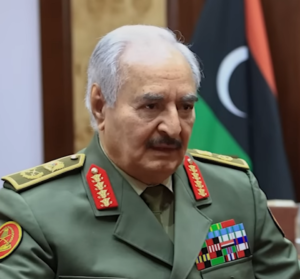
Khalifa Haftar commands the Libyan National Army (LNA).
Libyan Rejection of the Boulos Initiative
Unsurprisingly, the American initiative has faced resistance across Libya’s fragmented political spectrum. Key institutions, including the Presidential Council and the High Council of State, alongside various revolutionary and armed factions in western Libya, have expressed reservations or outright rejection.
In parallel, eastern forces have conducted large-scale military exercises, often referred to as Operation Karama Shield 2, which showcased extensive manpower and advanced military hardware, including Russian-supplied air defence systems. Beyond their tactical dimension, such exercises carry a clear signalling function, reinforcing the perception that any future political settlement must account for established military realities rather than attempt to bypass them.
The Plunder Economy and Armed Factions
Over time, Libya’s armed groups have also evolved into central components of a parallel political economy. Their activities extend beyond security provision into the regulation of economic life, including fuel distribution networks, cross-border smuggling routes, informal taxation systems, and influence over public spending and reconstruction contracts. In this context, many armed and political elites perceive competitive elections not as a pathway to legitimacy, but as a potential threat to entrenched economic interests and patronage networks.
This entanglement between coercive power and economic survival has contributed to the repeated failure of initiatives aimed at demilitarising urban centres. Despite formal agreements announced by authorities in Tripoli calling for the withdrawal of armed formations from the capital, implementation has remained limited and inconsistent. Episodes of renewed violence in Tripoli, Zawiya, and other urban areas have repeatedly followed such announcements, reinforcing perceptions among international observers of a fragile and reversible security environment.
The Oil Equation and Russian Influence
Libya’s relatively stable oil production—hovering around 1.4 million barrels per day—reflects a tacit and informal accommodation among competing actors. Rather than indicating institutional consolidation, this stability appears to rest on pragmatic arrangements that insulate the energy sector from direct confrontation. Oil thus remains both a shared resource and a potential bargaining instrument within Libya’s fragmented political economy.
This raises a central analytical question regarding the direction of US policy: whether Washington is genuinely invested in supporting a long-term democratic transition anchored in unified institutions, or whether it is instead prioritising a narrower form of ‘functional stability’ aimed at ensuring energy flows and containing geopolitical competitors, particularly Russia through its expanding Africa Corps presence in Libya and the wider Sahel.
Russia’s engagement in Libya has deepened through its relationships with eastern and southern actors, especially those within the LNA’s orbit.
Field Marshal Khalifa Haftar asserts that the Libyan National Army (LNA) exercises effective operational control over the vast majority of Libya’s territory, particularly throughout the eastern and southern regions. Having anchored his political legitimacy on erasing transnational ‘jihadist’ networks from eastern Libya, Haftar successfully projected power over the strategic Oil Crescent and into the vast southern Fezzan—a porous border triangle abutting volatile neighbouring states.
Despite occasional security friction with Chadian and Sudanese armed factions operating across these frontiers, the LNA has largely mitigated these threats through sustained military deployments, though isolated pockets remain conduits for lucrative smuggling networks. To maintain this architecture, Haftar commands a force estimated at nearly 100,000 personnel, relying heavily on critical logistical, intelligence, and military support from Egypt and Russia to circumvent the enduring UN arms embargo on Libya.
Legitimising Chaos and Postponing Elections
In response to these complexities, Washington has advanced an approach centred on gradual militia integration, institutional co-optation, and financial centralisation aimed at reducing illicit revenue streams. This strategy is reinforced by a set of regional security partnerships involving, Egypt, and the United Arab Emirates. However, such an approach risks producing what analysts increasingly describe as a ‘stability trap,’ where short-term de-escalation masks unresolved structural tensions.
Evidence from the ground suggests that stability in western Libya, particularly in Tripoli, remains contingent and highly sensitive to localised triggers. Even minor incidents have the potential to escalate rapidly into armed confrontations, underscoring the absence of a fully functioning monopoly of force. Recent episodes of violence linked to public gatherings and sporting events have demonstrated how quickly civilian spaces can become militarised, raising broader questions about the feasibility of nationwide electoral processes under current conditions.
International assessments, including reports by the UN Panel of Experts, Human Rights Watch, and the International Crisis Group consistently emphasise that armed groups have become embedded within Libya’s governance architecture. They exercise coercive influence over political decision-making, economic regulation, and public administration, often with limited accountability or effective oversight.
Recognizing these unyielding dynamics, Washington’s engagement in Libya has increasingly shifted toward a transactional, short-term approach centred on brokering elite deals with established power centres in both Tripoli and Benghazi. While this strategy manages to maintain a fragile, temporary stability, it practically obstructs any genuine pathway toward national political unification or the realisation of credible domestic elections. Instead of resolving the crisis, it perpetuates a closed political marketplace that privileges armed actors over democratic transition.
The post Libya’s Electoral Mirage: The Illusion of American Optimism appeared first on African Arguments.