Raoul Peck on Orwell, authoritarianism and the duty to act
Acclaimed filmmaker Raoul Peck says authoritarianism did not suddenly arrive with Donald Trump — it has been decades in the making. In this exclusive conversation with the SF Bay View, the director of Orwell 2+2=5 explains why George Orwell remains essential reading, how propaganda and historical amnesia fuel modern power, and why neutrality is itself a political choice. Peck argues that democracy demands more than voting; it demands action. The post Raoul Peck on Orwell, authoritarianism and the duty to act appeared first on San Francisco Bay View.
 Black News
Raoul Peck does not talk like a filmmaker promoting a screening. He talks like someone sounding an alarm. In a conversation with SF Bay View about his documentary “Orwell 2+2= 5: Orwell and the New Authoritarianism,” Peck returns again and again to one point: This present crisis did not arrive overnight, and no one gets to claim innocence inside of it.
Rather than treating George Orwell as a literary mascot for dystopian times, Peck reads him as a witness, an analyst and a guide to the present times.
by Tabari Morris
George Orwell remains one of the most important political writers of the last century because he wrote plainly and unsparingly about empire, class, war, propaganda and the many ways power distorts truth. Best known for “1984” and “Animal Farm,” Orwell also wrote from lived experience, including his time in Burma, the Spanish Civil War and among poor and working-class communities in England. In Raoul Peck’s reading, Orwell was never simply warning about one state or one ideology. He was warning about authoritarianism wherever it appears.
Raoul Peck brings that same urgency to his filmmaking. The Haitian-born filmmaker, raised across Haiti, Congo, the United States and Europe, has built a body of work that confronts colonialism, racism, dictatorship and historical amnesia. From “Lumumba” to “I Am Not Your Negro” to “Exterminate All the Brutes,” Peck has returned again and again to the question of how power shapes memory and how people resist it.

That is what led SF Bay View to this exclusive interview with Peck around his documentary “Orwell 2+2=5.” The film uses Orwell’s life, diaries and essays to read the present moment: propaganda, surveillance, permanent war and democratic backsliding. After screening the documentary, SF Bay View spoke directly with Peck about Orwell, Trump, media power, citizenship and why this is not a time for being passive.
Q: Why Orwell now? What made this film urgent in this political moment?
Raoul Peck: I’ve been making political films all my life, and most if not all of the films I made were always concerned about the world we were living in, whether it’s in Europe, in America, in Africa or in Haiti, my home country.
You don’t really choose the moment where you start working on a film and you don’t really choose when the film is finished and in what world it comes out.
Orwell came to me. It was one of those rare gifts that you get from the industry because the whole rights of Orwell’s books and essays and critics were offered to me, meaning full access and the possibility to make the film I wanted to make without any interference.
What we are living today, it’s not something that just popped up. It’s a lengthy, slow deconstruction that has been happening at least the last 40 years.

Q: You say what we are seeing now did not begin with Trump. What do you mean by that?
Raoul Peck: I’m not totally surprised over Donald Trump. There have been other types of Donald Trumps. There have been cleaner Donald Trumps. There have been smoother Donald Trumps.
Bill Clinton was a sort of Donald Trump because he allowed society to accept certain restrictions that were going on. He allowed the middle class to accept certain things in exchange for their silence.
As far as I’m concerned, Donald Trump is just the last emanation of a long streak of deconstruction of democracy.
Q: Orwell is claimed by many political camps. What do you think is most misunderstood about him?
Raoul Peck: He died very young, basically four months after the publication of “1984,” in a world that was centered around the Cold War.
He wasn’t there to do the spinning of his own book, so it was basically used as a propaganda instrument against Russia, against the Soviet Union.
Yes, it was right to criticize Stalinism. It was right to criticize what was going on in Russia. But Orwell’s writing was wider than that. His goal and his aim were about any sort of authoritarianism, whether it’s in Russia, in Europe or in Africa.
He was talking about what he had gone through himself, whether in Burma as a colonial soldier or during the Spanish Civil War.
He spoke about his experiences in the mines in the north of England. He went to work with the people most in need in places that no normal British middle class author would go, but he wanted to feel that in his own bones.
Q: Your work often tries to remove the possibility of innocence for the viewer. What denial or comfort did you want to unsettle here?
Raoul Peck: I totally agree with Orwell when he says there is not such a thing as a neutral position.
If I write a book, I write a political book. Everything is political. So the notion that, well, I’m an artist, I don’t do politics, or I don’t have a political position — not having a political position is a political position.
My film is also something that I hope will help people see through what is happening today.
The same way Orwell delivered us the matrix, the analysis, the toolbox to understand what authoritarianism is, the same way I hope this film helps connect the dots for people who most of the time are totally lost under what’s happening right now.
People have lost their history, have lost where they come from, and everything is done for them to be lost.
Q: The film links Orwell’s time to today’s authoritarianism, disinformation and permanent war. How did you decide which present-day events and struggles to place alongside his words?
Raoul Peck: Pick your choice. It’s everywhere.
It’s in my own country, in Haiti, being surrounded by gangsters and oligarchs. It’s in France with the rise of the extreme right. It’s in the U.S. as well with an administration that basically has no checks and balances.
A lot of people are just watching them wreck the country, where people are afraid, where immigrants are being chased in the streets, at their workplace, in the hospitals, in the tribunals.
My film is not a film for entertainment. My film is an object to fight.
It’s about our survival.
Orwell is not talking about Big Brother as if it’s a video game. It’s reality. Those are people who have bombs who can kill people and who actually are killing people right now.

Q: What, if anything, did you discover in the Orwell archives or historical material that surprised you?
Raoul Peck: What I did not expect is that I would succeed in discovering a much closer, organically closer Orwell, as somebody who went to the Third World and learned about the people in the Third World in a very humble, sincere and political way.
For a young 19-year-old British man to volunteer to go to Burma and discover, oh gosh, I’m a colonial policeman — and he lived through those five years in a very troublesome and conscious situation of what role he was being asked to play.
Orwell saw people like him. He wrote about it. I felt he was closer to me than many other European writers. He came to my world, he understood my world and he learned to look at us not as exotic but as real human beings.
Q: Is there a question about the film you wish journalists would ask more often?
Raoul Peck: On the contrary, my experience launching this film throughout the world is that a lot of journalists work in structures that do not enable them to speak about certain topics — the film was an excuse for them, through their questions and through my responses, to deal with those topics.
A lot of them were relieved to be able to take the freedom to talk about Orwell and to talk about the political implications that are in the film.
Journalists have become puppets because they are working in structures that they don’t dominate and that are using them, and even their publishers are puppets because there are billionaires above who are basically running the shots.
Q: When you picture a community screening like ours, what conversation do you hope people keep having after the credits roll?
Raoul Peck: I just hope that they realize that they are concerned.
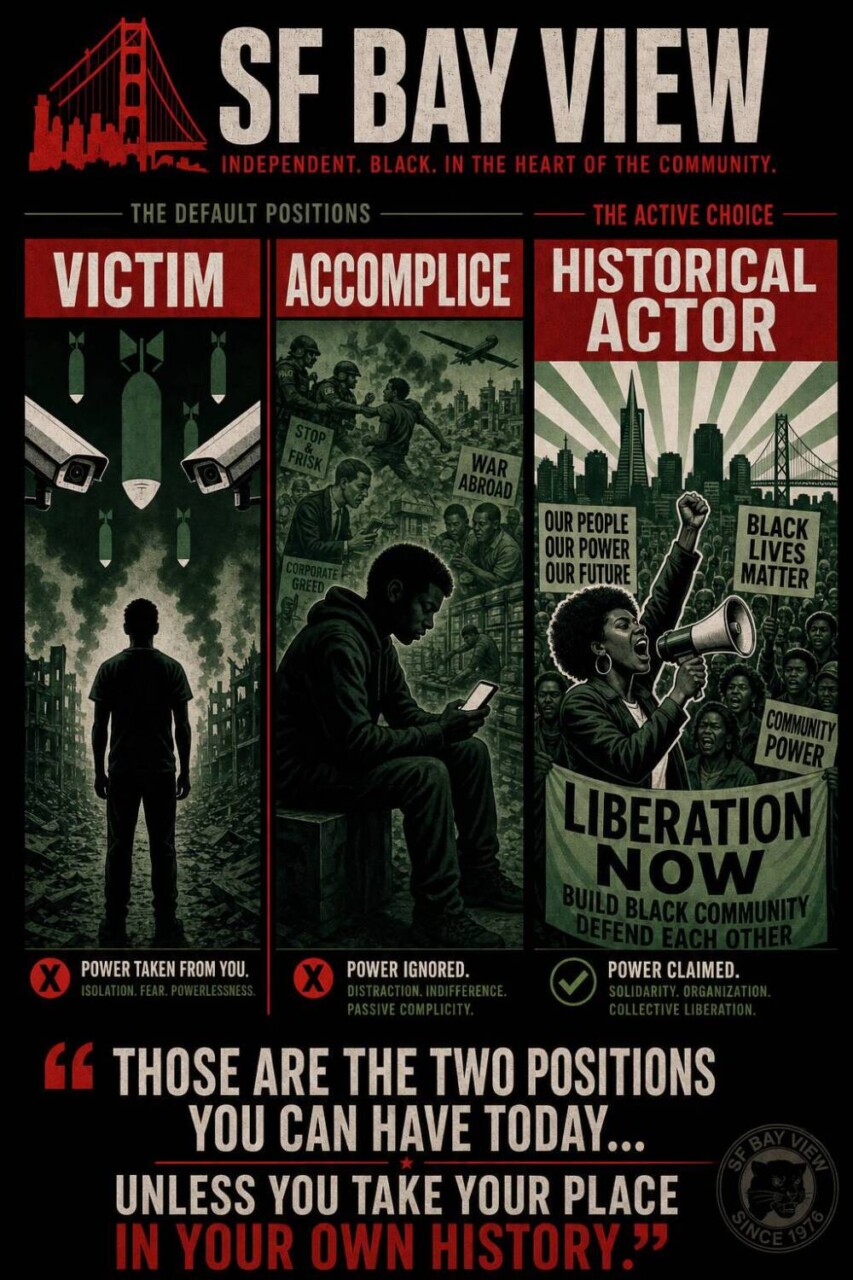
Being a citizen is not just going to vote. Democracy means that you’re an active citizen. Democracy is not that you just enjoy the freedom that you have. Democracy means that you defend the freedom that you have, whether at home and elsewhere.
A lot of populations have become perfect consumers. You just lie on your chair and consume. Everything is brought to you and you don’t have to think anymore.
Being a citizen is being an active citizen. Not saying anything makes you an accomplice.
It’s a call to action. Do something or not, but it’s on you. I did my job.
I’m not a guru. I’m not your teacher.
Tabari Morris is a City College of San Francisco journalism major and a certified Community Health Worker who is set to complete his Community Mental Health certification in December. He blends community reporting, health justice, investigative journalism, criminal justice coverage and multimedia storytelling to help keep the SF Bay View accountable to Black readers in print, online and on video. He can be reached at tabari@sfbayview.com.
The post Raoul Peck on Orwell, authoritarianism and the duty to act appeared first on San Francisco Bay View.