Recalling (to me, anyway) THE biggest accomplishment of your Community Journal!
Our Queen Mother (MCJ Publisher Patricia Pattillo) asked me to list a few of the accomplishments the paper made as we close out our 50th anniversary. Our advocacy for school choice […]
 Black News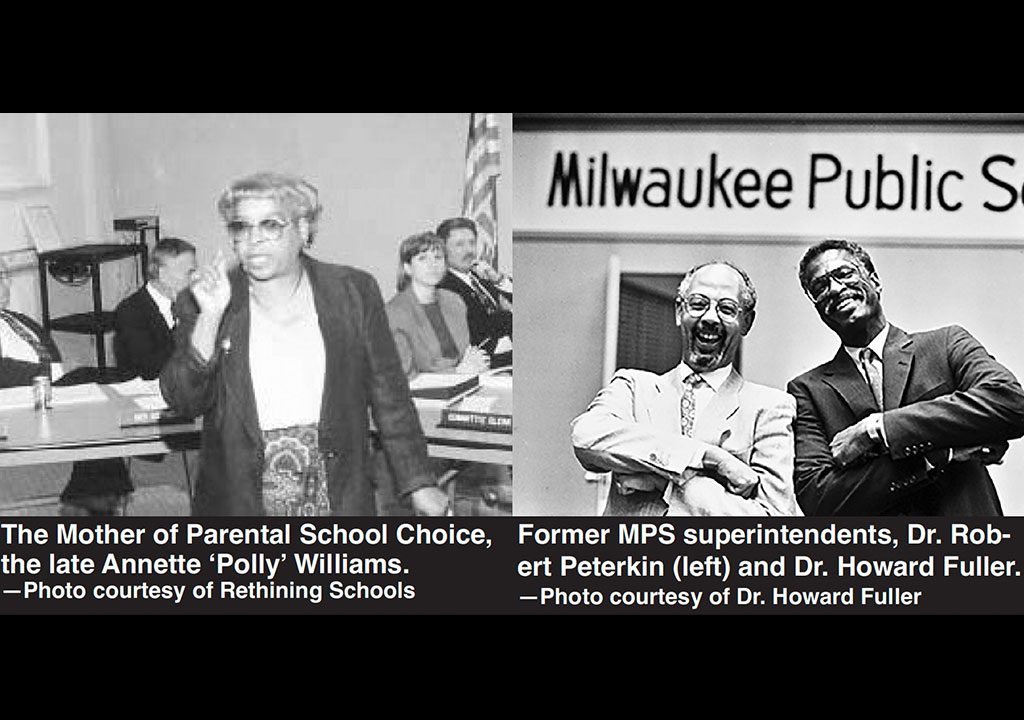
 Our Queen Mother (MCJ Publisher Patricia Pattillo) asked me to list a few of the accomplishments the paper made as we close out our 50th anniversary. Our advocacy for school choice is at the top of my category.
Being a former MPS teacher, she wasn’t fully supportive of the initiative three decades ago, but over time, she has taken pride in the fact that we risked this paper’s existence in our quest to empower our community.
Little did we—or more specifically, I—know that the seeds of the educational revolution we planted then would have universal impact.
Nor could we envision the price we were forced to pay.
As the only paper brave enough to support the late former state Assembly Representative, Annette ‘Polly’ Williams’ dream of offering alternatives for poor families trapped in failing ‘government’ (public) schools, we paid a steep price.
Those attacks included threats by the MTEA, the teachers’ union, which was intent on maintaining the failing status quo, to personal assaults on the integrity and philosophical agenda of those of us who put the interests of children before that of adults.
Union members threatened our advertisers, Democrats (who continue to be under the thumb of the teachers’ union) turned their backs on us, and even the local NAACP accused us of being advocates of segregation (read my book, ‘Not Yet Free at Last,’ to understand the irony of that claim).
But those seeds planted by Polly during meetings at her home near Atkinson Avenue three decades ago have redefined the concept of ‘public’ education.
Today, despite the ongoing challenges and verbal warfare, nearly half of our nation’s states have some sort of school choice (aka, ‘voucher’) programs. From a handful of supporters then, today, 80% of Americans support choice.
Last week, New York Governor Kathy Hochul announced that her state will opt into the Federal Scholarship Tax Credit program, a form of school choice, making New York State the largest state to embrace school choice and leave its imprint on the movement.
It is not a stretch to credit Milwaukee’s Howard Fuller as the czar of the national choice movement—including charter schools —just as Polly Williams is the architect of the last battleground for civil rights — education.
Both can take credit for the results of a recent survey by City Forward Collective, which reveals nearly two-thirds of Wisconsinites support school choice. And many more Black folks fall into that category, despite the efforts of the NAACP and Democrats who have consistently sought to undermine it.
Indeed, school choice has been a political hot French Fry since its inception.
While Polly was a Democrat (in name only, it could be said), she (we) faced rabid opposition from her party, the local and state teachers’ unions, the state superintendent of the Department of Public Instruction, and even the governor, who served as state superintendent of DPI before his election to governor eight years ago (that would be Tony Evers).
It’s been a war of ideologies and logic that has tested loyalties and confused Black voters. Even though the egg has been broken, as former Mayor Tom Barrett once said, it continues to be fought in the court of public opinion, legislative halls, boardrooms, and bathrooms.
Interestingly, while Polly and anyone who has supported school choice—Black empowerment– have found ourselves attacked for seeking an alternative to the failing status quo, I can’t remember the original catalyst for choice schools in the district finding himself under the same scrutiny.
Maybe that’s because he was otherwise an advocate for public education, as well as the superintendent of MPS—the late Robert S. Peterkin.
While it has been conveniently ignored, Peterkin persuaded a state lawmaker to draft legislation for a limited school-choice program within the district. No, it was not the Republican Party, Bradley Foundation or ET, but Peterkin, himself a Democrat, who started the conversation following then-Governor Tommy Thompson’s failed attempt to enact a universal voucher program.
That point has been intentionally ignored by the teachers’ union and Democrats who cast attention on the program’s origins, for obvious reasons. It is more politically convenient to attack the GOP and conservatives than two Black Democrats.
The shameful irony is that the political party that supposedly ‘loves da darkies’ and who know what’s best for us, is in fact under the thumb of a special interest (union) which wants to sustain the failing status quo, and more importantly, keep gettin’ those education dollars.
The same can be said of the NAACP, which unsuccessfully sued to stop school choice, claiming it would ‘enhance’ segregation by providing a financial cushion (half of what MPS receives) for Black schools, like Harambee and Urban Day.
Asked to elaborate on that claim, the president of the Milwaukee NAACP (who won’t be named here because he is a Black community legend said during a debate on school choice in 1999: “anything all Black is all bad.’
Say what? All Black, as in Black banks, Historically Black Colleges and Universities (HBCU’s), and Black business, I asked?
In Milwaukee–the Garden of Educational Eden— school choice came about not only because of educational apartheid, but moreover because of the failure of the Democratic school board and so-called civil rights organizations to address that paradigm.
Just as slavery and bigotry (vs. racism) can be traced to the unwillingness of the Christian church to combat those twin evils, Milwaukee continues to host the widest gap in racial academic achievement because those in power have buried their heads in the sand.
As a result, we have schools like Washington and North Division, where failure is the status quo, and poverty is the prevailing outcome.
North Division has the lowest student proficiency rates in math, reading, and social sciences, not only in Milwaukee, but also in the entire state of Wisconsin, Mars, and Jupiter.
Thus, it’s surprising (or maybe not) that opponents of school choice have, for three decades, fought tooth and nail to maintain the status quo, while seeking to derail our program, not because it has failed, but because it has succeeded by most measures—higher graduation rates, academic superiority, and attendance.
I speak not merely as a griot, but as an active participant who remains frustrated by the opposition to change.
I was a member of the Harambee Community School board when Peterkin held meetings with representatives of a handful of Black and Hispanic schools to solicit support for a school choice program back in 1988. I later worked directly with Polly as a captain in her school choice army.
Prior to that enlistment, Peterkin acknowledged that the financially poor community schools were successful in educating poor children, while MPS, despite 500 times the budget and seemingly limitless resources, was not.
Obviously, Peterkin was a visionary who saw local education through different prisms. He once said all Milwaukee children were part of a holistic agenda.
But his advocacy of a school choice bill program fell short, primarily because of Democratic and teacher union opposition.
That opened the door for Polly, whose citizen army directly lobbied Black state Democratic legislators to join Republicans in a bipartisan effort to change the status quo.
But as soon as then-Republican Governor Tommy Thompson (an avid supporter of choice and Polly) left office, however, the union sicced Democrats on their nemesis—supporters of voucher—undermining, at the very least, our quest for Black empowerment.
What they couldn’t and didn’t address was MPS’ failure—clearly illuminated by the reality that we host the widest (racial) achievement gap in the country.
Thus, it should be no surprise that that dichotomy has fueled ever-growing support for choice and demands for MPS accountability.
The CFC survey reveals a picture that may cost Democrats at the polls.
According to the survey, 80% of voters are more likely to support a candidate who would hold all publicly funded schools accountable for student outcomes.
A majority of undecided gubernatorial candidates say they’d be more likely to back someone who supports school choice, compared to 37% of voters already committed to a candidate.
Sixty percent support charters, which the MTEA hates with a passion, despite or because they have proven to be successful. In fact, the only two Milwaukee schools to be listed in the top 20 statewide are non-instrumentality charters—Milwaukee College Prep school–a fact that is at the heart of teacher opposition because they (non-instrumentality charters) do not have to hire union teachers.
Most glaringly, the survey revealed overwhelming opposition to the lowering of standards for so-calledstudent success.
Without public input, the Department of Public Instruction lowered standards last year, obviously as its solution to student failure.
In other words, DPI Superintendent Jill Underly,who admitted she sent her child to a private schoolbecause she is privileged (her own word), paintedover the walls of apartheid using a ploy DonaldTrump would be proud of.
What she couldn’t do was paint over students’ inability to read or write.
And the MPS board has apparently done absolutelynothing to address the failure of schools like Washington and, particularly, North Division. Insultingly,‘North’ has the worst academic achievement recordin the Midwest.
From my observations, MPS Superintendent,Brenda Cassellius, stands poised to do what no othersuperintendent in recent memory has done: shake upthe district and put the interests of students beforethose of ‘educrats’ and the union.
She is also willing to listen to the community, including those clamoring for changes at North Division.
Which means she will probably be listening to concerned citizens and members of Call to Action whowill host a community forum on North next Tuesday,from 5-7 p.m. at Community Within the Corridor, located at 2709 N. 32nd Street.
The forum is entitled, “The Future of North Division High School, Students and Elementary School in Zip Code 53206.”
This may be the last opportunity for us to direct the train, as some theorize the school (the only highschool in 53206) may be sold to a special interest, ora private school.
Sadly—or ironically, you can say—Black folkshave done little beyond complaining and crying overacademic disparities and the failure of ‘most’ Blackstudents in Milwaukee.
Which means we should not be upset if someone outside the community steals the ball and runs in theother direction.
As Malcolm X once said, you can be either part ofthe solution or part of the problem.
Hotep.