The rise of France’s rollerskiing scene, as its snowfall thins
Carving road — With changing climates forcing skiers to travel higher up mountains in search of quality powder, a small community is turning to tarmac and building a new vision of the sport that doesn’t rely on winter.
 Black News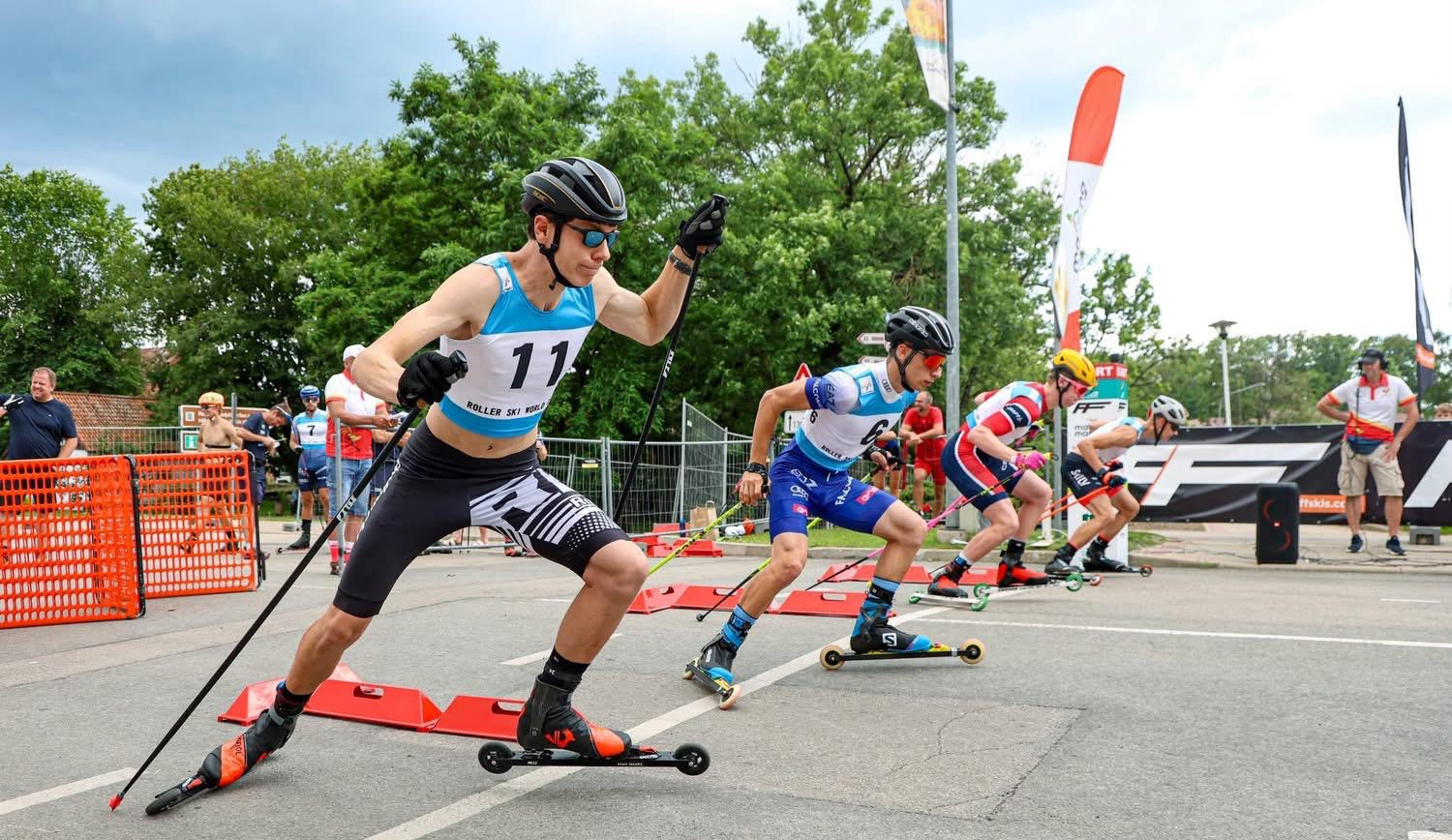
Carving road — With changing climates forcing skiers to travel higher up mountains in search of quality powder, a small community is turning to tarmac and building a new vision of the sport that doesn’t rely on winter.
It’s a Sunday in Bénodet, a seaside town on the southern tip of Brittany, and a small group of skiers has attracted a crowd. There’s no snow, no mountain, just the high street, where they glide past on rollerskis, poles clicking against tarmac, turning heads as they go. “Several people stopped to ask what we were doing,” says Johan Pluchon, president of Breizh Ski-Roues, a rollerskiing club in Vern-sur-Seiche, in Brittany. “It’s still slightly an iconoclastic sport that makes people turn and stare as we pass.”
Rollerskiing, or ski-roue, looks exactly like it sounds: cross-country skiing, but on wheels. Short skis fitted with one small wheel at each end. Nordic poles modified with rubber tips for grip on asphalt. The same gliding technique, the same alternating arm-and-leg rhythm, the same burning lungs. The only things missing are the snow, the cold and the mountains.
For decades, the sport has been a training tool; something that elite Nordic skiers do from May to October to stay sharp between snow seasons. You can find online footage of Norwegian superstar Johannes Høsflot Klæbo grinding out summer kilometres on rollerskis. But something is shifting. In France, people are increasingly viewing it as an individual sport, putting on helmets and knee pads, heading out to cycle lanes, country roads and old railway paths with no intention of waiting for snow.
François Letellier, a rollerski instructor at the ASPTT Ski Nantes club, got into the sport almost by accident. “I discovered it without really realising it,” he says. Living in Paris, he would travel to the mountains once a year and watch long-distance ski races from the sidelines. “One day I saw a race, the Transjurassienne, and I thought it could be possible,” he says. “To train, I equipped myself with roller skates and poles.”
The story of rollerskiing in France is, in large part, a story about snow that is no longer there. Christophe Maury, founder of R17, his own brand of rollerskis based in Gérardmer in the Vosges, was introduced to the sport through his sons. They started out as cross-country skiers, but it became harder to continue as snow conditions worsened in what he describes as the growing problem of unreliable snowfall and climate change.
Training for winter meant driving further into the mountains, climbing higher for better conditions and burning more fuel to chase winters that kept shrinking. “There’s a moment,” he says, “where you have to face an obvious truth. Either we stop, or we do something else. Rollerskiing is the only alternative.”
Read next: How splitboarding is breaking new ground
“There’s a moment where you have to face an obvious truth. Either we stop, or we do something else. Rollerskiing is the only alternative.”
Championship races that once stretched across 15 or 20 venues are now hanging on in increasingly unreliable snow conditions. Maury doesn’t sugarcoat it: rain, slush, podiums where sometimes only two athletes show up because there aren’t enough in the category to make a race. “My sons don’t see the point anymore,” he says. “The snow is awful, you end up destroying the equipment, skiing over rocks.”
So his family pivoted. He built skis with wheels. His sons started competing internationally, on asphalt, in summers. Last year, he brought them to the Rollerski World Cup in Madona, Latvia. Across the line were athletes from all around the globe. “You realise there’s this global picture,” he says, “where some nations have structured national teams, and others, like us in France, are just showing up with what we’ve got, on our own.”
For Maury, the Fédération Française de Ski has never seriously backed rollerskiing. Its view, held consistently for years, is that the discipline only exists as preparation for snow, a training tool, nothing more. It frustrates him. In his view, the federation is defending a model the climate has already made obsolete. “I think cross-country skiing is condemned, so it will inevitably move towards rollerskiing,” he says.
According to Pluchon in Rennes, the federation’s response has been to move in a different direction altogether. Rather than giving rollerskiing more recognition, they are now pushing biathlon running as a summer alternative. “They’re trying to pull the rug out from under the athletics federation,” he says. “They’re suggesting we create biathlon running sections. But we ski to ski. Not to go running or do a biathlon.”
Against this backdrop, rollerskiing remains a marginal pursuit in France, with a community that is small and scattered. Breizh Ski-Roues near Rennes counts around 25 members. Ski Golfe, a club in Morbihan founded in 2019, has about 20 active skiers. The whole practice, as Nicolas Bernard, president of Ski Golfe, puts it, remains both “informal” and “intimate”, and he doesn’t mean that as a euphemism. “We remain on the margins of the margins,” he says.
What holds these skiers together, beyond a shared attachment to a niche sport, is harder to define. It’s not competition – there is very little of it in France. Not background either: Pluchon talks about people who have been rollerskiing for a decade without ever stepping onto snow, while others used to race at a high level. The sport is open to people from all backgrounds and all ages, with the club’s newest recruit being 73.
“There are sports that will always remain on the margins,” Pluchon says. “But is that necessarily a problem?”
Read next: Eating concrete with London Skate Mums
What they seem to share is a specific appetite for a kind of effort that’s hard to describe without sounding ridiculous. Bernard broke his hand the first time he put on rollerskis. He'd hit speed he hadn't expected and fell hard. “Even though I fell and hurt myself,” he says, “there was only one thing I wanted to know: when can I get back on?” He describes rollerskiing as a sport that is accessible but technical, the kind of thing that quickly becomes addictive.
What keeps people coming back, Bernard, Letellier and Pluchon are all in alignment: it is something like flying. Not the dramatic kind. The quiet, sustained kind that comes from balancing on one ski long enough that momentum takes over and the ground beneath you seems to disappear. “After three or four years,” Pluchon says, “when you can stay on one leg and really glide, you almost feel like you're flying.”
Getting there requires patience. Falls are more painful than they look, you're on tarmac, not powder, and the wheels move faster than most beginners expect. However, the psychological barrier is bigger than the physical one. “The main obstacle is the fear of falling,” Letellier says. “With every step, you have to create your imbalance in order to move forward. You have to learn to fall before you can ski.”
Once that initial fear settles, the experience starts to shift. The focus moves from staying upright to where the road takes you. Bernard lives near a country road in the Scorff valley near Quéven, between the hamlets of Kervegant and Le Roze, a place he describes as resembling a fjord – a small river, a winding country road, trees closing in on both sides. He rollerskied there once at sunset, with a few club members. “It was insane,” he says. “Those moments shared with friends from the club, they remind you why you do it.”
For Pluchon, the standout session is the yearly 106km challenge that his club is organising this year in June, along a converted railway line on the Brittany coastline. 46km in the morning, 60 in the afternoon, seven hours on wheels where you have to stay focused just to stay upright. “You finish completely spent,” he says, “but with the feeling you’ve done something amazing.”
He’s also honest about the limits of the experience. On training days, they head to the same spots, convenient and safe, open only to pedestrians, bikes and rollerskis. It works, but it can feel repetitive: the same landscape, the same turns, the same surface, chosen as much for safety as anything else. “It’s functional,” he says. “I don’t like doing the same things over and over. But for safety reasons, we’re stuck with it.”
The safety question is a valid one. Rollerskiing on open roads requires constant attention to traffic, to surface quality, to the poles that jab between your skis if you lose focus for even a second. The Ski Golfe club is lucky: they train at a municipal campsite in Saint-Pierre-Quiberon that closes for the winter, giving them a secure, closed-off site with an ocean view. Most clubs don’t have that. Getting 12 people out on open tarmac is, Pluchon argues, “quite a lot of accidents waiting to happen.”
For how long that gliding happens on snow, though, is another question. Letellier thinks rollerskiing is gaining ground precisely because snow is losing it. “People are starting to think twice about getting in the car to drive to the mountains,” he says. “Having snow is less and less guaranteed. If you love gliding…” He doesn't finish the sentence but the implication is clear: if you love gliding, you turn to rollerskiing.
Interviews for this story were conducted in French and have been translated by the writer.
Flore Boitel is a freelance journalist. Follow her on LinkedIn.
Buy your copy of Huck 83 here.
Enjoyed this article? Follow Huck on Instagram for more from the cutting edge of sport, music and counterculture.
Support stories like this by becoming a member of Club Huck.